
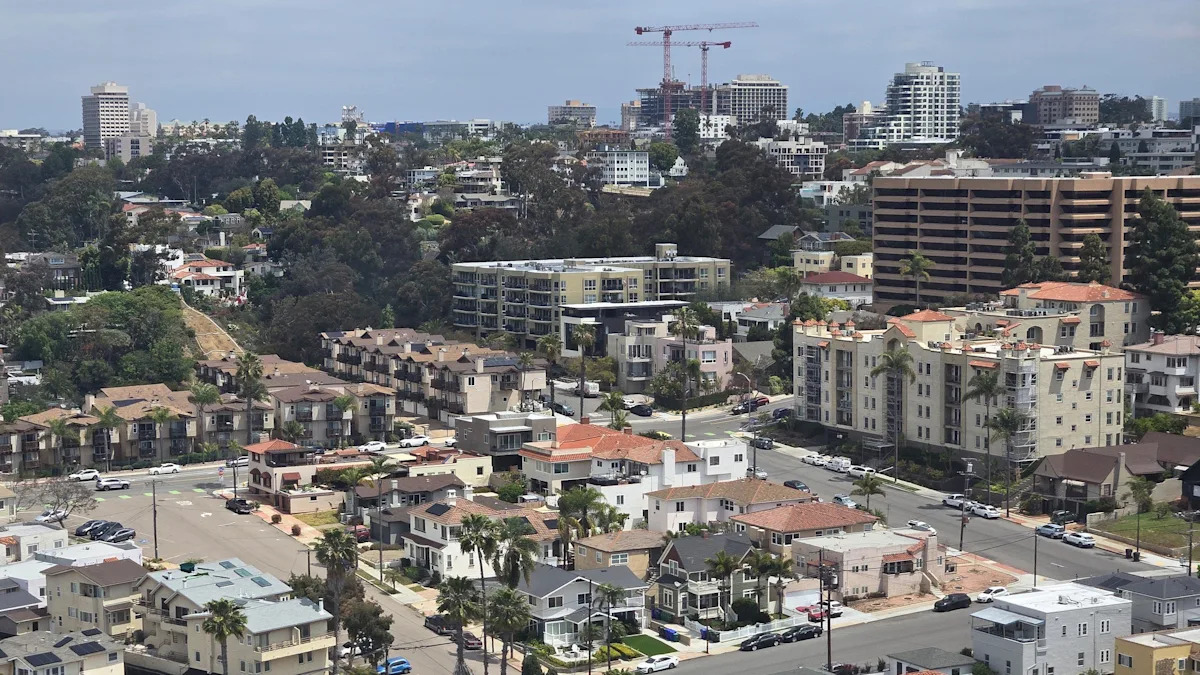
A certain kind of fatalism has seeped into the housing conversation in California: The shortage is too deep, the politics too restrictive, and the process too tangled for the state to ever build its way out of high prices and steep competition. But while Los Angeles has become a poster child for the argument, San Diego is emerging as a blueprint for the Golden State to get back on track.
The rate of construction for new homes in the City of Angels was already under pressure before wildfires destroyed nearly 16,000 homes in early 2025. The year leading up to the fires, the city permitted 17,200 housing units, or just 30% of what the city needed to hit its annual goal from state regulators.
But two hours south, San Diego was building at a faster clip despite having roughly 40% of L.A.’s population.
San Diego permitted 8,782 new homes in 2024, extending a two-year run averaging roughly 9,200 permits a year—about a 40% jump from the early 2020s. Since 2021, it has permitted more than 31,000 homes, according to the city’s Annual Report on Homes.
The contrast is even sharper in apartments: San Diego built at nearly double L.A.’s pace over the past quarter, with the number of new apartments under construction rising 10% from three years earlier, while L.A.’s apartment construction fell by 33%, the Los Angeles Times reports.
Those differences are now showing up in market outcomes. Median asking rent is down almost 3% year over year in San Diego, and list prices are down almost 4%, based on the latest Realtor.com® Rent and Housing reports. In L.A., rents are down about 1% and list prices are down about 1.5%.
So what’s San Diego doing differently? In a high-cost environment, San Diego has leaned into two levers that cities can still control: incentives and certainty. In other words, it made “yes” faster, more predictable, and more profitable than “no.”
San Diego’s triple threat advantage: Speed, clarity, and fewer ‘deal breakers’
San Diego’s reforms can be summarized in one principle: Adding enough upside to keep projects viable.
In 2023, Mayor Todd Gloria issued an executive order streamlining the city’s permitting process with a focus on affordable housing. The updates have netted big changes: 1 in 6 homes permitted over the past two years received approval in eight business days or less, says Tahra Hoops, director of economic analysis at the Chamber of Progress.
For Hoops, the implication is blunt: “It shows that when you actually want to have housing built, you are going to ensure that the streamlined permitting measures that you put into place can actually work.”
It also shows that speed is one of the most effective levers a city can pull. Shorter timelines cut the risk of death by delay, when carrying costs pile up and financing terms can collapse. In a market where rates and costs are shifting fast, predictable approvals are making the difference between a project breaking ground and a developer walking away.
The city also paired that timeline certainty with targeted incentives that further improve the math for projects that might otherwise stall.
Under its 100% affordable density bonus, developers who set aside all units as income-restricted can build more units to help their construction costs pencil out into profits. In Transit Priority Areas, these developers are allowed to build with no density cap. They can also add up to three extra stories, or 33 feet. The approach helped deliver about 4,500 units last year.
“It’s kind of funny how you have to, almost like, bribe people to build the housing that is needed. But it shows that it definitely works,” Hoops says.
The point isn’t just to encourage more building in the abstract, but also to offset the conditions that make builders more risk-averse in the first place.
And those conditions are intensifying, says Hoops.
“There is a heightened need for incentives,” she notes. “Housing finance is a large issue.” And in California, she adds, the financing challenge is compounded by the state’s insurance problems.
But the pressure isn’t limited to money. Hoops also points to labor constraints and disruption tied to federal immigration enforcement. Layer in broader uncertainty, and developers tighten up even more.
“We are still in a state of elevated economic uncertainty, and developers are going to be a bit more risk-averse,” she says.
When ‘yes’ gets easier, affordability eases
When developers are risk-averse, the most practical move a city can make is to keep projects alive long enough to get built. San Diego did that by speeding up approvals and making outcomes more predictable. The result is not instant affordability, but a market that is visibly less overheated than it would be under scarcity.
“Throughout 2025, the San Diego housing market was, generally speaking, softer than the overall West,” explains Jake Krimmel, senior economist at Realtor.com. “Inventory, time on market, and price reductions were all higher than the regional averages; price growth as a result was lower.”
That softness is, in part, the point. New construction reduces scarcity and takes some oxygen out of the bidding-war dynamic. But it also underscores the ceiling on what a few high-production years can accomplish in a place that has been underbuilding for decades.
“The median list price in January 2026 in San Diego was $899,000—and although that’s down 5.7% from $950,000 a year ago, that’s third-highest among the top 50 U.S. metros,” says Krimmel. (Only L.A. and San Jose were higher.)
Rent trends hold more clues. In San Diego, median asking rents fell 2.8% over the past year, according to data from Realtor.com, but the relief has not been evenly distributed. The 25th percentile rent grew as a share of the median, up 1.5 percentage points from 2019 to 2025, suggesting the lower end has remained tight even as the middle cools.
That pattern fits the basic filtering theory, which suggests that adding enough new supply at the top end gives higher-income renters somewhere to go so they are not competing for older midtier units. Over time, that brings down prices for everyone.
As Krimmel put it, “The fact that rental growth rates were lower at the 75th percentile and median since 2022—during a time of soaring rental demand—is indicative that adding rental supply at the top filters down to lower rent increases for the rest of the distribution, all else equal.”
But his last point —“all else equal”—is rarely true in housing. Rent growth is also shaped by job growth, migration, and other market factors that make it hard to parse exactly what’s driving the changes.
“I would generally view compression at the bottom of the distribution as a result of median rents moderating rather than rent at the bottom surging,” he adds.
So, San Diego isn’t a utopia. But it does offer evidence that policy-driven production can reduce the intensity of price spikes, especially in the broad middle of the market where most renters live, even when homeownership remains out of reach for many.
So, what can California learn from San Diego?
San Diego is a point of hope in a state up against a nearly 3 million-unit housing shortage, and it offers one clear takeaway: Use policy to let builders build.
On the policy front, start with timelines. Plenty of cities have announced streamlining efforts, but San Diego operationalized it by approving more than 15% of permitted homes in eight days. That kind of certainty is a powerful antidote for risk-averse developers.
Next, sweeten the deal by fixing incentive structures that reward delay. To this point, Los Angeles offers a cautionary tale. It costs only $229 to file a complaint as an “aggrieved person” to block housing, while it costs over $22,000 to file paperwork to obtain permits. That makes obstruction cheap and building expensive. If California wants more housing, it has to flip that equation so stalling is not the easiest move.
Finally, turn state policy into actual starts. The state’s Abundant and Affordable Homes Near Transit Act can be a forcing function, but only if local leaders treat it as one. If, on the flip side, they treat it like a workaround, the cycle repeats. Projects get pushed into hearings and court fights, and progress stays in the planning phase, not as units delivered. It shows up as plans instead of homes.
The through-line is execution. San Diego built a process where projects are less likely to die in the messy middle. Los Angeles has largely done the opposite. Even after a disaster, it has focused on rebuilding what was there and managing the crisis within existing structures, rather than rewriting the structures that keep housing scarce.