
What if the money cities spend on interest and banking fees were reinvested in their communities?
That question drives a growing public banking movement across California, including in Sacramento, where community leaders and residents gathered Jan. 27 at Parkside Community Church to discuss creating a publicly owned bank.
The town hall, organized by the Sacramento Climate Coalition and Sacramento Area Congregations Together, brought together advocates who argue that a public bank could help the city fund affordable housing, climate resilience, and local infrastructure while keeping taxpayer dollars circulating locally rather than flowing to Wall Street.
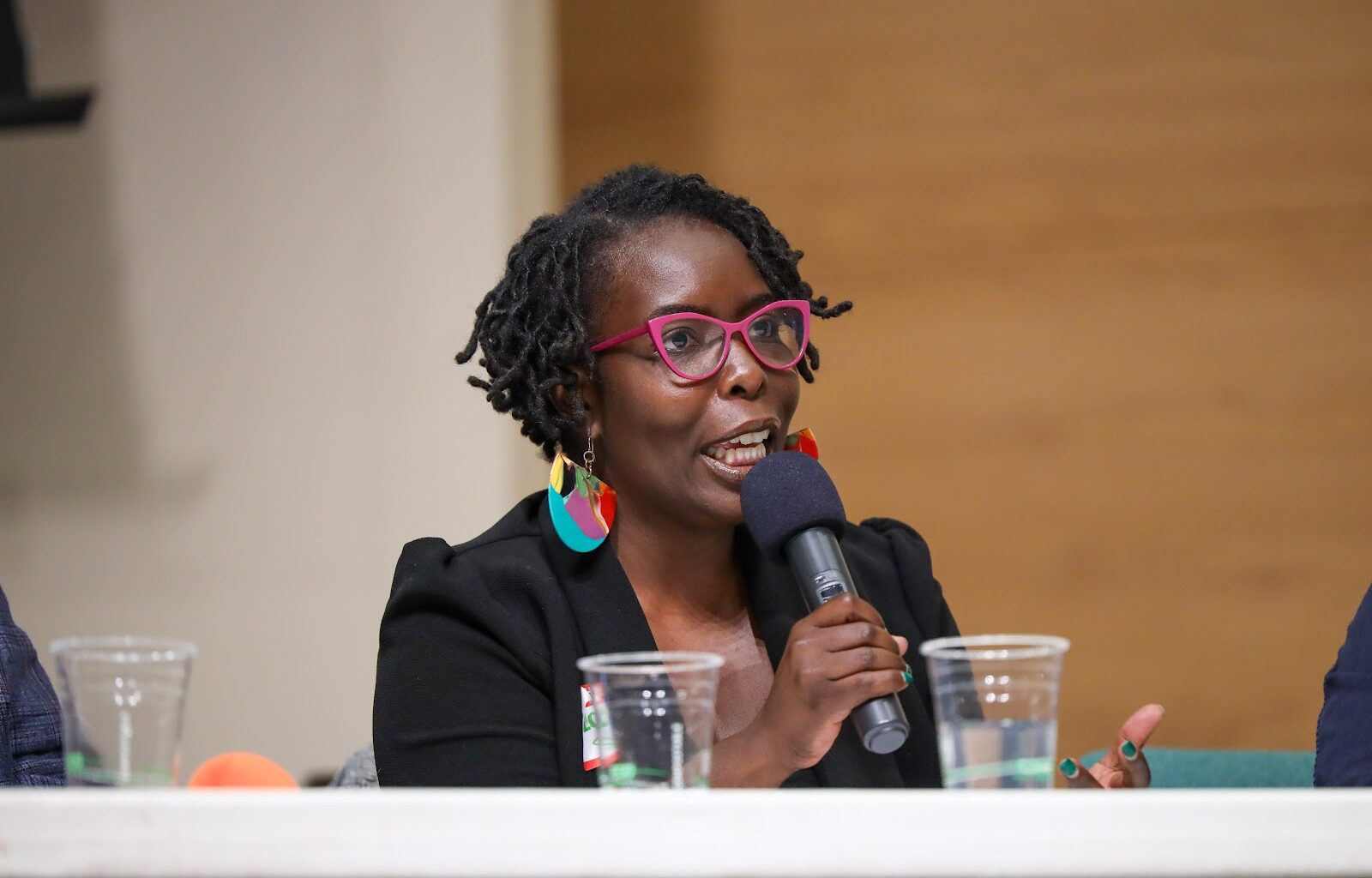
“We’re in a moment now where our cities are being asked to do more,” said Trinity Tran, executive director of the California Public Banking Alliance. “With volatility at the federal level, municipalities across the country are facing widening budget deficits while urgent needs, from housing to climate resilience, remain underfunded.”
Public banks are financial institutions owned by government entities, such as a city, county, or state, that manage public funds and reinvest them in public priorities. Unlike private banks, which are driven by shareholder profit, such banks serve the public interest by using public dollars to finance projects such as clean energy, small business support, and long-term community development.
Supporters say the model offers cities a way to stretch limited resources as local governments confront rising costs and uncertain federal support.
“The question isn’t just is there enough money,” Tran said. “The question is who decides where our common dollars go today, how they’re used, and whether they stay in communities and benefit our localities, or [whether] they keep getting signed out to private institutions that don’t answer to our communities.”
Cities often pay millions of dollars annually to private financial institutions to manage public funds and long-term debt. Tran pointed to Los Angeles, where the city pays about $1.4 billion in debt service each year, including hundreds of millions in fees to major banks.
Public banking advocates argue that instead of sending away those dollars, cities could recapture them and reinvest locally.
“We are able to recycle our public dollars, reinvest them year after year, and maximize their impact,” Tran said.
 California Public Banking Alliance Executive Director Trinity Tran greets town hall members. Douglas Carter, OBSERVER
Finland, consistently ranked among the world’s happiest countries, is one of several that use public banking systems to support housing, infrastructure, and long-term community investment. Nations including Germany, Brazil, and Costa Rica have long relied on publicly owned financial institutions to fund local development, support economies, and keep public dollars circulating within communities.
However, in the United States, public banking remains rare. The Bank of North Dakota, founded more than a century ago, is the nation’s only state-owned public bank, and advocates often point to its sustained stability as proof the model can succeed. The century-old institution has remained profitable for decades, returned significant profits to the state, and helped stabilize local lending during economic downturns.
California has become recognized as a national leader in the modern public banking movement. At least 10 cities and regions across the state have active public banking campaigns, including San Francisco, Los Angeles, the East Bay, and Sacramento.
Sacramento formally entered the conversation in 2019 when the city authorized exploration of a public bank amid growing interest statewide.
Former Sacramento City Councilmember Katie Valenzuela said the idea gained momentum as residents and community groups questioned whether the city’s financial system served everyone fairly.
“It really isn’t fair to the public,” Valenzuela said. “It’s about who can call the mayor or who can call a councilmember to get access to our capital.”
Valenzuela argued Sacramento already manages significant public assets, including utilities and long-term infrastructure funds, that could be leveraged to strengthen the local economy and build resilience.
Despite early enthusiasm, Sacramento’s effort slowed after the initial feasibility work began.
The City Council approved funding to explore the concept, authorizing $50,000 to begin the process. Consultants responded with proposals detailing what a Sacramento public bank could look like, but moving beyond the study phase proved difficult.
Valenzuela said the project became stuck in city bureaucracy.
As other crises emerged, including the pandemic, elections, and competing city priorities, the proposal was deprioritized. She suggested renewed public attention could help restart the effort.
“Events like this get attention,” she said, pointing to community organizing as a key driver of momentum.
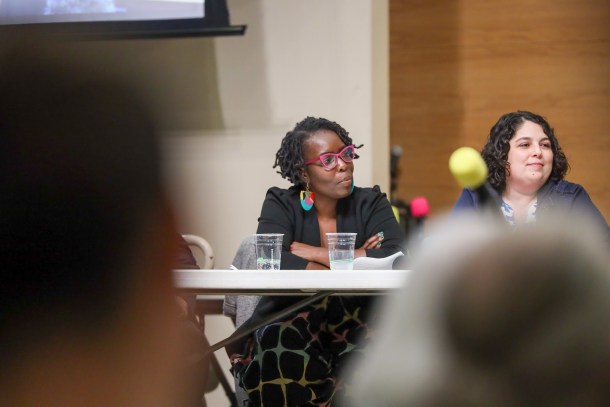 Dr. Flojaune Cofer, left, and former Sacramento City Councilmember Katie Valenzuela listen to public comments at the town hall. Douglas Carter, OBSERVER
For some advocates, public banking is not only a financial tool but also a public health strategy.
Dr. Flojaune Cofer, an epidemiologist and progressive organizer, described public banks as part of the infrastructure that determines whether communities thrive.
“The strongest drivers of health are not the 15 minutes you spend with your health care provider,” Cofer said. “It’s everything else happening in your community: housing stability, income security, safe neighborhoods.”
Life expectancy in California can vary by nearly 20 years across ZIP codes, reflecting decades of disinvestment.
“When we have resilient communities, we are healthier, we live longer lives,” she said. “Decisions that are made in our communities really are critical decisions.”
Advocates say the push for public banking is no longer simply theoretical. Lawmakers and organizers are now focused on what comes next.
One proposal outlined at the Sacramento town hall calls for California to take a phased approach by expanding the state’s Infrastructure and Economic Development Bank, known as IBank, into a full state depository institution.
Under the plan, the first phase would broaden IBank’s lending authority and create pilot financing programs for priorities such as affordable housing, climate resilience, and small business support, focusing on disadvantaged and environmental justice communities. The proposal also recommends establishing a state bank commission led by the governor, treasurer, and controller.
A second phase would require the state to contract with independent experts to develop an expansion plan and seek public input through hearings within the first year. The plan would address long-term governance, deposit protections, and capitalization options, striving to complete a five-year business model within 18 months.
The final phase would involve formally chartering and launching the state bank, appointing a governing board, and pursuing access to federal banking systems.Organizers are starting with a community call to action, which can be accessed at bit.ly/sacpb.
Related