
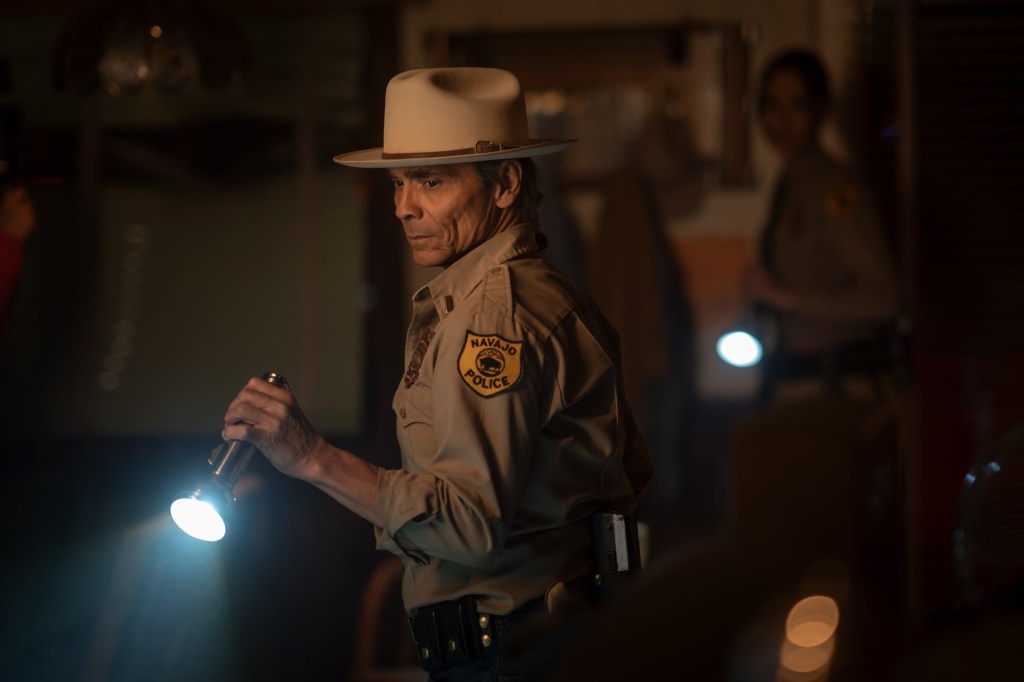
When the fourth season of the AMC series “Dark Winds” begins, Lt. Joe Leaphorn is weary and getting ready to retire from the Navajo Tribal Police.
Earlier in the series, which is set in the 1970s, Leaphorn had taken justice into his own hands, and he’d nearly snapped last season due to the mounting repercussions for that decision.
Leaphorn may seem ready to step back, but the show’s network AMC recently announced it will return for a fifth season; meanwhile, Zahn McClarnon, whose deeply inhabited performance as Leaphorn made the third season so riveting, is actually taking on more responsibility. McClarnon makes his directing debut with the second episode of the new season, and with the announcement of the renewal, he said in a recent interview that he hopes to get back behind the camera again.
McClarnon and company are also moving into new territory in another way in this new season – while the show has always been centered around the Navajo Nation in Arizona and New Mexico, this season focuses on a young Navajo girl whose life is in jeopardy and who runs away to Los Angeles prompting Leaphorn and his sergeants, Jim Chee (Kiowa Gordon) and Bernadette Manuelito (Jessica Matten) to go on the hunt in the big city.
Exploring ’70s-era L.A., Leaphorn, Chee and Manuelito’s investigation takes them to a seedy motel, a pawn shop, a Wilshire Boulevard dive bar and the FBI building.
This interview has been edited for length and clarity.
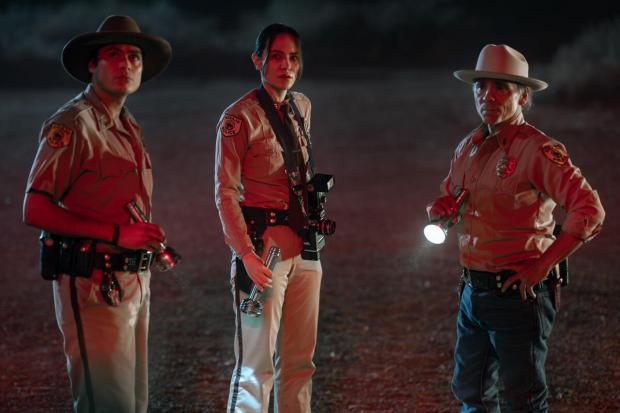 Zahn McClarnon as Joe Leaphorn and Jessica Matten as Bernadette Manuelito in “Dark Winds.” (Photo Credit: Michael Moriatis/AMC)
Q. Considering last season’s storyline, I have to ask if you feel you could have burrowed so deeply into Joe’s traumas in the first two seasons or did it help to live in his skin for a while?
Getting to know and understand the character season by season allowed me to delve into a heck of a lot more. Also, the first season of any show, you’re trying to get your footing. By the third season, the show found its direction, and I was embedded in the character. There’s a lot in Joe’s experience that I grew up around and that I could relate to. So I could get to that spot within myself.
Q. You’re an executive producer and have been involved behind the scenes since the beginning. What are your priorities?
I’ve been a big part of production and pre-production since day one. Authenticity is the No. 1 concern. We are trying to humanize and normalize Native culture. We’re not a documentary. We’re just a television show.
And these are universals that we’re dealing with – everybody has loss and love and community – but we take the culture and the authenticity very seriously. We utilize cultural consultants with the Navajo Nation, making sure everything, the ceremonies, the language, the props, are true to Navajo customs.
Another big thing for me is the show employing Native writers, Native directors, and Native crew – getting people a jumpstart in the business is very important to me because it’s difficult to get your foot in the door. And I think we’ve been accomplishing that.
I give notes on the scripts, and I’m constantly changing dialogue. It’s not about big changes but just about the way Joe would say things.
Q. Do you read all the novels and look for ones you’d like to see adapted?
I’ve read 95 percent of the books. And we get together and collaborate on which books we should probably do. But we certainly take creative liberties –Tony Hillerman’s intentions were to honor the Indigenous people in their stories, but we have strong Indigenous voices within our writing room and our directors to recontextualize them into a more accurate point of view.
Q. This season takes the Tribal Police to Los Angeles. What was that like for the characters?
They’re undercover and dealing with external factors that certainly require different tools and tactics than what they’d use out on the reservation. But also, we touch on issues like the Relocation Act of 1956, which was passed to encourage Natives to leave their homes for cities for vocational training and jobs, but was just another form of trying to assimilate natives into the culture. This led to poverty and discrimination and the show asks how displacing people from their roots and their culture affects people.
Q. You directed the season’s second episode. Was that something you always wanted to do?
No. It was never really on my radar because it’s so difficult to get your foot in the door. But AMC was kind enough to ask if I’d want to direct. At first, it sounded overwhelming, but I realized I have a great team around me and that it would be ridiculous if I didn’t take the opportunity to learn something new.
And that’s what I’ve gained from this show. I am learning so much about this business – how to make a television show, how to be a No. 1 on the call sheet. So I couldn’t pass this up. And, you know, the episode turned out pretty good.
Q. You have a great chase scene through the Indian Health Services building and some interesting shots, like one from underneath a medicine cabinet as it’s being opened up. Did you have any favorite moments?
That medicine cabinet shot was my favorite – but to be honest, it was more director of photography Blake Evans’ idea than mine. We called it our “Severance” shot, actually – he knows how much I love the style of that show, so we talked about going for that.
Q. What were the biggest challenges?
The prep work, going to the location, and sitting with the DP, going over how we’re going to shoot it, and then applying our ideas on the day when we have such limited time because TV goes extremely fast – we have eight days to shoot an episode. I’d love drone shots and big camera crane shots, but we can’t go over budget.
Q. Did you learn anything about yourself as an actor from being on the other side of the camera?
Yeah, I learned how much I dislike watching myself act.