

“There are multiple things that go into the decision to pick a provider. It’s how you feel. Sometimes it’s cultural and language competence, sometimes it is proximity to your home or work. And so on top of it, to layer a bunch of other things for eligibility, it makes it difficult and complicated,” she said.
Ingrid Mezquita, director of the Department of Early Childhood, said the city is carefully building out the system, adding more ELFA sites and infant and toddler care slots in neighborhoods that need them most. Depending on their qualifications, she said, some providers can “easily whisk through in less than three months and some programs may take a little longer.”
“We need to have those kinds of quality assurances because, at the end of the day, our accountability and our responsibility is to that child and to that family and the programs that do come on board and do enroll in this public funding support also prescribe to that and have that shared accountability with us,” she said.
Over the past three years, the city used unspent funds that accrued when it was fighting a taxpayer group’s lawsuit over Baby Prop C to clear the waitlist for lower-income families who needed child care, boost wages for more than 3,000 early educators, who have historically been underpaid, and support their professional development. Those funds are expected to run out in six years.
As a result, the city-funded child care programs are serving more than 9,000 kids, have a lower staff turnover rate than the state average, and children’s kindergarten readiness has gone up, Mezquita said.
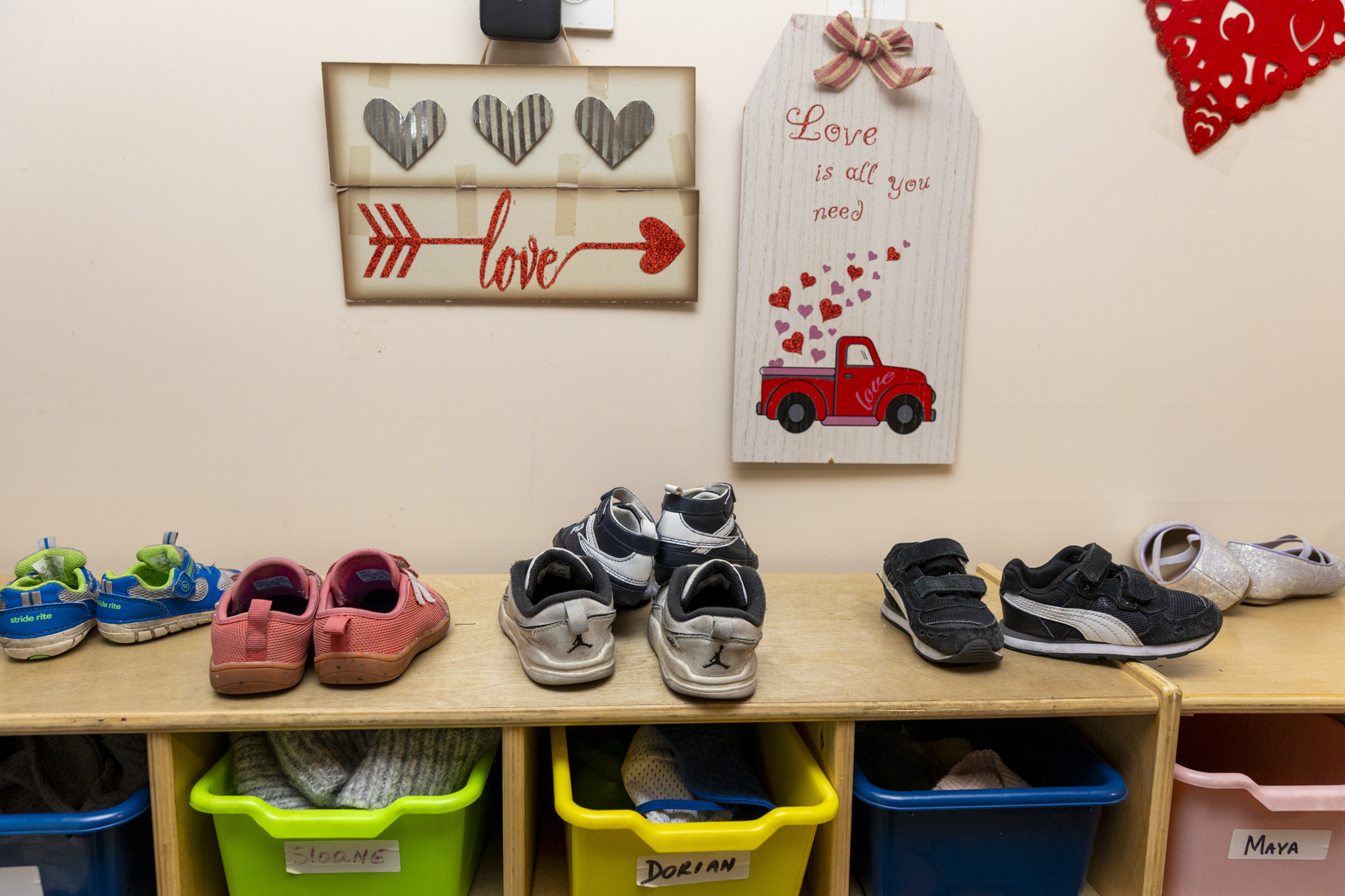 Shoes line a cubby at Daycare Bumblebee in San Francisco on Jan. 30, 2026. (Tâm Vũ/KQED)
About 700 children are currently on the wait list for care, though there are about 1,000 available spaces. One reason for the discrepancy is that there aren’t enough infant- and toddler-care slots to meet demand, or the open slots don’t match families’ preferred schedule, location or language, she said.
“We have expanded access, but the only thing that is a little bit of an art and a science — mostly art — to pinpoint is the preferences of families,” she said at a recent Board of Supervisors hearing.
The Department of Early Childhood estimates that ongoing revenue from the commercial rent tax can pay for the expanded subsidies. But the department cautions that it may not cover the program’s full cost down the road if the commercial real estate market softens.
Mezquita said she’s hopeful San Francisco’s experiment will demonstrate that it can be scaled up and funded with state dollars. The city was first to offer free preschool for 4-year-olds in 2005, and this year, California expanded transitional kindergarten for all children who turn 4 by Sept. 1.
“We are building a universal system. How we’re designing it is also taking into account that eventually, yes, we also need the partnership with the state to be able to not only expand it, but also make it widely available,” she said.