
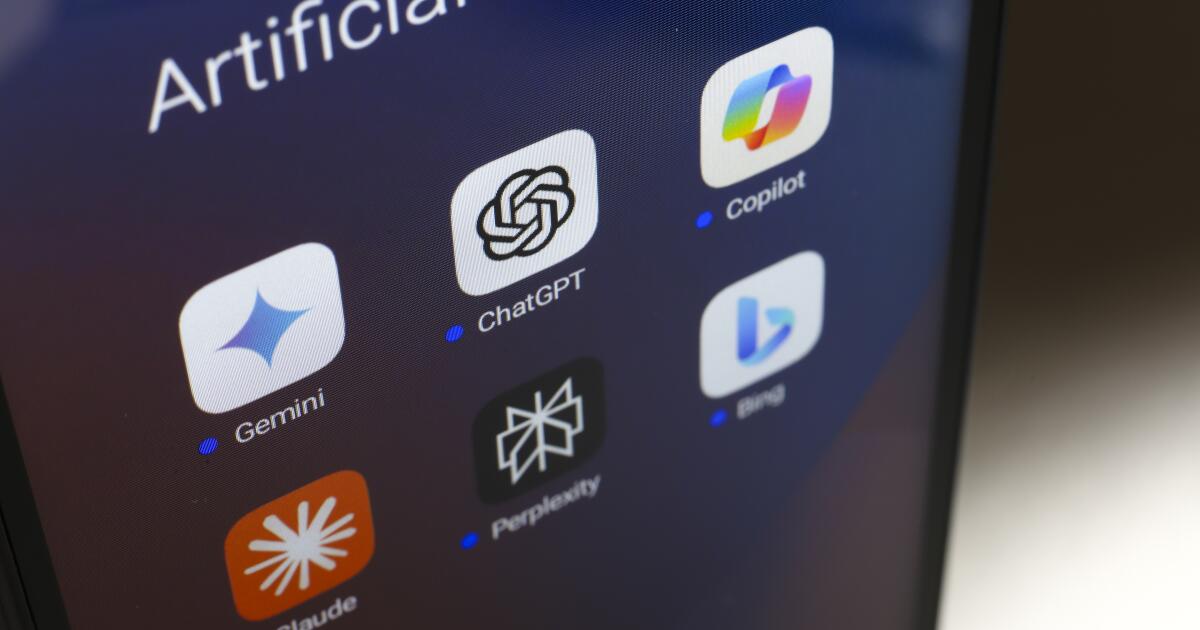
The chatbot wars entered the Super Bowl this year.
At Super Bowl LX, a ChatGPT competitor paid millions of dollars for commercials mocking the leading artificial intelligence chatbot’s plans to put advertisements in its chats.
One of the ads, titled “Betrayal,” showed a man seeking help to communicate better with his mother. His therapist, representing a sponsored bot, offers advice on mending the relationship, then suddenly suggests a mature dating site to connect with “roaring cougars.”
The ads from Anthropic, which has a chatbot named Claude, ends with the tagline: “Ads are coming to AI. But not to Claude.”
AI companies are spending hundreds of billions of dollars and need to generate more revenue to keep spending. Though much of the money comes from subscriptions from companies and other heavy users, companies serving regular consumers will probably need to increasingly rely on ads and other methods to monetize mass market users.
The Super Bowl Sunday ads launched a debate about what a future would look like in which the bots many people talk to all day start pitching products.
OpenAI, which has more than 800 million users, generated around $20 billion in revenue in 2025, according to its chief executive, Sam Altman. That still isn’t enough to cover what it has borrowed and plans to spend.
Last month, OpenAI said it will be testing ads for its free-tier users and its low-cost ChatGPT Go subscribers in the U.S.
“Subscriptions cover the committed users,” said former Google executive Justin Inman, who is the founder of Emberos, a startup that researches brand visibility in AI. “But they have a ton of free users as well.”
Ads have just started rolling out on ChatGPT, and the company has shared examples of what they look like in a chat.
One example showed a static link to purchase hot sauce at the bottom of the answer, labeled ‘sponsored’. Another was more conversational. After answering a user query about Santa Fe, the chatbox provided a link to a desert cottage in the locality.
OpenAI underlined that the ads won’t influence ChatGPT’s answers and will be separate and clearly labeled.
Altman responded to the Anthropic commercial on X, calling it funny but “dishonest.”
“We would obviously never run ads in the way Anthropic depicts them,” he said. “We are not stupid and we know our users would reject that.”
He suggested Anthropic was being elitist.
“Anthropic serves an expensive product to rich people,” he said, while OpenAI feels “strongly that we need to bring AI to billions of people who can’t pay for subscriptions.”
Anthropic was founded in 2021 by former OpenAI employees. Though the two companies have been long-term rivals, the Super Bowl ad was one of the first times the scuffle was so public.
While ChatGPT targeted everyday users, Anthropic has focused on selling chatbot services to business customers. The company has witnessed explosive growth, clocking a reported $9 billion in revenue in 2025, and is projected to reach $26 billion this year.
Demis Hassabis, the CEO of Google DeepMind, which operates Gemini, said in a recent interview that he was surprised by OpenAI’s decision to monetize the chatbot through ads this early. Pushing products mid-conversation inside a chatbot could hurt users’ trust in AI as a helpful assistant, he said.
Though Google’s Gemini chatbot doesn’t push ads, last year the company introduced ads in the AI-generated summaries users see atop Google search results. The company also began testing ads in “AI Mode,” a conversation feature on the Google homepage, where sponsored cards appear below the AI-generated search results.
Elon Musk’s Grok, the AI that is integrated into the platform X, also told advertisers last year that it would start testing ads inside chatbot responses as a way to boost revenue and pay for the expensive chips powering AI.
More U.S. shoppers are already turning to AI chatbots, and a Deloitte survey found that trust in generative AI has been steadily increasing. Younger shoppers are using chatbots for comparison shopping, finding deals, summarizing product reviews, and generating shopping lists.
Even without bribing the bots to provide direct advertising, brands are already trying to find ways to get into the good books of AI search results. An entire cottage industry of startups and consultants has emerged to help retailers and brands ensure their products appear in AI search results, a field called Generative Engine Optimization.
The market for traditional search engine optimization was $20 billion to $25 billion, but the potential for AI-driven commerce is much larger, said Amay Aggarwal, a co-founder of Anglera. His company helped Los Angeles-based e-bike and outdoor goods retailer Retrospec adapt its product catalog so that AI chatbots such as ChatGPT and Gemini could accurately recommend the right bikes for specific conditions.
Even as advertising evolves to embrace AI, many of the top AI companies saw value in old-school Super Bowl television ads. In the era of fragmented internet culture, the Super Bowl remains one of the last major shared American television viewing events that draws more than 100 million viewers. AI companies paid up to $10 million for a 30-second spot.
Super Bowl LX was overrun with advertisements from many AI majors, including OpenAI, which promoted its coding platform Codex, and Google’s Gemini, which spotlighted its photo-generation capabilities.
Despite being the “AI Super Bowl,” none of the major AI companies — OpenAI, Google, Anthropic — made the top 20 brands that performed well in generative AI search and conversation during Super Bowl week.
“Being an AI brand doesn’t automatically translate into being remembered by AI,” said Inman of Emberos, whose company produced The AI Influence Index, which tracked the top seven Super Bowl advertisers and how they were showing up in AI queries.
The seven brands that dominated chatbot searches were XFINITY, Bud Light, Squarespace, Ramp, Budweiser, Volkswagen and Dove.
“As ads move into chatbots, the real competition won’t be for attention — it’ll be for how clearly your message survives retelling by AI,” Inman said.