
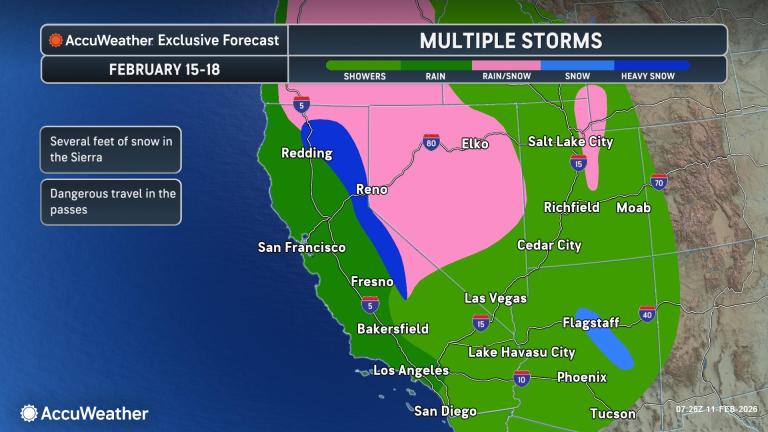
“It is possible the series of storms next week in California delivers close to an entire month’s worth of rain and snow,” AccuWeather Chief On-Air Meteorologist Bernie Rayno said.
Published Feb 11, 2026 9:50 AM CST
|
Updated Feb 11, 2026 9:55 AM CST
A climber in Colorado’s Rocky Mountains captured footage from inside a frozen waterfall, showing water still flowing beneath the ice after he broke through the frozen surface on Jan. 30.
Multiple storms will spin southward along the Pacific Coast of the United States next week. Each storm will bring abundant rain and mountain snow and cause significant impacts on travel and the potential for flooding and mudslides. Parts of the West are in desperate need of moisture.
A several-day break will follow this week’s storm along the Pacific Coast as its snow and rain shift eastward, eventually affecting the south-central and southeastern regions of the nation with drenching rain and thunderstorms.
This image of the western United States and the adjacent eastern Pacific Ocean was captured on Wednesday morning, Feb. 11, 2026. (AccuWeather Enhanced RealVue™ Satellite)
A storm over the Gulf of Alaska at midweek will drop southward to be just off the Northwest coast late this week. Then over the weekend, the storm will begin to pivot eastward, and rain will break out over parts of the coasts of Washington and Oregon.
On Sunday or Sunday night, drenching rain is likely to spin into coastal areas of Northern and Central California. From there, low-elevation rain and mountain snow will expand southward and eastward across California then into the interior West.
Multiple rounds of rain and mountain snow are likely from this storm in the West as it hovers along the California coast during the first half of the week before shifting inland. Local commuters, cross-country shippers and airline passengers should expect travel delays due to the likelihood of flash flooding, poor visibility and heavy snow over the passes — especially over Donner Pass, along Interstate 80.
“It is possible the series of storms next week in California delivers close to an entire month’s worth of rain and snow,” AccuWeather Chief On-Air Meteorologist Bernie Rayno said. “Multiple inches of rain will pour down in many areas, while feet of snow pile up in the Sierra Nevada.”
Another storm may drop southward along the Pacific Coast in its wake later next week and may focus more on Washington and Oregon.
Much of the interior West is in desperate need of storms with ample moisture. The developing pattern through the third week of February should help.
“Prior to this week, the amount of water locked up in the existing snow cover was close to a record minimum in Colorado and Utah,” AccuWeather Senior Meteorologist Brett Anderson said. “This zone constitutes a large part of the Colorado River basin, and with limited spring runoff available, it could be a major problem for summer water concerns on the river and man-made lakes.”
The Colorado River basin is home to approximately 40 million people.
Have the app? Unlock AccuWeather Alerts™ with Premium+
In contrast to the pattern that brought some of the coldest weather in years to the Midwest and East in recent weeks, much of the western third of the nation has been very warm for months prior to recent days.
Seven states in the West have experienced their warmest December and January period on record. The period of record dates back decades.
More stories of interest:
Want next-level safety, ad-free? Unlock advanced, hyperlocal severe weather alerts when you subscribe to Premium+ on the AccuWeather app. AccuWeather Alerts™ are prompted by our expert meteorologists who monitor and analyze dangerous weather risks 24/7 to keep you and your family safer.