
You can find all of Marketplace’s coverage of the Los Angeles wildfires here — including David Brancaccio’s own rebuilding journey.
Depending on which expert you ask, the U.S. needs somewhere between 2 million and 5 million more homes to address the country’s shortage. On top of that, a lot of the housing stock we already have is vulnerable to increasing climate and weather changes. In 2024, Hurricane Helene destroyed 1,000 homes in North Carolina alone. In 2025, the Southern California wildfires destroyed more than 12,000 homes — mine among them.
When we lost our 99-year-old house in the Altadena fire a year ago, poet Mary Brancaccio, my wife, remarked that we had the perfect house for the last hundred years. What we needed to build, she said, was a house for the next hundred.
This Old House Radio Hour and Marketplace worked together on a special report exploring that idea. It’s called “Building Tomorrow.” In it, we meet some great people building differently.
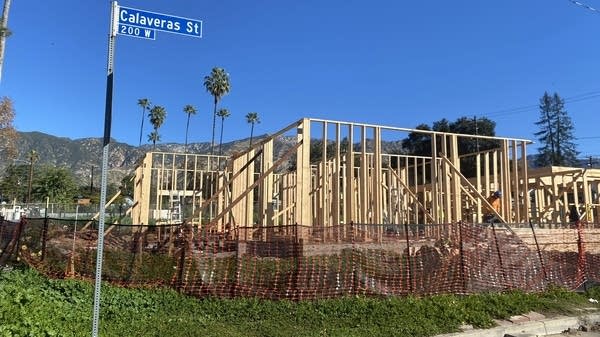
A home under construction in Altadena, California. The 2025 wildfires destroyed more than 12,000 homes.
Chris Wolfe / This Old House Productions
People like my neighbor Heidi Luest, who’s got property about three blocks east of mine. She lost a beloved house of 25 years in the Eaton fire a little more than a year ago. But what she’s rebuilding is something more.
“I’m building a bunker. So I decided to name my house Edith,” Luest said.
As in, Edith Bunker, from the ‘70s sitcom “All in the Family.”
“Sorry, I have to make a joke out of everything,” Luest said. “But I figured, as long as I have a house and it’s gonna be strong and sturdy, why not give her a name?”
Luest is building with panels that look like they’re pressed from Styrofoam cups. These are “insulated concrete forms.”
“So it’s ICF blocks. It’s basically 2-inch foam, 6-inch concrete, another 2-inch foam,” she explained. “You put rebar in the center and you pour concrete in it. It can take up to 250 mile-an-hour winds. It’s gonna give me a four- to six-hour firewall. And I probably won’t need any heating or cooling because it’s that insulated. It’s like a Lego. It’s got the tongue and groove, and they kind of snap together.”
It’s a creative approach from a creative person.
“I’m a scenic artist,” she said. “I’ve done backdrops for the movie and music industry. I did a Katy Perry Super Bowl halftime show in the backyard. I’ve done props for Lady Gaga.”
It’s too bad we can’t just paint a backdrop of our houses and call it a day, but that doesn’t quite work. You can’t live in those. But we can live in a concrete house, built quickly with snap-together panels.
“I’m saving in labor because it’s not back-breaking,” Luest said. “Literally, there’s only three guys building it.”
She thinks she might be able to move in come springtime.
Three blocks south of my property is another burnt-up parcel, which now has three, 800-square-foot small houses coming together quickly. Here, even kitchen cabinets are already in place. The whole thing is prefabricated by a company called LiveLarge Home.
The owner of this property is Aloe Blacc. (Yes, that Aloe Blacc.) He’s happy to show off the front house.
“Near completion. They are just working on final touches,” he said. “The whole thing came on a crane. These two halves were put together. What I did not want was the headache of the trauma of a fire, and then the headache of a contractor, who will sign and then go take a bunch of other work and never show up or have supply issues. I got what I paid for. And it was delivered earlier than expected.”
The place has a sleek, Euro-feel inside. Its structure isn’t wood but something called fiber cement that meets tough California building codes.
“So California, we have floods earthquakes and fires,” Blacc said. “Fiber cement is fire resistant. We held a torch to the wall for three minutes and it did nothing but put like a black mark that you just wipe off with a rag.”
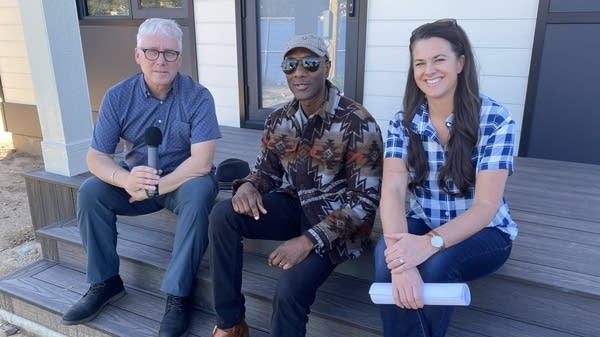
“Marketplace Morning Report” host David Brancaccio, musician and property owner Aloe Blacc, and “This Old House Radio Hour” host Jenn Largesse pose on the steps of a house on Blacc’s property.
Chris Wolfe / This Old House Productions
He had mentioned he’d bought the property before the fire for his elderly dad.
“Unfortunately, my father passed. So he won’t be living here,” Blacc said. “But because this community is in such need of housing, people will want to live near where they’re building. Lucky enough to be part of this beautiful community and help restore it in the way that I can.”
And then there’s question of existing homes. For those who aren’t rebuilding from the ground up, how can they prepare for the future? There are ways.
I remembered a visit I had made many years ago to a renovated duplex in the Boston-area, where physicist Zeyneb Magavi had tried to make her home as environmentally friendly as her budget and the technology of the time could make it.
It was the winter of 2008. I was on assignment for PBS television. We didn’t know the great financial crisis was coming later that year. But we knew the climate crisis was unfolding.
At the time, here’s what preparation looked like. Magavi showed me the insulation work she did herself, made from ground-up blue jeans. She also showed me something of a novelty at the time: a recessed LED light fixture. At the time, she had to convince the electrical supplier to make a special order. It was $800. Now you can get one at the hardware store for $26 and change.
When we contacted Magavi all these years later, she was still in the house, the bones of which have just turned 100 years old. And what we found is proof that you don’t have to build new to be cutting edge. After 18 years, she was iterating yet again to future-proof her home.
First off, a crew was taking her house to the next level of energy efficiency by connecting its heating and cooling system to an underground geothermal well. Dig 4 to 6 feet into the soil even during a chilly New England winter, and there’s a fairly constant moderate temperature that can be used to make a house warmer or cooler without much energy through the magic of thermodynamics.
“The best moment of a gas boiler approaches 98%, 99% efficiency,” Magavi said. “With a geothermal heat pump for a single building, it’s four or five times, so it’s like 400% or 500% efficiency.”
Magavi, in the intervening years, has become head of a nonprofit, HEET, that works with utility companies to put in networked geothermal for whole neighborhoods, even towns. It was her turn. When she first renovated, she had the foresight to put an air distribution system into the walls that could be adapted to new technology as it became available.
“We’re in the basement next to the mechanicals for the hot water distribution system currently providing hot water, which gets pumped through these radiators,” she explained. “The same hot water and radiators will work equally well with the geothermal heat pump swapped out for the gas boiler.”
It’s made for a smooth transition.
“With the geothermal coming on, and also with much hotter summers since we began this, the stuff’s in the walls already. And all we have to do is install the equipment,” she said. “I certainly approached this home as a forever home, as a place I wanted to invest in, not just for myself — for my kids, for the community, and I was really trying intentionally to build a home for the future.”
Related Topics