
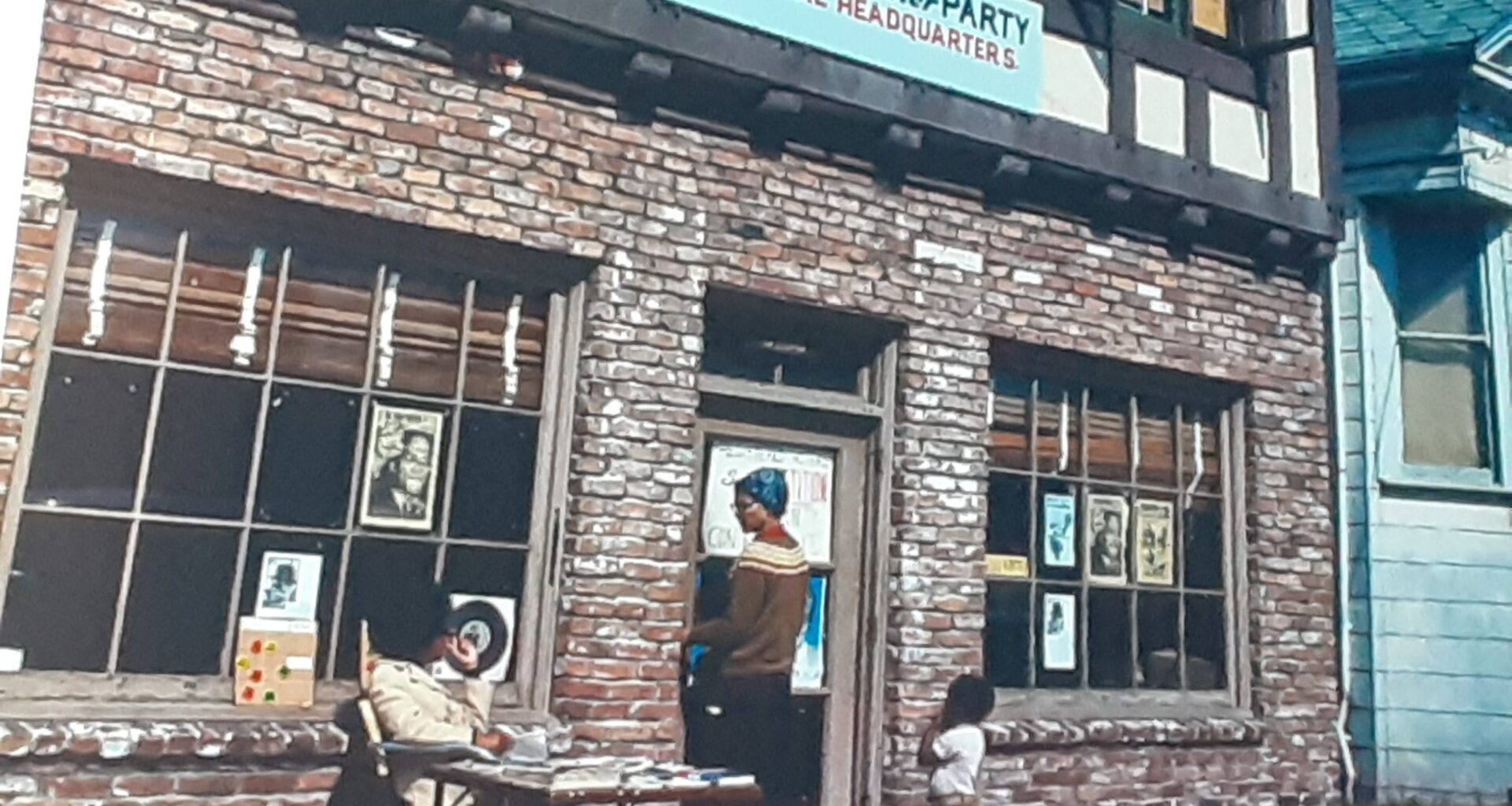
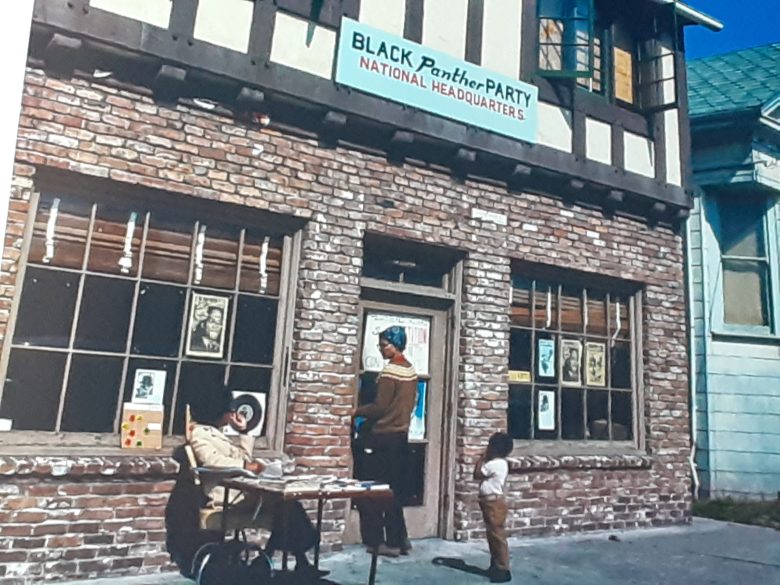
 A building on Shattuck Avenue in South Berkeley was the Black Panther Party’s headquarters between 1968 and 1970. Credit: It’s About Time: Black Panther Alumni Committee/Archive
The Black Panther Party is indelibly linked to Oakland, where it was founded. But when the Panthers’ North Oakland headquarters was badly damaged by a hail of gunfire, the party relocated to Berkeley in September of 1968.
The Panthers’ radical agenda found a deep vein of support in Berkeley from the beginning, and those ties expanded when they moved into a house at 3106 Shattuck Ave., near Prince Street. “The Black Panther Party in Berkeley: An Archival Exhibit and 60th Anniversary Celebration,” on view on the second floor of Berkeley’s Central Library through May 29, explores that chapter of the party’s history.
“The downstairs was our office and the upstairs was where we laid out the paper,” recalled Billy X. Jennings, the exhibit’s curator, who will be on hand for an opening reception March 21. “Most of the staffing came directly from Berkeley High School and UC Berkeley, and some people from the community. Barbara Lee was a student at Mills College and came by the office three days a week to work for me.”
A former party member and founder of the Panther Alumni Association and Archive, It’s About Time, Jennings has assembled a trove of archival photographs, art pieces, newspapers and other ephemera that capture the Black Panthers’ widespread connections to Berkeley.
The party’s move to its South Berkeley headquarters came at a pivotal moment for the Panthers.
Huey Newton, the organization’s minister of defense and co-founder, had spent the summer facing charges stemming from a 1967 gun battle that led to the death of Oakland police Officer John Frey, an altercation in which Newton was also shot.
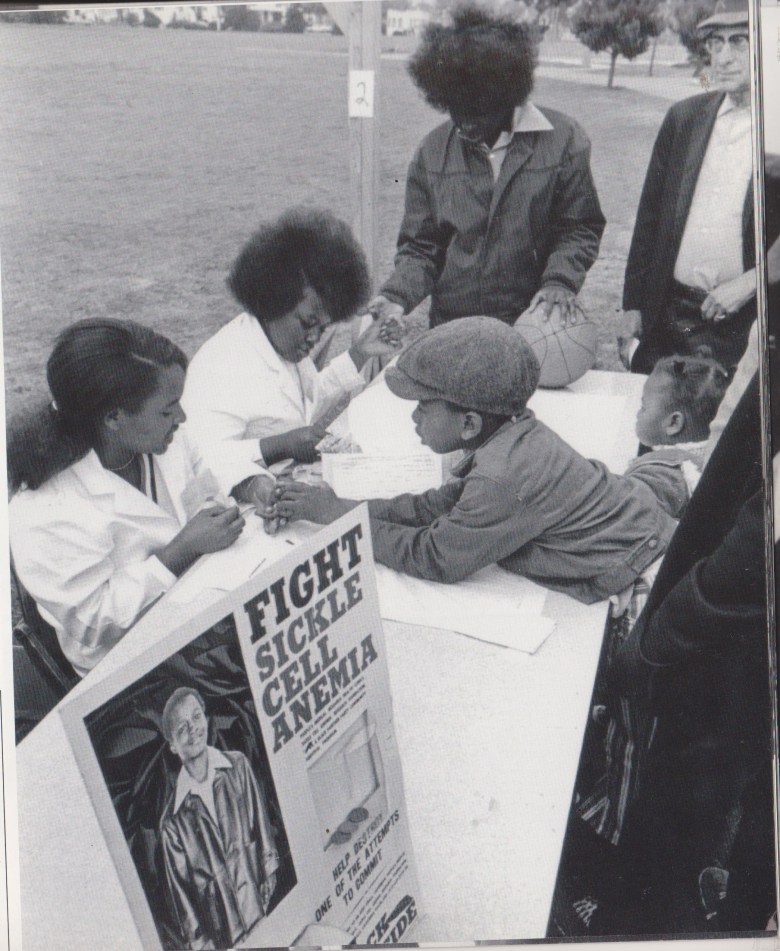 The Black Panther Party organized sickle cell anemia testing in San Pablo Park during the Black Community Survival Conference in 1972. Credit: It’s About Time: Black Panther Alumni Committee/Archive
Convicted by an Alameda County jury of voluntary manslaughter on Sept. 10, 1968, and sentenced to two to 15 years, Newton was also found not guilty of felonious assault, while a kidnapping charge was dismissed. The verdict left Panther supporters dismayed and Oakland police enraged. That night, according to “The Shadow of the Panther,” Hugh Pearson’s biography of Newton, “two officers showed up drunk in front of the Black Panther Party headquarters and fired 12 to 28 rounds of ammunition into it.”
The Shattuck headquarters became a magnet for young radicals, self-styled revolutionaries and people looking to support the various community programs run by the party. Future death-row cause célèbre Mumia Abu-Jamal, then known as Wes Cook, worked at the Shattuck office as a teenager.
“In his book ‘We Want Freedom,’ he talked about his Berkeley experience and learning from Emory Douglas,” Jennings said, referring to the party’s minister of culture and graphic artist who shaped the arresting look of the party’s posters and newspaper, The Black Panther.
The paper would become a megaphone for the party — a photo in the exhibition captures several National Guard troops reading it during the battle for People’s Park. But first they had to find someone willing to take their business.
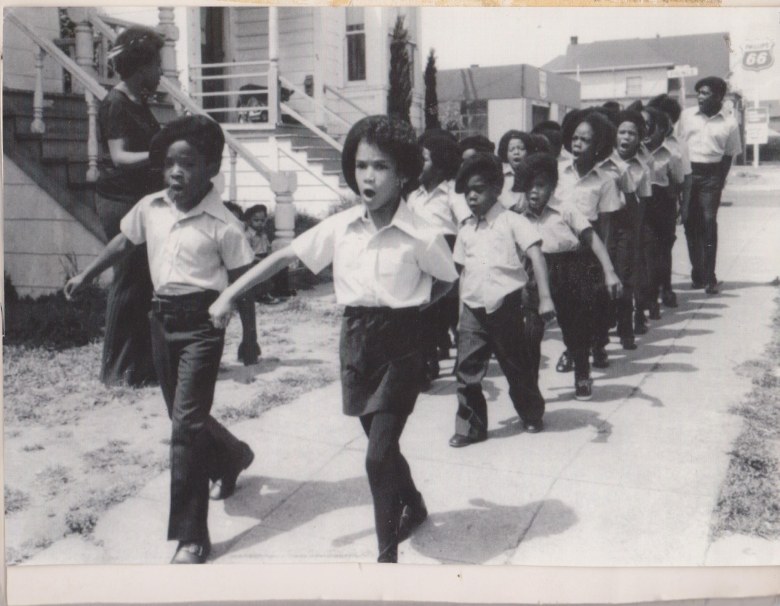 Members of the Panther Youth School march down Shattuck Avenue in 1970. Credit: Stephen Shames, courtesy It’s About Time: Black Panther Alumni Committee/Archive
“Nobody would print it,” Jennings said. Through Eldridge Cleaver, party co-founder Elbert “Big Man” Howard reached out to Yippies co-founder and Berkeley Barb correspondent Stew Albert, who connected the Panthers with the San Francisco press that printed the Barb.
“That’s how we started, and it became the number one Black newspaper in America, outselling Muhammad Speaks,” Jennings said. “We were selling 300,000 a week out of our 48 chapters. We set an example for people to follow. Your kids don’t have to go to school hungry. You don’t have to take guff from the police.”
KPFA covered the party closely, often broadcasting speeches and interviewing party leaders. The Panthers’ official R&B band, The Lumpen, performed versions of popular songs rewritten to spread the revolutionary message at events around Berkeley.
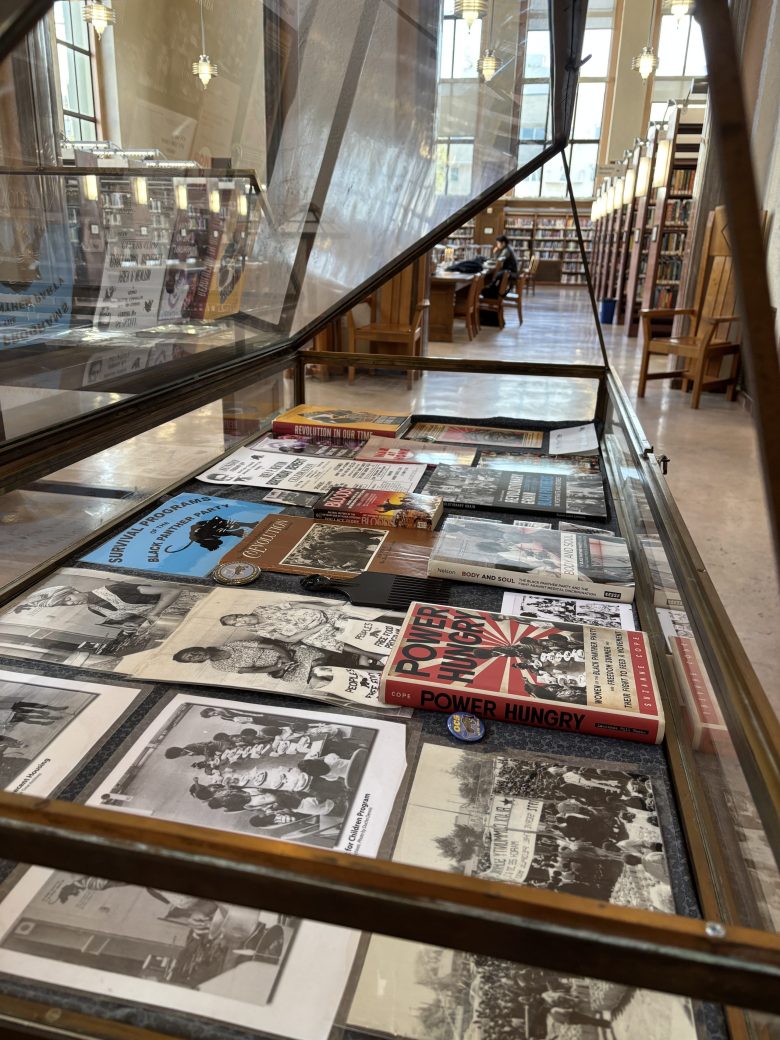 “The Black Panther Party in Berkeley: An Archival Exhibit and 60th Anniversary Celebration” is on view on the second floor of Berkeley’s Central Library through May 29. Credit: Berkeley Public Library
Looking to cultivate allies on the left, the Panthers spearheaded the United Front Against Fascism conference in Oakland in July of 1969. The conference led to the first chapter of the National Committee to Combat Fascism, a radical white affiliate in Berkeley under the guidance of the Black Panther Party leadership.
One of the NCCF’s first actions was to campaign for an initiative on the 1971 Berkeley ballot for “community control of police,” which would have replaced the city’s police department with three independent “neighborhood” departments. The initiative lost, as did a similar one in 1973, but on that ballot voters did approve one of the nation’s first civilian-run police review commissions.
The Panthers ran many other projects, most famously the free breakfast program for children, as well as free medical clinics, job training, and various educational initiatives, like the Oakland Community School.
At the same time, violence continued to emanate from the party, which was targeted by an FBI program, COINTELPRO, that sought to sow divisions within the ranks and between the Panthers and other radical activist organizations. Richard Aoki, a widely revered Berkeley activist who supplied the Panthers with guns early on, turned out to be a longtime FBI informant. The internecine struggles had their own body count, like the still unsolved 1974 killing of Black Panther Party bookkeeper Betty Van Patter.
“We made mistakes, stayed with the gun too long,” Jennings said. “It was a tool to educate and organize people. It’s not against the law to protect yourself. It’s in the Constitution. Other leaders took that further, talked about offensive stuff.”
After Cleaver fled the country and ended up in Algeria, Jennings credits Newton with turning the Black Panthers back to their “original version” after he was released from prison in 1970, “as a revolutionary organization here to set an example for people to follow. You can get a gun like everyone else, use it when you’ve got to use it. Your enemy is not white people. Your struggle is a class struggle.”
The Berkeley exhibit is one of several commemorations happening around Northern California tied to the 60th anniversary of the party’s founding on Oct. 15, 1966.
Jennings has already curated exhibitions at Oakland Public Library’s 81st Avenue branch and held a Black Panther Party Pop Up at the Vallejo John F. Kennedy Library. He noted another exhibit at the California Museum in Sacramento, which opened last June, was a full-circle moment: Rifle-toting Panthers held an iconic demonstration at the state Capitol on May 2, 1967, that quickly led to California repealing its open-carry law.
“They invited us” this time, Jennings said, sounding both amused and amazed. “The last time we were there we had guns.”
“*” indicates required fields