
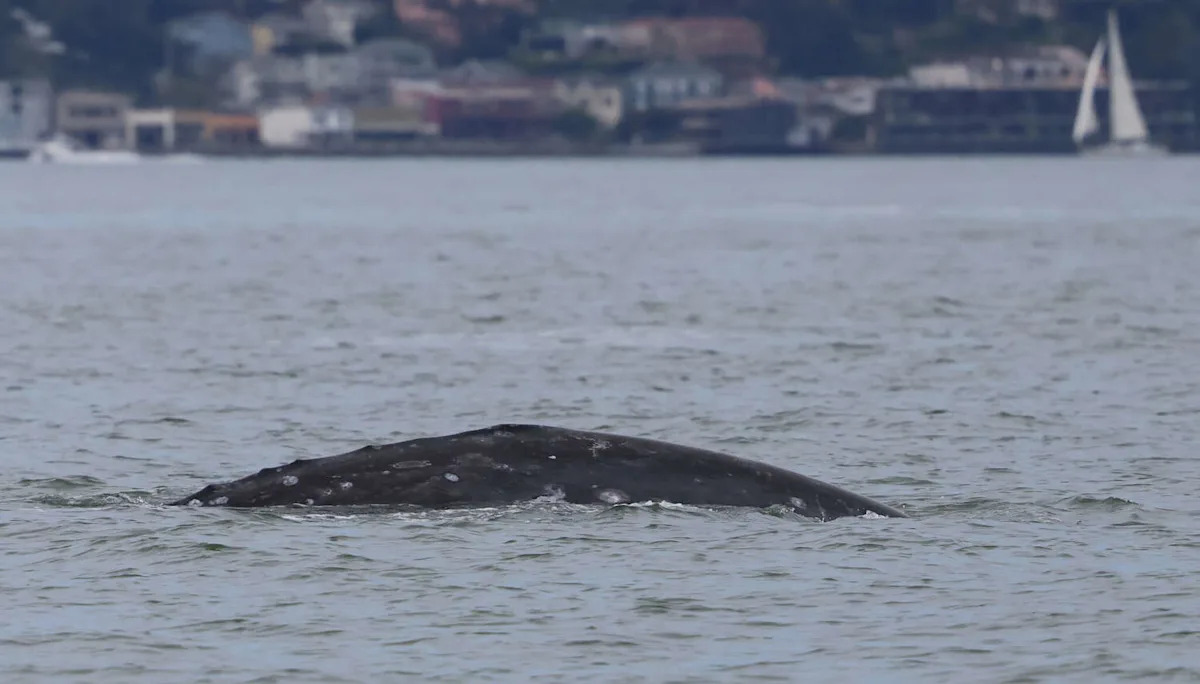
The first gray whale of the year has arrived “unseasonably early” in San Francisco Bay, experts from the Marine Mammal Center told SFGATE this week, raising questions over the species’ behavior and how it is using the bay to survive. The news follows a troubling year for the species that saw 21 individuals wash up dead in the Bay Area alone – the most in 25 years – and the lowest population estimates since the early 1970s.
Bill Keener, a field researcher for the Sausalito-based organization, said a ferry skipper first spotted the whale near the terminal on the western edge of Richmond on Jan. 18. After receiving the report, he immediately tried to catch a glimpse himself. “I ran from shore but never saw it,” Keener told SFGATE over the phone. Three days later, he was able to photograph the massive cetacean, getting close enough to capture the unique mottling pattern on its back before it dove down to the sea floor to feed on tiny invertebrates in the mud. On Monday afternoon, Keener was out on the water when he spotted it again – and it wasn’t alone.
As of the end of January, the Marine Mammal Center has documented three different gray whales passing through San Francisco Bay, the second of which was first spotted near Angel Island and headed out toward Fort Point, while the third was observed near Alameda and hasn’t been seen since. The duo Keener saw on Monday, however, seem to have been hanging out in the bay for weeks.
“We were surprised,” he said. “This is really unusual from what we’ve been tracking since they really started coming back in 2018.” That was the year before an unusual mortality event was declared for the eastern North Pacific population of gray whales, which lasted through 2023 and saw the decline of more than 50% of the animals.
Scientists believe the cause of hundreds of whale deaths during the event was related to changing conditions in their Arctic feeding grounds where they spend the summer, which in turn led to malnutrition and decreased birth rates. An estimated count of 85 gray whale calves last year was the lowest since experts started keeping records in 1994, according to the Marine Mammal Center. Experts believe the whales learned to seek other food sources along their migratory route.
“The event might be over, but we still have whales coming in, presumably because they want to rest and find food in San Francisco Bay,” Keener said.
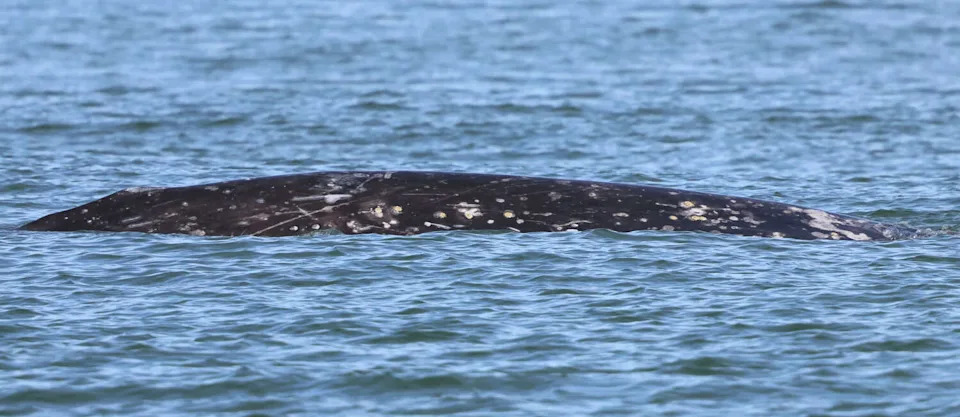
The second of two gray whales is photographed exploring San Francisco Bay on Feb. 9, 2026, by members of the Marine Mammal Center’s Cetacean Conservation Biology Team during a vessel survey. (Photo by Bill Keener © The Marine Mammal Center, NOAA Permit #26532)
It’s not yet clear whether this year’s early arrivals are indicative of a behavioral trend, but Keener pointed out that he usually doesn’t see gray whales show up in the bay until mid-February. According to records in the Marine Mammal Center’s database going back to 2018, there were just two years when a whale showed up in January – 2020 and 2022. However, Keener noted just a single whale was seen each time and only stayed in the bay for a day before taking off again.
Last year, whales did not arrive in San Francisco Bay until Feb. 26. In 2024, the first sighting was on March 11; in 2023, the first whale appeared on Feb. 8. Prior to that, initial sightings of the animals were recorded on Jan. 1 in 2022; Feb. 10 in 2021; Jan. 26 in 2020; Feb. 17 in 2019; and March 17 in 2018.
According to Keener, this has been the only year that multiple whales were in the bay at once prior to February since the center began documenting the phenomenon. “It yields a lot of questions, and until we’re able to follow and study them over time, we’re not going to know the answers,” Keener said.
One theory is that, as more whales have been introduced to the bay and learned that it existed as a food source, other whales found out about it too, he said.
“Before, what was happening was that they were on their northbound migration and hungry after they’d been so far away from the Arctic. Others had been in their Baja breeding grounds and ran out of energy,” he said. “Now it could be that, now they know what San Francisco Bay is about, they want to come in a little bit earlier.”
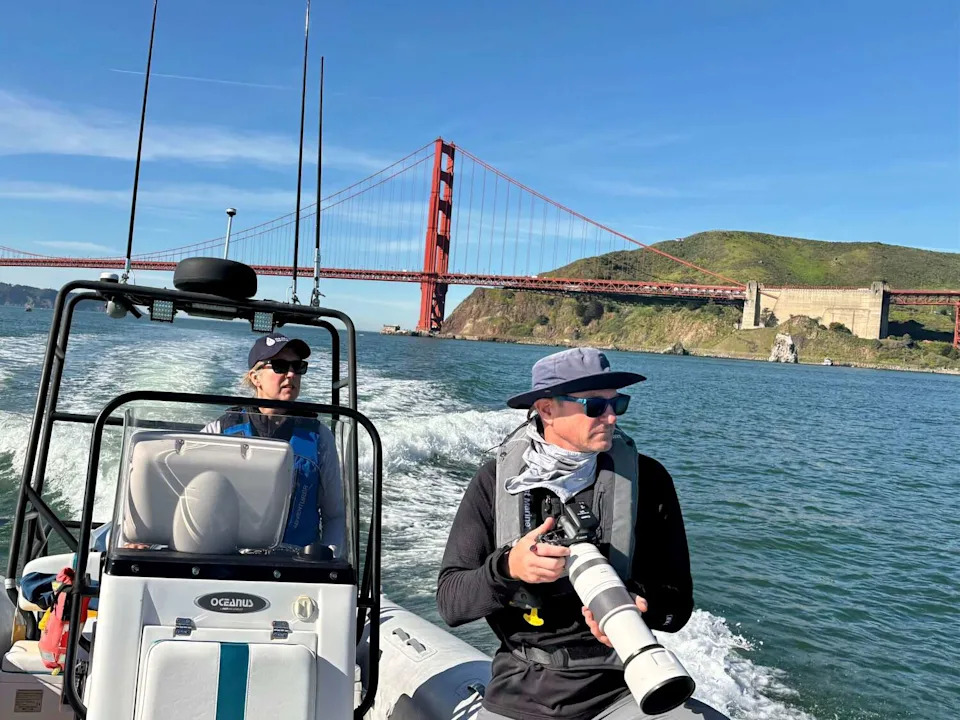
From left, Kathi George, the director of cetacean conservation biology at the Marine Mammal Center, and research volunteer Darrin Allen search for gray whales in San Francisco Bay during a vessel survey on March 25, 2025. (Photo Giancarlo Rulli © The Marine Mammal Center)
The Marine Mammal Center is currently working with the Smithsonian Environmental Research Center, the Marin County branch of the national institution, to answer other questions, like what exactly the whales are feeding on and what prey is available. Keener also hopes to learn how long the whales are staying in the bay and why.
“Do they leave and come back? What are they doing? Are they staying all night in one small area?” he wondered aloud. “It’s important because we want to know what the hot spots are, so we can get that information to the shipping industry and ferry operators so they’re aware of areas that have whales.”
So far, the whales Keener has seen in the bay this year appear relatively healthy, all things considered. And while he’s heartened that no dead whales have washed up yet in the region, the Marine Mammal Center has been taking action to reduce fatalities in the bay with a new training program, Whale Smart. The program educates vessel operators on the presence of whales, their behaviors and movements, how to safely navigate around them in the water and alert the Coast Guard when needed. It was developed in the aftermath of last year’s “unprecedented” whale deaths, 43% of which were due to suspected vessel strikes, according to a news release from the center.
Keener said that when he was out on the water on Monday, another ferry radioed over to his research boat to notify them of the presence of the whale that he happened to be following. It asked if he knew exactly where it was so they could avoid it, adjusting its route in real time.
“I was so happy, because years ago, when gray whales first arrived in the bay, we didn’t know what to say or do,” he said. “Now we have more information and can alert people to what’s happening.”
More Local
– National Park Service officials make difficult decision about Alcatraz coyote
– Another Bay Area city moves to outlaw short-term rentals
– California’s housing market is splitting in two
– A first look inside the $41 million transformation of a 104-year-old SF icon
Get SFGATE’s top stories sent to your inbox by signing up for The Daily newsletter here.
This article originally published at Whales are arriving early in San Francisco Bay. Scientists don’t know why..