
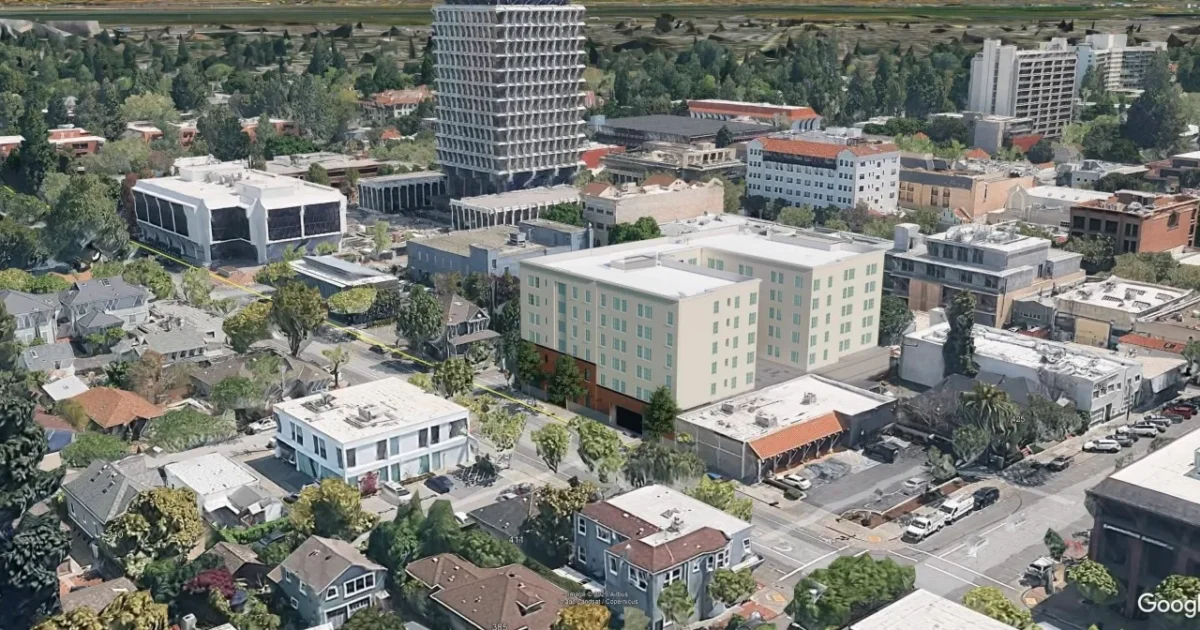
Undeterred by an ongoing legal challenge, the nonprofit Alta Housing last week filed a formal application to construct an affordable-housing complex with 72 apartments on a downtown parking lot near the corner of Lytton Avenue and Kipling Street.
The six-story project on what’s known as “Lot T” is the first to take advantage of the city’s new program to build affordable housing on public parking lots. The city’s Housing Element, a state-mandated roadmap for housing production, proposes building housing on six lots that would collectively yield about 290 units. For of these are in the downtown area, while two others are near California Avenue, according to the document.
“University Avenue downtown is an urbanized area well served by efficient transit and City infrastructure with access to services and amenities,” the Housing Element states. “The area does not include any known environmental constraints; it is not located near wildfire zones or in the flood zone and is not in an area vulnerable to sea level rise.”
Not everyone, however, is enamored by this strategy. Land use attorney David Lanferman, who had previously represented downtown developer Charles “Chop” Keenan in a successful lawsuit over parking fees, criticized the proposal to convert parking lots to housing sites before the Housing Element was adopted in August 2024. Once the city agreed to work with Alta Housing on the Lot T project, Lanferman filed a lawsuit against the city in a bid to stop the project.
Lanferman, who is representing a group called Downtown Vibrancy, is alleging that because downtown parking facilities were funded through assessments on downtown property owners, the city cannot legally convert them to other uses.
“The Defendants’ actions and efforts to replace vital parking facilities with housing is inconsistent with many of the City’s land use plans and policies, and is in disregard of the rights and interests of the Downtown property owners who paid for the parking lots,” his complain states. “Moreover, the City’s actions are unnecessarily harmful to the broader community, which has long been served by the existing parking lots, and has made irretrievable investments and commitments in reliance on their perpetuation.”
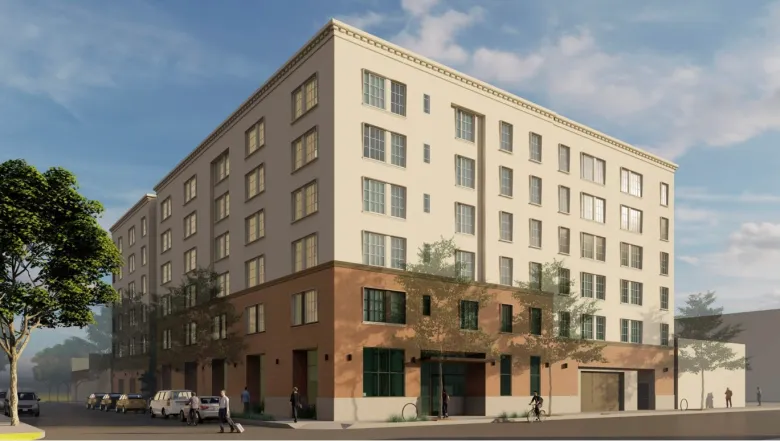 Alta Housing project is the first take advantage of a new program to build affordable housing on public parking lots. Courtesy Pyatok Architecture + Urban Design/city of Palo Alto.
The city has strongly disputed this allegation. In a court statement submitted earlier this month, the city denied that Lot T is “encumbered by the rights of others.”
“The City contends Petitioner misreads the title report which does not show the city’s rights in Lot T are encumbered,” the statement reads.
The two sides are currently wrangling over the scope of discovery, which the city claiming that it should be limited to the administrative record that the City Council considered before voting to approve its agreement with Alta Housing and Lanferman arguing that it should include a broader array of documents, including many that date back decades, according to the city’s court filing.
The litigation could delay construction that even in the best-case scenario wouldn’t commence until 2028, according to the city. It has not, however, stopped the city and Alta from moving ahead with the planning process. According to the newly submitted plans, the building at 450 Lytton Ave. would feature five stories of housing, which will be a mix of one-, two- and three-story apartments, over one story of parking.
Nearly half of the units will be designated for households with “extremely low incomes,” with income at or below 30% of area median income. The remaining units would be split between households with “very low” income (30% to 50% of AMI) and “low” income (50% to 80% of AMI). One of the 72 units would be designated for the building manager.
Studios are notably missing from the proposal. During a recent public hearing on the project, Alta Housing CEO Randy Tsuda told the City Council that demand for studios isn’t as strong at the developer’s properties as it is for larger units.
“We do find that the units that tend to take the longest to rent are the studio units,” Tsuda said at the Oct. 22 hearing, which was designed to gauge the council’s appetite for more units at the site. “Even if you are a single or a two-person household, if you have the option people tend to choose more space.”
At the podium level, the new development would include a courtyard, a laundry and a community room. The garage on the ground floor would include 34 parking spaces and bike parking spaces, according to project documents.
Even with the legal challenge threatening to delay the project, the City Council enthusiastically endorsed the Alta Housing proposal during its Oct. 22 hearing, urging the developer to move ahead with the largest of the proposed designs. Council member Ed Lauing also supported the developer’s choice to include larger units, suggesting that this would make room for families to move in and create a stable environment for downtown’s newest apartment complex.
“I’m happiest as a council member when we’re sitting here and moving the ball forward on affordable housing,” Lauing said at the hearing. “We are all committed to do this. We all know how crucial this is. This project looks terrific, in the right place and so on.”