
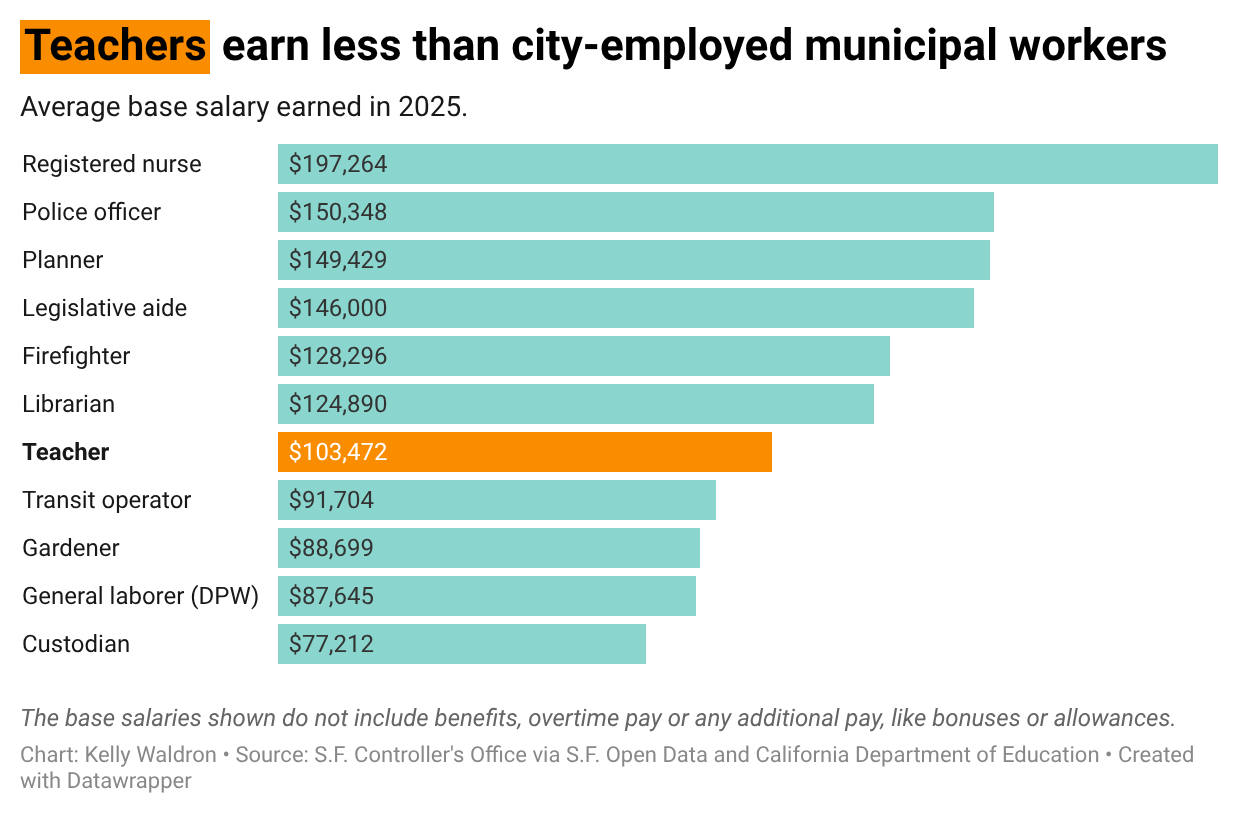
As the San Francisco educators’ strike is set to stretch into its fourth day with an end unknown, a Mission Local analysis of city payroll data found that San Francisco Unified School District teachers make significantly less than city-employed municipal workers.
The average salary for teachers in the school district is $103,472, according to the California Department of Education. Pay brackets vary based on years of service in teaching. For example, K-12 teachers just starting out earn an annual salary of $85,381, while those further along in their careers earn over $100,000, up to $131,654, for those with 26 to 28 years of experience.
Compared to city workers’ salaries across a variety of roles and departments, teachers’ average salaries are far lower — close to half that of registered nurses, around 30 percent less than police officers and city planners, and tens of thousands less than firefighters.
Mission Local calculated the average salaries for a selection of public-sector jobs using city payroll data from last year. Of the jobs analyzed, teachers rank last in pay among those that generally require a bachelor’s degree.
Wages have been a key sticking point in negotiations between union and district officials. The union is seeking nine percent raises for “credentialed” employees over two years; the district has offered six percent.
The range of teacher salaries across the Bay Area is wide, according to state data. Certified teachers in the Oakland Unified district earn an average of $84,127, and $97,383 in the South San Francisco Unified district. Meanwhile, the average is much higher in some other nearby districts: $129,418 for San Leandro Unified district teachers and $149,175 for those at Santa Clara Unified.
While San Francisco teachers and city employees work in the same city and are subject to its financial slings and arrows, their salaries do not emanate from the same source. San Francisco public schools are run by the district, which is primarily funded by the state and not the city. It runs its own budget, though the city does allocate some tax revenue.
This analysis only took into account employees who were paid a full-time base salary for a year, and does not include any additional pay, overtime, or benefits. Nor did this analysis account for the weeks during which schools are closed, and teachers have time off. When schools are closed, teachers still have some obligations, like preparing coursework for when school goes back into session.
Generally, teachers work more than 40 hours a week when school is in session, but do not receive much in overtime pay. The average overtime pay paid in 2023 across all SFUSD employees was just over $1,000, according to data published by Transparent California.
But for some city employees, overtime pay is significant, which widens the gap in pay even more. Of some 24,000 city employees who worked full-time for a full year in 2025, over 1,700 received overtime pay equal to 50 percent or more of their base pay. That often means tens of thousands of dollars a year in overtime, sometimes hundreds of thousands.
And while it is unusual, last year over 360 employees made more in overtime pay than they did in base salary. The vast majority of those are law enforcement officers in the police or sheriff’s departments.
The district is in a difficult situation. In 2024, the district projected a deficit of over $100 million for the upcoming school year, which led to the state taking charge of the district’s financial oversight. Student enrollment has declined. As the district receives funding from the state based upon student attendance, this adds pressure to the district to make cuts.
Amid potential cuts, however, educators say they are burdened by rising costs and low wages.
Jill Wynns, a longtime former member of the San Francisco school board, said the reason for teachers’ comparatively low salaries is straightforward: “They aren’t city employees.”
Unlike the city, the school district cannot levy fees and taxes to generate funds, unless district officials go to the ballot to pass additional tax measures.
“They’re in a box,” said Wynns, referring to the school district. “They’re not in charge of their own revenue.”