
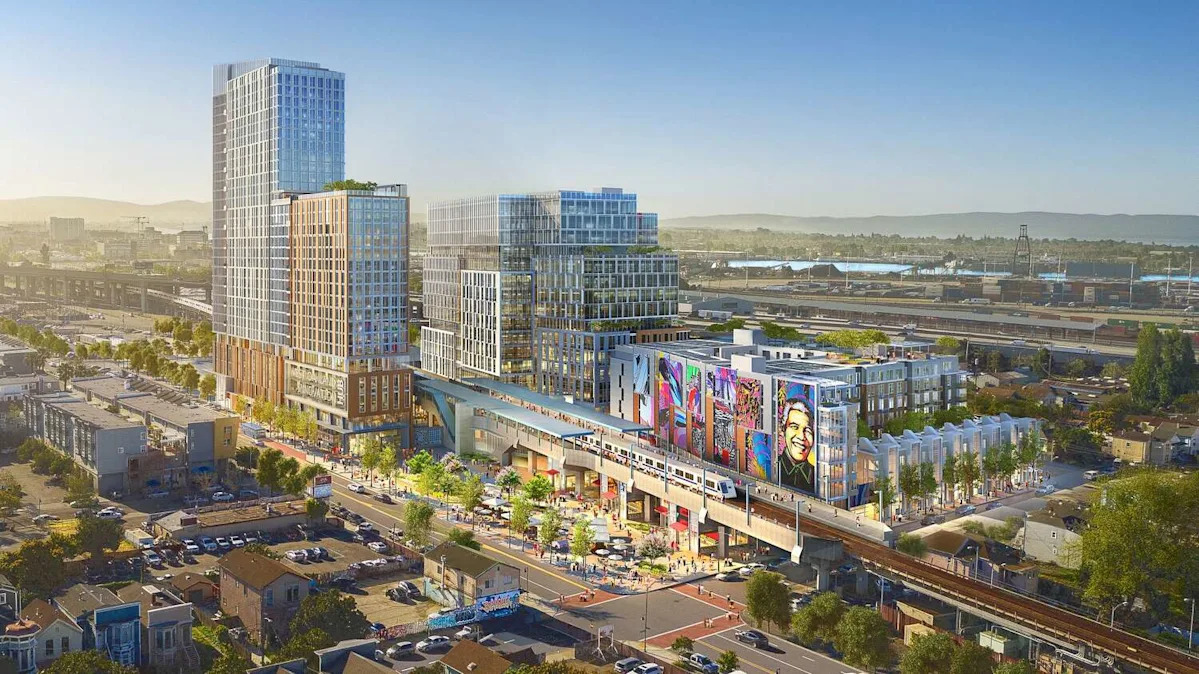
A long-planned transit-oriented development on BART property at the West Oakland Station is finally moving closer to starting construction.
Developers of Mandela Station expect to break ground in May on the first phase of the project, a 240-unit affordable apartment building on what is now a BART parking lot, one of the project’s partners, Alan Dones, told The Chronicle this week.
At full build-out, Mandela Station will also feature a 320-foot residential tower with 522 market-rate units, 14,350 square feet of retail space and 125 parking spots.
As a first step, the development team has begun soil testing that will run through Feb. 17, temporarily taking 60 of the station’s 440 parking spaces out of service, BART announced earlier this week.
The project stands out in Oakland’s sluggish development climate. Higher interest rates and flat rents have sidelined many market-rate projects, and a number of apartment buildings that opened between 2019 and 2023 have since fallen into foreclosure or have been sold at deep discounts.
Affordable housing, by contrast, remains one of the few types of projects that can still secure financing, in part because of expanded federal tax credit programs that have drawn more private developers into the sector.
“There are some projects that help to be a spark – that help bring about the recovery of an economic downturn,” said Dones, a longtime Oakland developer whose company SUDA LLC is co-developing the Mandela Station project with MacFarlane Partners, a San Francisco real estate investment firm.
Dones said the project, originally scheduled to break ground in 2022, was delayed by Covid and a limited supply of federal low-income tax credits the project needed to move forward.
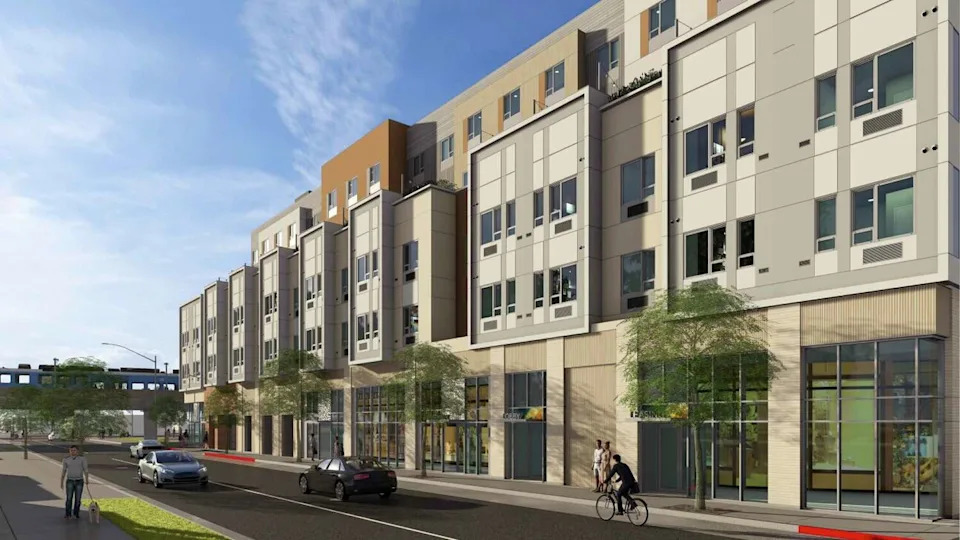
The first phase of Mandela Station, a 240-unit affordable apartment building, is set to break ground in May on BART-owned land at the West Oakland station. (OA Architects/Courtesy of OA Architects)
The 240-unit building is expected to cost $189 million, according to an application filed with the California Debt Limit Allocation Committee – or about $780,000 per unit, not counting the cost of the land. The median cost of building an affordable unit in Alameda County, before the cost of land, was about $798,000 in 2025, according to the Bay Area Council Economic Institute.
Units there will be affordable to people making between 30% and 60% of the area median income – or between $33,600 and $67,140 for a single-person household. The project is slated to open in the second quarter of 2028.
The project will be funded with $7 million in federal low-income housing tax credits. It is also slated to get up to $47 million from bonds issued by the California Municipal Finance Authority, a little-known public agency that acts as a “conduit issuer,” allowing developers to access tax-exempt financing for projects deemed to have a public benefit.
The City of Oakland is also providing $33 million in funding from the 2022 Measure U affordable housing infrastructure bond – one of the largest commitments the city has ever made to a single project. The Oakland Housing Authority is also slated to provide 60 “project-based vouchers” – another source of federal rental subsidies that will help fund dedicated units for the homeless – plus a $5 million loan.
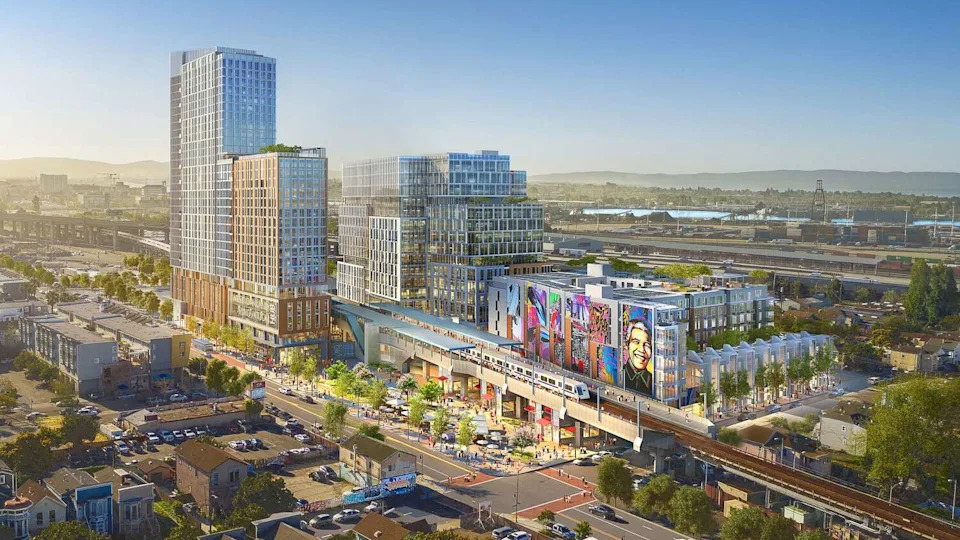
A rendering of the original mixed-used complex planned for the parking lot of the West Oakland BART station. The design has changed slightly, but the first phase, which includes affordable housing in the smaller building to the right. (JRDV Urban International)
The larger master-planned project was entitled in 2020 by SUDA and MacFarlane Partners. Since then, SUDA also brought on other partners for the affordable housing project. The development team for that phase is led by the Pacific Cos., an Idaho-based for-profit affordable housing developer, and Innovative Housing Opportunities Inc., a Santa Ana nonprofit, as well as SUDA.
The development group is set to make around $20 million in fees from the project, according to the project’s application for bond financing from CMFA.
The design has changed somewhat since the project was entitled in 2020. The building will now rise just six stories, instead of seven, with smaller, denser units to keep the total unit count the same. Plans for a “rotating art exhibit wall” have been dropped, though the project will still include a piece of public art on a different location, the developers told Oakland’s Design Review Committee in 2024.
As for the rest of Mandela Station, Dones said that he and MacFarlane Partners hope to break ground on the next phase within the next 24 months.
“The site is seven minutes from the AI capital of the world. We’re in the heart of the Bay Area.” Dones said. “Mandela Station has an important responsibility to maximize what we can do on this site.”
This article originally published at First phase of massive housing project set to break ground at this East Bay BART station.