
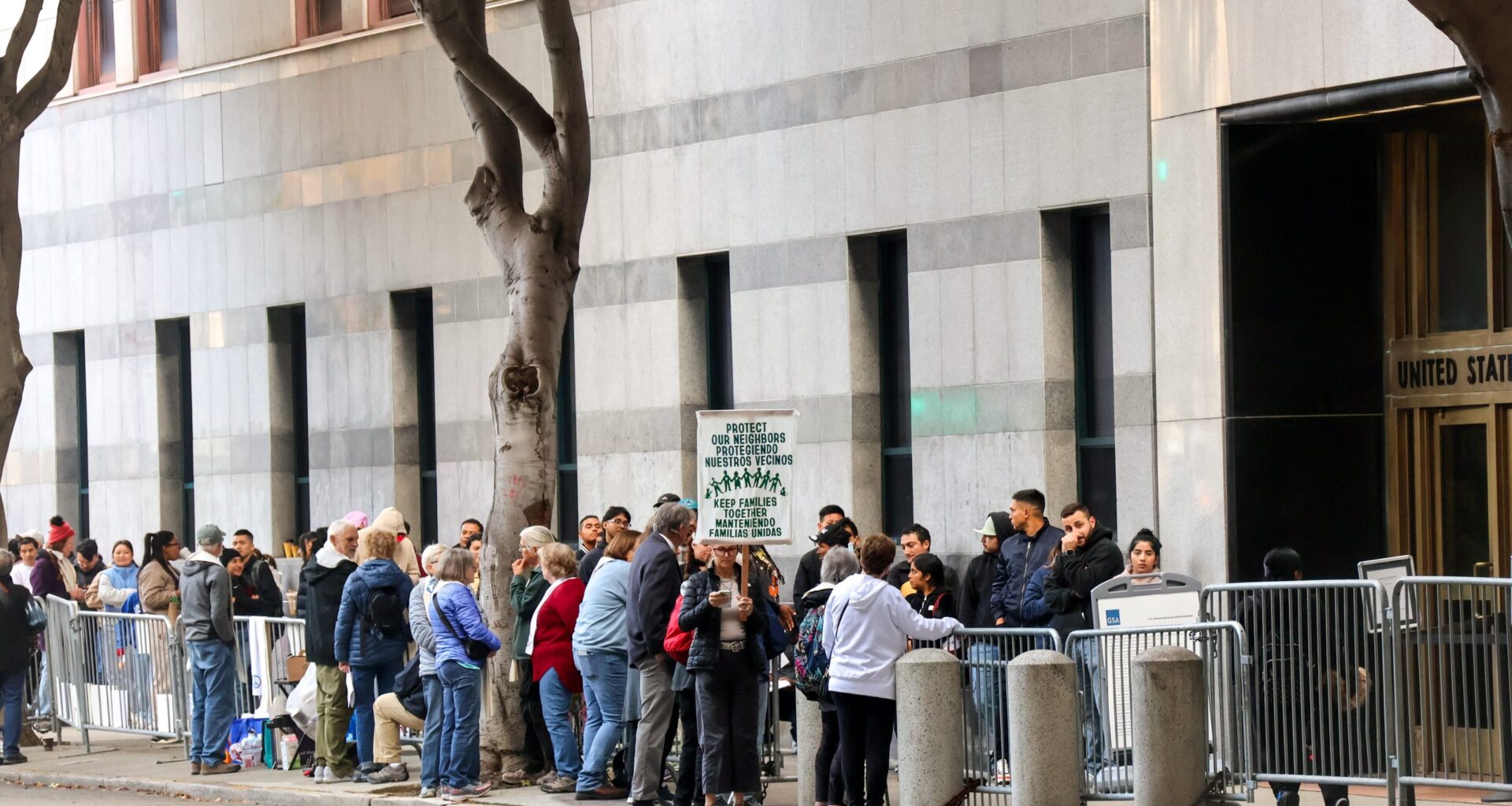
Outside the San Francisco immigration court building at 630 Sansome St., a long line of people carrying manila folders stuffed with documents waited nervously for their check-in appointments last Thursday.
Those waiting outside were in line for their mandatory check-ins with Immigration and Customs Enforcement — appointments that allow federal officials to track the whereabouts and status of those in the immigration system. Inside, a separate group of people wait to appear before a judge and argue their case to stay in the country.
Asylum-seekers often wait years before getting inside for their day in court. But today, those court appearances only put them closer to deportation, with little chance of staying in the country.
“Asylum is essentially over,” said Jesus Ibanez, an immigration attorney representing a client at the Sansome courthouse on Thursday. Instead, Department of Homeland Security attorneys rapidly close out cases, which attorneys say is a way to encourage asylum-seekers to self-deport.
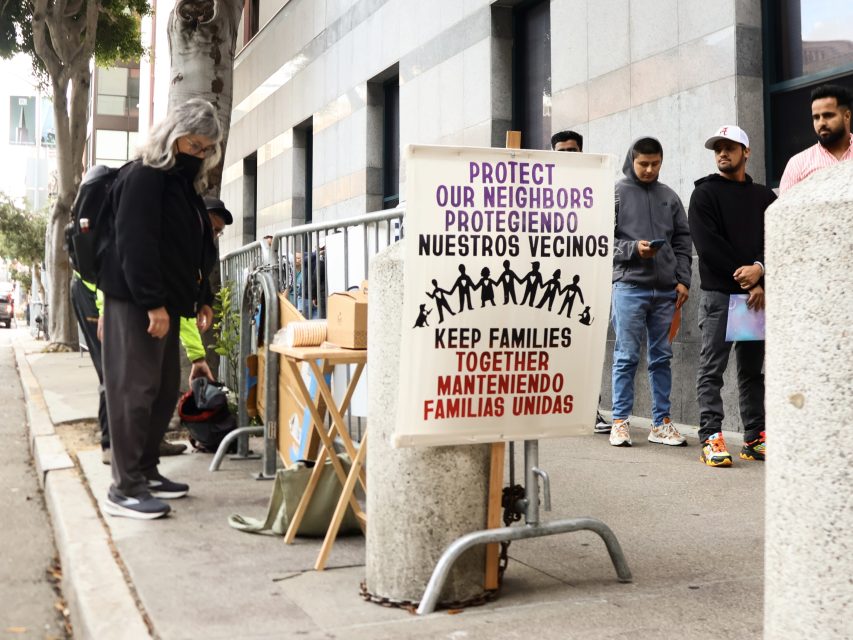 Immigrants stand in line outside of the 630 Sansome St. immigration courthouse and a sign reads, “Protect Our Neighbors, Keep Families Together.” Photo by Sage Rios Mace.
San Francisco’s ever-shrinking court
At the Sansome Street courthouse, a single courtroom handles what are called “master-calendar hearings,” the first step in the process, where judges hear multiple cases at once for scheduling. Those take place on Thursdays and Fridays.
The other three days of the week, the courtrooms are deserted: 17 of the 21 judges assigned to San Francisco’s two immigration courts a year ago have been fired since June 2025, and the court’s capacity to hear cases has drastically decreased.
But last Thursday, Judge Frank A. Seminerio, appointed in 2021, sat on the bench, moving through 33 cases. He now splits his time between the city’s two immigration courts, and later in the day went to the courtrooms at 100 Montgomery St., where he would handle another load of cases.
But in no case is there an actual asylum hearing.
He once heard full cases and made decisions. Nowadays, cases are pushed through a process known as “pretermit” where federal attorneys ask the court to effectively deny an asylum-seeker their hearing, and instead give them the option to go to a third country and seek asylum there. Trump attorneys have been seeking removals to Honduras, Ecuador, Uganda, and other countries even when immigrants have never been there before.
This process “denies asylum seekers a full evidentiary hearing,” explained Jeremiah Johnson, a fired immigration judge who used to work in the city’s courts. Instead, it means immigrants must appear at another hearing to prove they cannot be removed to a safe third country.
There is a high burden for asylum-seekers to show that they cannot safely go to a third country, or sometimes two, if the federal government offers more than one alternative. If the case is denied, the asylum seeker is “ordered removed” and the case is closed.
But these countries limit the number of people they accept to sometimes as low as 240 in a two-year period. Federal attorneys know those countries will not accept the thousands they are seeking to send there. The effect of their motions is, instead, to put asylum-seekers in limbo awaiting court, or push them to self-deport, according to immigration attorneys.
San Francisco has had motions to pretermit in at least 737 different cases when you combine last year and January of this year. There have been over 100 third-country removal orders given in San Francisco immigration court, to Honduras, Ecuador, and Guatemala, according to Joseph Gunther, a researcher who is studying this across the country.
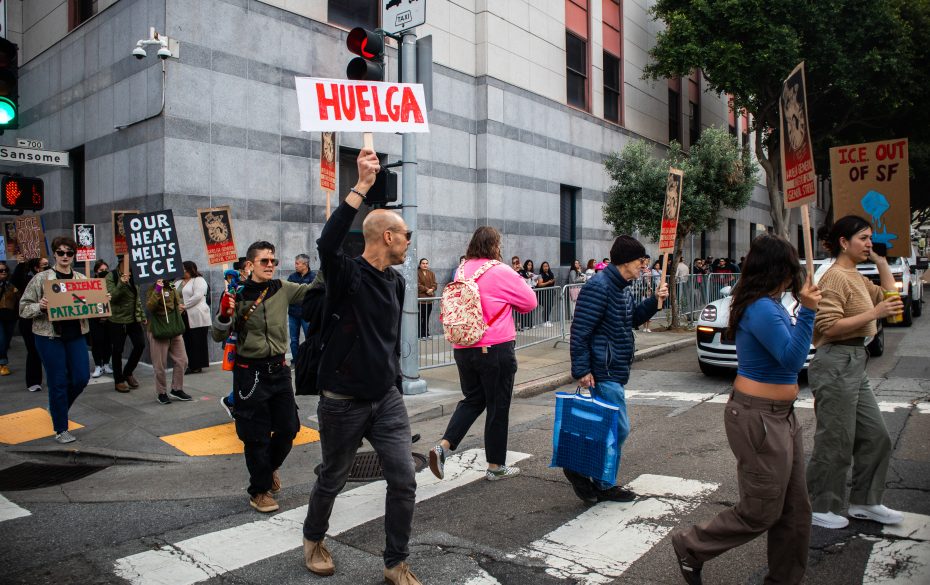 Protesters chant as they walk around the perimeter of 630 Sansome immigration court on Oct. 24, 2025. Asylum-seekers took photos and videos as they waited in line for their immigration hearings. Photo by Mariana Garcia.
Proving persecution in two, sometimes three countries
Last Thursday, three asylum-seekers were brought to the front of the courtroom and given headphones for simultaneous translation. They were not working, but they informed the translator they could hear fine without the headphones.
In each case, a “motion to pretermit” was filed by the Department of Homeland Security, and the department offered immigrants the chance to go to Ecuador or Honduras, where the United States has cooperative agreements.
The respondents, two from Guatemala and the third from Colombia, will now have to show they have suffered persecution not only in their home country, but also in this third country. They were told to send in their evidence a week before their court dates, which were set a few months in the future.
One respondent raised his hand and asked the judge if he could have more time to gather the evidence.
“It is very hard to get ahold of an attorney and how much they charge,” the man, originally from Colombia, said through the court translator. Lawyers are hard to come by, and scammers target desperate immigrants offering fraudulent services.
Seminerio denied the request.
Milli Atkinson, director of the Immigrant Legal Defense Program at the San Francisco Bar Association, is trying to educate clients about “pretermits,” and encouraging them to appeal the eventual order of removal.
“The goal for us is to preserve these issues for appeal,” said Atkinson.
But even filing an appeal to the Board of Immigration Appeals has become more difficult. It is harder to get a fee waiver, and the cost is now around $1,030.
The Board of Immigration Appeals has also announced they may soon curtail the time period for filing an appeal from 30 days down to 10.
One attorney told Mission Local that these changes have made his own practice economically unfeasible because he has to charge his clients exorbitant rates to make any money.
Moreover, the chances of them winning the case are next to zero. He is considering leaving immigration law completely.
“This is just a big clogging up the system for years of people not having any way to move forward on their immigration case,” said Atkinson.
Because of this, many immigrants are making the decision to return to their home country because they do not want to risk being ordered to a third country. Others are sticking it out, and fighting their case.
Mission Local is only using first names of non-citizens to protect their identity.