
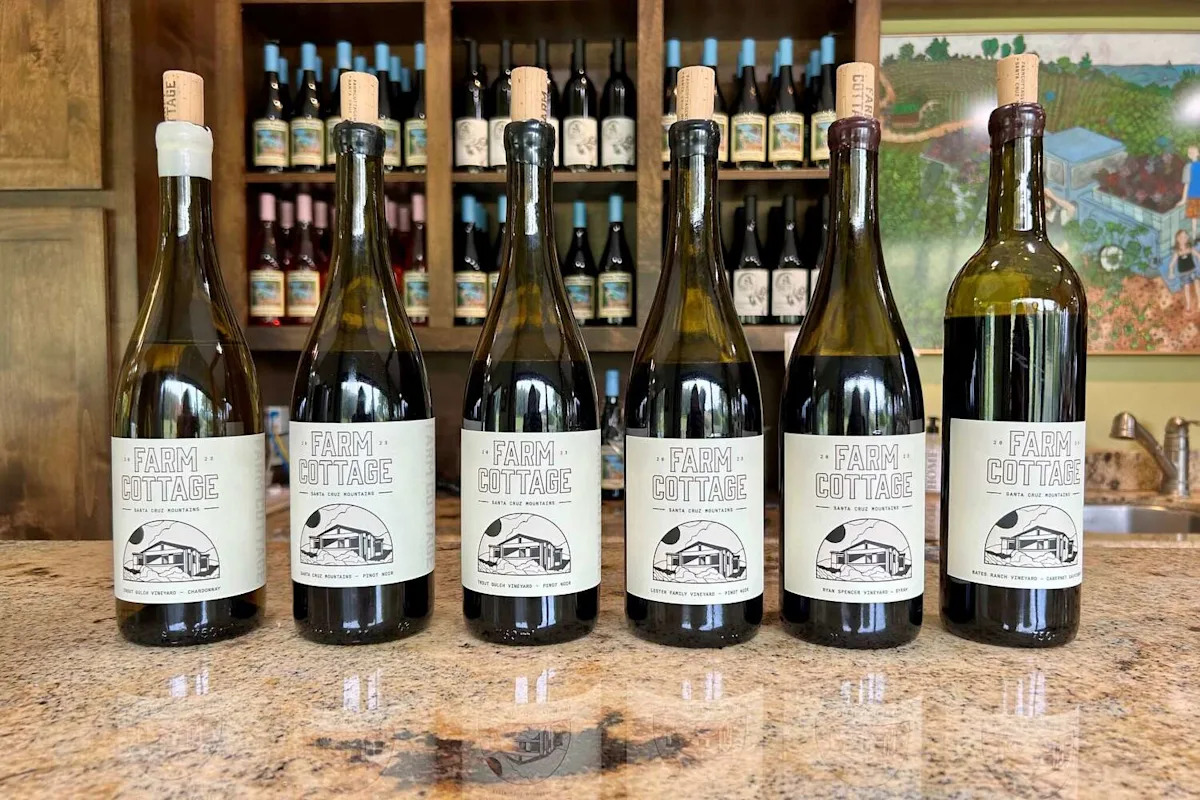
Ryan Alfaro makes wine for two labels: Alfaro Family Vineyards, his family’s nearly 30-year-old Santa Cruz Mountains estate, and Farm Cottage Wines, a small project the winemaker launched on his own in 2019. It might look, from the outside, like Alfaro would have a differentiation problem. The Farm Cottage and Alfaro Family wines are both primarily Santa Cruz Mountains Pinot Noir and Chardonnay, in many cases sourced from the same exact vineyards, and they have the same winemaker – so, how are they different?
The answer, in short: The Farm Cottage wines are whole-cluster.
Widely practiced in France’s Burgundy, Beaujolais and Rhone regions, whole-cluster fermentation occurs when a winemaker chooses not to remove the stems from the grape clusters, but instead include them in the fermentation. The presence of these stems can have several effects: It adds some additional tannin, beyond what you’re getting from the grape’s skins and seeds, imbuing the wine with a grippy, angular texture. Stems can also add flavor – ideally a pleasant spiciness, or, if they’re less ripe, a bitter herbaceousness.
Alfaro first experimented with whole-cluster in 2019. He hadn’t yet taken over as the winemaker for the family winery, but his father had an excess of fruit that year, so he was offered some Pinot Noir from the Trout Gulch Vineyard, one of Alfaro Family’s estate sites, to play around with. “Trout Gulch is so cold and four miles from the ocean, so we have no problem getting bright red fruit,” Alfaro said. “I thought stem inclusion, if done properly, could add a third dimension of texture and savoriness.”
He didn’t think that going full whole-cluster for the Alfaro Family wines would be appropriate; he wasn’t going to mess with the house style. Alfaro Family is one of those wineries with such a strong local following that it barely sends its wines outside of its immediate area, selling just about everything it produces to a devoted wine club and a supportive set of Santa Cruz-area restaurants. “We have a customer base that’s familiar with the style of wine,” he said, “and the customer base is incredible.”
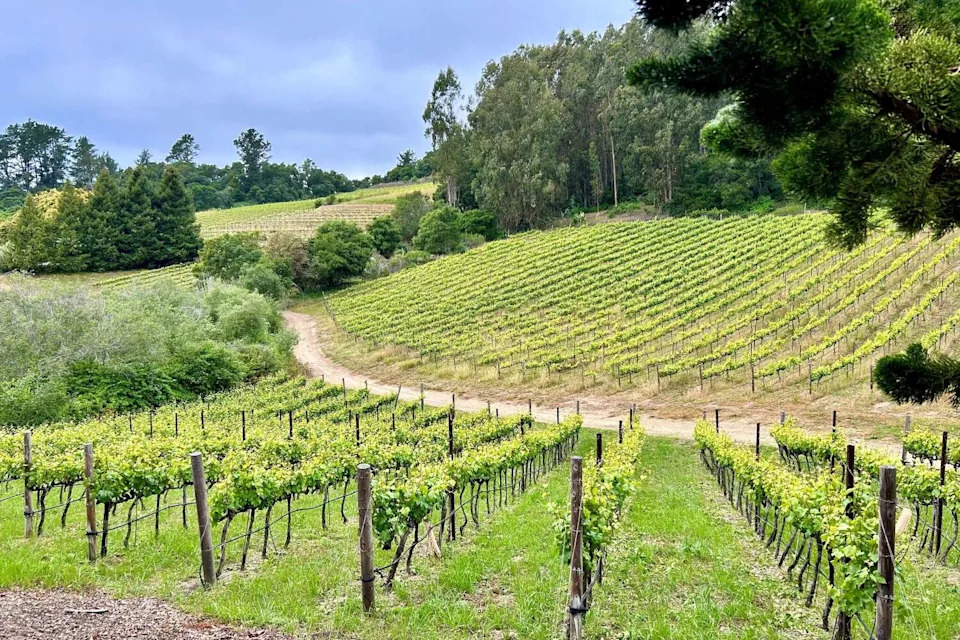
Alfaro Family Vineyards in Corralitos. (Esther Mobley/S.F. Chronicle)
Whole-cluster can be risky, which is why many winemakers avoid it. “If it’s aggressive, it can be overbearing,” Alfaro said, especially when the stems are underripe. “No one wants to drink a wine that tastes like green stems.”
But the results turned out so well – silky, spicy, cherry-forward – that Alfaro’s parents encouraged him to spin off his own label. He named it after the cottage on the Alfaro Family Vineyards property that his grandparents once inhabited, and where he now lives.
Farm Cottage now consists of seven wines, all of them thrilling in their structure and savoriness. The entry-level red wine, the Santa Cruz Mountains Pinot Noir – a blend of several vineyards in the region – smells like stepping into a cool redwood forest. Alfaro prices it at $40 retail, which means it could be a $14 by-the-glass pour at a restaurant; it would be hard, dining out, to find a more exciting California Pinot for that price.
A Syrah from the Ryan Spencer Vineyard, picked late in the season, is all olive and sage, with searing acidity. And Alfaro’s Trout Gulch Vineyard Chardonnay – not whole-cluster, since it’s a white wine and is pressed into juice before its fermentation – is minerally, sharp as a laser and bursting with grapefruit.
One potential downside of stem inclusion is raising the wine’s pH, which can lead to a lower perceptible acidity. That’s partly why Alfaro doesn’t pick his grapes early in the season, even though early picking has been all the rage among progressive-minded California winemakers, aiming to avoid overripe fruit bombs, over the last decade. “I’m focused on getting ripeness in the fruit,” he said. “I make Pinot Noirs ranging from 13-13.5% (alcohol by volume), and some people think 13.5 is high for Pinot Noir nowadays.” Still, despite those riper harvests, none of the Farm Cottage wines taste overblown – these are textural, restrained delicacies.
Also, it turns out, they taste plenty different from the Alfaro Family wines, despite their similarities in sourcing. Where Farm Cottage’s Syrah tastes like olives, Alfaro Family’s is meaty, giving the umami-packed hit of seared beef. Where Farm Cottage’s Trout Gulch Pinot is woodsy, Alfaro Family’s is more straightforwardly fruity.
It’s refreshing to see a California winemaker playing in two different lanes, equally comfortable with distinct styles. “I’m a strong believer that wine doesn’t all need to be made one way,” Alfaro said. “I hope customers and winemakers themselves don’t get too caught up in wine needing to be one specific thing. That’s the beauty of the wine world.”
This article originally published at The technique that makes these new California wines so thrilling.