
Sacramento’s tourism officials, looking to secure the business and attention of conventioneers and site selectors for the country’s largest sporting competitions, often face a challenge: Organizing enough hotel beds for everyone to lay their heads at night.
It was a stumbling block in Sacramento’s pitch, several years ago, to host the NBA All-Star Game. Compared to cities like Indianapolis and Austin, “if you look at just the sheer inventory of what they have, as far as hotels in and near the downtown, we’re very low,” said Scott Ford, deputy director of the Downtown Sacramento Partnership.
A view of the downtown skyline — and the Kimpton Sawyer hotel — graces a tenth-floor king suite at The Exchange Sacramento, a boutique hotel part of the Curio Collection by Hilton, in 2021. According to Visit Sacramento, the city and unincorporated Sacramento County have just over 11,500 hotel rooms. XAVIER MASCAREÑAS Sacramento Bee file
The All-Star Game — which will be played Sunday in Inglewood — is one of hundreds of U.S. gatherings each year that call for more hotel beds than Sacramento can supply, sending thousands of attendees of religious, political, labor and industry meetings to other shores.
Sacramento and unincorporated Sacramento County have just over 11,500 hotel rooms, said Mike Testa, president and CEO of Visit Sacramento, the convention and visitors’ bureau. But organizers typically want to lodge their guests near events, ideally within walking distance, and the number of rooms in the central business district, where the city has its convention center and NBA arena, is just shy of 4,400.
Subtracting motel rooms, which many event organizers exclude categorically, there are 3,125 hotel rooms between the Sacramento River and Alhambra Boulevard, which is too few for many events. The Brewers Association’s annual expo and the American Gastroenterological Association’s “Digestive Disease Week” — sited this year in Philadelphia and Chicago — need, for instance, 5,000 and 10,000 hotel rooms, respectively, on the most highly-attended days.
Such business would stand to benefit the city, officials say, in sales and bed tax revenues and in visibility.
Despite the challenges, Sacramento has still hosted high-profile events in recent years, such as the Aftershock festival — which feeds hotels from Davis to Lincoln, and drew a record 164,000 people last year — and the Terra Madre food festival, which packed around 160,000 people into the central city in September. The city will host two rounds of women’s NCAA March Madness next month — the Sweet Sixteen and Elite Eight — the highest rounds of the competition ever held in Sacramento.
But additional hotel capacity, local officials said, would open up new possibilities. It would allow the Terra Madre festival to grow, for instance. And it would give Sacramento a shot at hosting even larger sporting events.
“The further you get into tournaments or the larger the profile of the event goes, the more traveling fan base and media come in,” Ford said. “It is a significant economic boost.”
Nationally, experts said, high construction costs, interest rates and a pandemic have dampened hotel development. Still, Sacramento has several proposed projects in the works, including a five-star, luxury hotel steps from the Downtown Commons.
The future Hotel Eleanor, developer Roger Hume’s newest project, stands in June at 7th and J streets just steps from the Downtown Commons. It will occupy the Capital National Bank Building, which dates to 1915. HECTOR AMEZCUA Sacramento Bee file
In the meantime, local leaders have proven amenable to creativity. This year’s AfterShock festival will introduce camping at Cal Expo. And Sacramento’s past pitches to host the All-Star Game have contemplated docking cruise ships at the local port, reserving up to 1,000 homes and apartments through Airbnb, and lodging some guests in the Napa Valley, with dedicated freeway lanes to ferry them to and fro.
But downtown hotels hit capacity multiple times each year during major events, said one longtime hotelier.
“Sacramento is ready for the next hotel,” said Jeroen Gerrese, the general manager of the Sheraton Grand at 12th and J Streets.
Rather than viewing prospective new players as competition, Gerrese said the additional capacity would allow for larger events, which would benefit existing hotels like his — a rising tide that lifts all boats.
“I would welcome it,” he said. “I wish the hotel was built already.”
Costs and competition
In the downtown area, hotel rooms were 70% occupied in 2025 — a level typically seen as an indicator that a market needs more hotel rooms, Testa said, though the rate is down from 77% in 2018.
The city may see an additional 95 beds as early as summer 2027, six blocks west of the Sheraton. Roger Hume, a local developer, submitted plans in December for a hotel at 7th and J Streets, in a former bank building.
Hotel Eleanor, Hume said, will be something that “just doesn’t exist in the market, currently.” It will have a grand ballroom, and the lobby will become a bar and restaurant with a nightly pianist. It will have a spa with a steam room, a sauna and a cold plunge. The former bank’s largest remaining vault will become a private dining speakeasy which guests will enter in the alley through a “banged-up door that hasn’t been painted in 40 years,” and respond to specific prompts before the vault door opens.
“You haven’t seen anything like it, I can assure you,” Hume said.
Developer Roger Hume stands inside the former Capital National Bank Building in downtown Sacramento in June. He plans to spend $30 million to convert it into a hotel. HECTOR AMEZCUA Sacramento Bee file
Hume said he was encouraged by the success of his previous project, converting the former Eastern Star temple at 27th and K streets into the 128-room Hyatt House. Since it opened in early 2023, occupancy has been “tremendous.”
“That’s why I was so encouraged to build another one,” said Hume.
Still, other projects haven’t come to fruition as quickly.
Up until 2019, U.S. hotels were performing better each year, said Michael Stathokostopoulos, senior director of hospitality analytics for CoStar.
After the onset of the pandemic, as construction costs and interest rates rose, development became more expensive. The income from operating hotels often didn’t justify the building costs. At the same time, business travel has been slow to recover, and leisure travelers — especially on the lower end of the income scale — have grown increasingly interested in short-term rentals, Stathokostopoulos said. A majority of people planning vacations now check both short-term rentals and hotels and compare costs.
Luxury hotels like Hume’s proposed project have fared better, Stathokostopoulos said. They compete less with short-term rentals, and the clientele are less price-sensitive. But generally, many projects are lingering in the pre-construction phase as developers rally financing.
Guests cross the historic lobby of the Hyatt House hotel in midtown Sacramento on Wednesday. The conversion of the Eastern Star temple, built as the meeting place of a Masonic women’s organization in the 1920s, added 148 rooms to the city’s hotel room inventory in 2023. NATHANIEL LEVINE nlevine@sacbee.com
“The number of hotels that are getting built, and especially the bigger ones — the ones that really move the needle in terms of inventory — you saw fewer and fewer,” he said.
Hume said he was able to control project costs and schedules more effectively with the Hyatt House hotel, because his firm acted as the general contractor. And he credited city officials for championing the project.
But he acknowledged the challenging environment.
“Not all projects work,” Hume said. “You may have a vision for something, and it just doesn’t pencil.”
California State Parks’ John Fraser stands in 2023 at the proposed site of a new hotel in Old Sacramento State Park. The building would be designed to blend in with other Gold Rush-era historic structures, he said. PAUL KITAGAKI JR. Sacramento Bee file
In Old Sacramento, officials plan to issue a request for proposals this year for a developer and operator for a boutique hotel with 140 to 170 beds on a 1.5-acre parcel owned by California State Parks.
Once a developer is selected, the project may be completed within three to four years, said John Fraser, Capital District Superintendent for the agency.
The agency recently redid its cost estimates for the project, both because it had reached some conclusions about what the hotel would look like — and therefore what the materials would cost — and because costs and interest rates rose since the finances were first studied in 2019.
Where Sacramento’s hotel rooms areThis interactive map shows the locations of the 3,125 hotel rooms in Sacramento’s central business district, which stretches from the riverfront to Alhambra Boulevard. Each bubble is sized relative to the number of rooms at the 16 hotels, a number which ranges from 16 to 505. Touch or mouse over a bubble to see the hotel’s name, address and number of rooms. 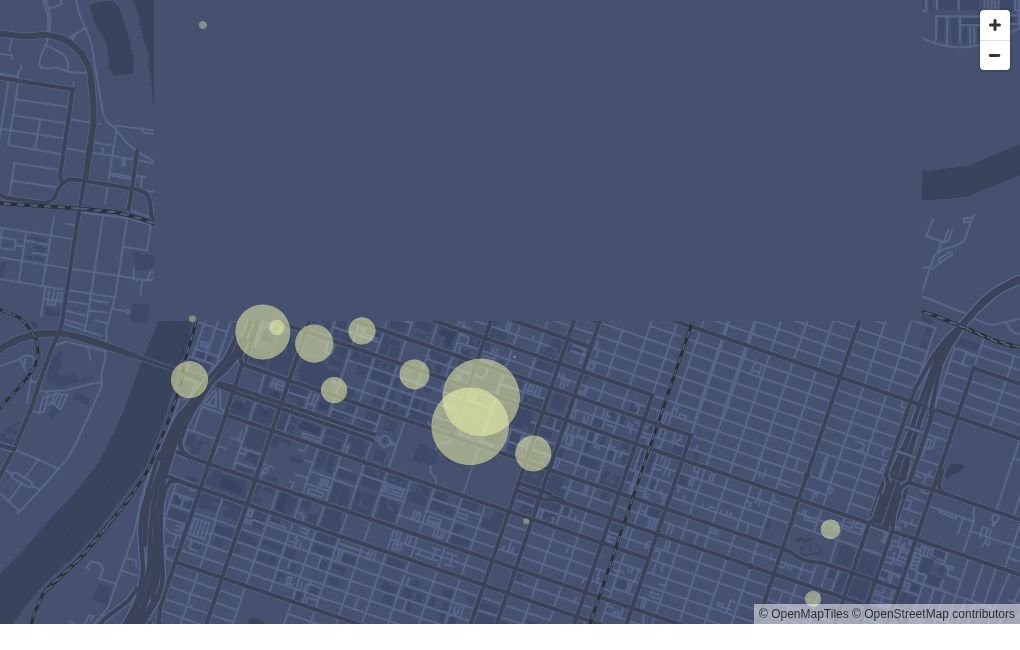 Source: Visit Sacramento. Map: NATHANIEL LEVINE Growing beyond government
The NBA looks at a variety of criteria for All-Star Game sites, such as local infrastructure, fan support and world-class arenas. But generally the league aims for hotel capacity of 7,250 rooms, with five-star options.
For now, Sacramento remains “a ways off” from that benchmark, Testa said.
The league is evaluating bids for the 2028, 2029 and 2030 games, and will make selections later this year, according to an NBA spokesperson.
But, Testa added, the city has a good shot at hosting the women’s Final Four, and more hotels will come to fruition as the economy improves.
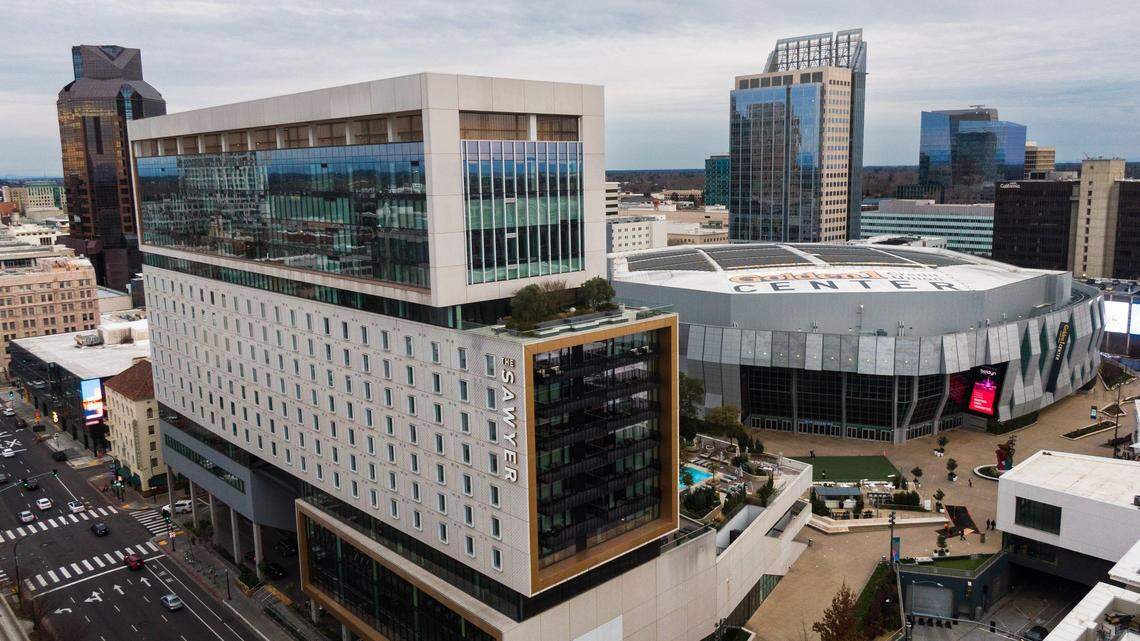
The Kimpton Sawyer Hotel stands next to Golden 1 Center, home of the Sacramento Kings, in downtown earlier this month. NATHANIEL LEVINE nlevine@sacbee.com
The city has a half-dozen big projects expected in the coming years that will demand hotel space, like Sacramento Republic FC’s planned stadium in the Railyards, said Councilmember Phil Pluckebaum, whose district includes downtown and midtown. Not to mention, officials have spent the past year or so contemplating the region’s odds at leveraging the Athletics’ temporary stint here into a permanent Major League Baseball presence.
The city has worked to streamline permitting, said Leslie Fritzsche, Sacramento’s economic investment manager. Though direct investment from the city is unlikely, given the budget environment, staff consider other methods of investing the revenues that are generated by hotel projects themselves, like bed tax and property tax.
Plus, Fritzsche said, occupancy rates are high and daily per-room revenues are rising.
“I think both of those factors show that we have a market from our hotels,” Fritzsche said. “If some of the financing is able to soften a bit to make them occur.”
The city’s hotel tax collections have risen steadily over the past three years, to $39.8 million in the first 11 months of 2025, compared to $30.4 million in the same period in 2022, according to Visit Sacramento.
The dining room at the Hyatt Centric Downtown Sacramento in 2021, the year the building reopened as a hotel. It first opened in 1911 as the upscale Hotel Clayton. PAUL KITAGAKI JR. Sacramento Bee file
National news outlets and leisure travelers are taking notice of Sacramento, said Gerrese, the downtown Sheraton manager. Visit Sacramento has done a good job of maintaining local hotels’ business from associations, while diversifying the city’s draws.
“People come here and they think: ‘It’s the capital, it’s a government city,’ etc., etc. And it really isn’t anymore,” Gerrese said. “I mean, it’s still there, of course… but there is this whole transition with farm-to-fork, with the outdoor events.”
Associations and business groups, he continued, will always be the Sheraton’s baseline. But the city is becoming more and more of a tourism destination.
“That’s why that other hotel — whatever it is and wherever the location might be — is needed,” Gerrese said.
Related Stories from Sacramento Bee

The Sacramento Bee
Annika Merrilees is a business reporter for The Sacramento Bee. She previously spent five years covering business and health care for the St. Louis Post-Dispatch.