
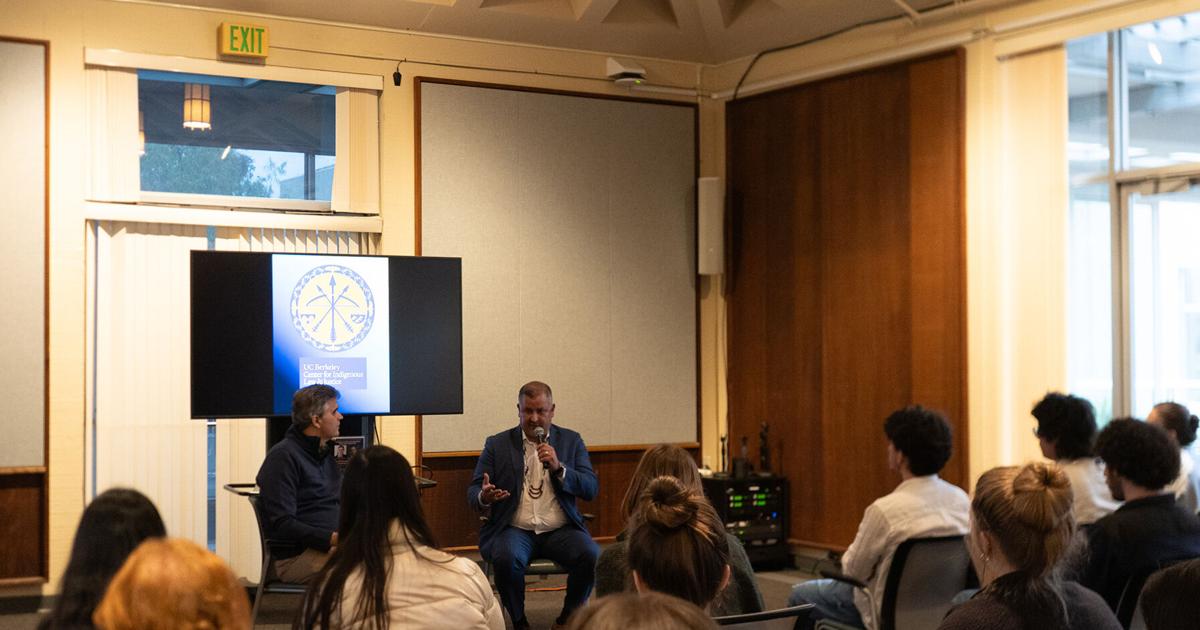
Artwork hangs in the Center for Indigenous Law and Justice at the UC Berkeley School of Law. Its artist, Judge Victorio L. Shaw, is the longest-tenured member on the board of trustees of California Indian Legal Services and chief judge of the Shingle Springs Tribal Court.
Shaw, a member of the Hoopa Valley Tribe, joined UC Berkeley law professor Seth Davison Feb. 10 to discuss the tribal court systems and their intersections with state and federal courts. Shingle Springs Tribal Court, which is located in El Dorado County, is one of the only joint-jurisdiction courts in the nation, and the first in California.
“It’s great as someone who went through law school, but also as an artist, and I get to be creative in my role as a tribal court judge,” Shaw said. “It really is about the spirit of the law. ‘What are we all here for?’ We’re here to help this person, just like we would come together in a village to help a sick person or somebody who’s struggling.”
Taking on a wellness approach with teams of counselors, medical professionals and law enforcement, Shaw depicts the nature of the court as a place of helping, describing himself as a “healer” before a lawyer.
Shaw highlighted the Tribal Court’s work with juvenile cases, particularly with struggling students.The court works to create a positive environment for children and assist families. If a child needs to go to school, the tribe will take them, Shaw said.
“We haven’t failed to graduate any of our tribal children who’ve gone through that program,” Shaw said.
Shaw describes the “non-native attorneys” working for the Shingle Springs Tribal Court as humble and open-minded workers, not coming to the tribe as a “savior.”
In his professional career, Shaw describes the offers he had received from firms and realizing many of them wanted him to be their “token Indian.”From there, Shaw describes how he went out on his own and began taking family law cases.
“If your goal is justice, and you’re a very idealistic person, you’re going to have to be creative, and you’re going to have to look for little pockets of justice that you can find … but you’re going to have a lot of hard days,” Shaw said. “But that’s okay, because we need idealistic people who are lawyers. And you just have to realize you’re going to have to look outside of the box a little bit.”
Indeed, Shaw claims that the law primarily keeps order in society and that, when justice happens, it’s more of a “coincidence” than the intention of the law.
Shaw said the structure of the law didn’t always work for him, or for Indigenous people, who he said face constant attacks on their sovereignty.
“As a native person, we are spiritual people, and so when I say the spirit of the law, I really mean the Great Spirit … ‘What are the feelings, the unseen, unspoken things that I can draw from to put into this person and this case, to really get them to make better decisions?’” Shaw said. “When I have the robe on, I embody the spirit of the chief judge, and I draw upon the spirit of the Creator.”