
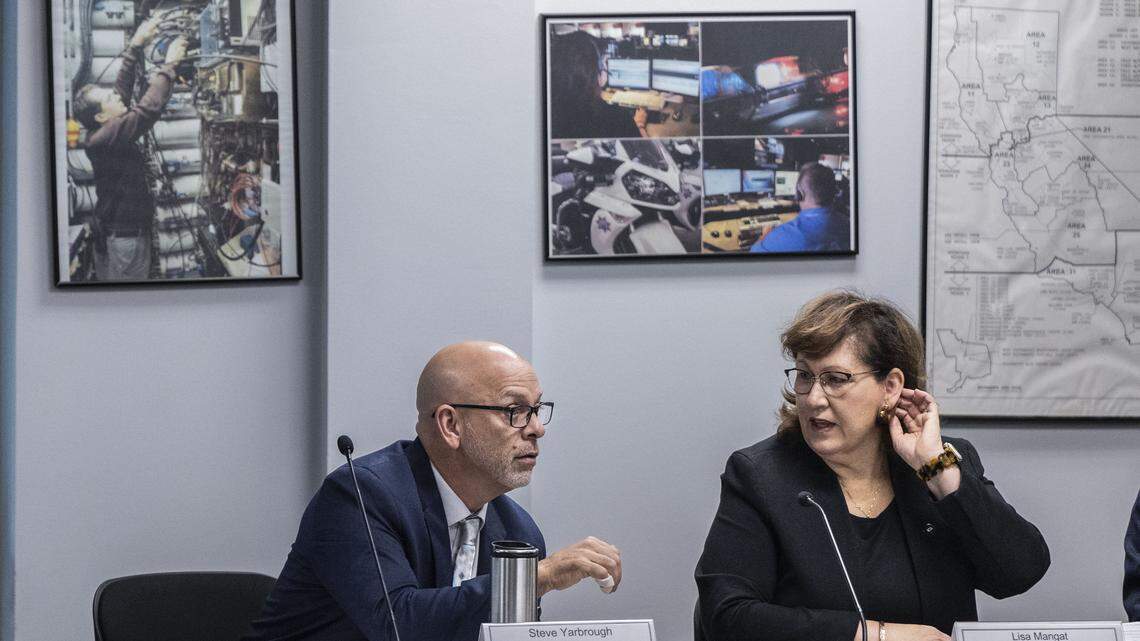
Steven Yarbrough, chair of the State 911 Advisory board, speaks with Cal OES Chief Deputy Director of Policy and Administration Lisa Mangat during a board meeting on Wednesday, Nov. 19, 2025 in Sacramento.
HECTOR AMEZCUA
hamezcua@sacbee.com
California’s effort to modernize its antiquated 911 system, which has been hampered by delays in recent years, has attracted the attention of the Federal Communications Commission.
In a Tuesday letter addressed to Gov. Gavin Newsom, FCC Chairman Brendan Carr said California had wasted hundreds of millions of public dollars to build out its Next Generation 911 system, which state leaders decided to redesign after facing obstacles that they deemed too difficult to surmount.
Carr demanded information about California’s spending on Next Generation 911 and why the project had faced delays seven years after Newsom pledged in 2019 to update the state’s legacy system.
Carr cited reporting from The Sacramento Bee that found the state previously spent over $450 million to build out a new 911 system over several years, but the Governor’s Office of Emergency Services decided in 2024 to scrap the project’s design after encountering call-routing and reliability issues.
“These failures are the direct result of your mismanagement of peoples’ hard-earned money,” Carr wrote to Newsom. “I share the serious and growing concerns regarding California’s wasteful spending, especially of federal funds, which were given to California with a clear public safety purpose.”
Carr noted that the federal government gave California $11 million in 2019 to support the development of modern 911 systems.
“Californians deserve facts, not partisan talking points dressed up as regulatory correspondence. The state’s Next Generation 911 buildout has been funded overwhelmingly by a small, dedicated fee on phone users in California, not by the federal government. Californians have paid for a stronger 911 system, and that’s exactly what we’re building,” Cal OES spokesperson Matt Notley said in a statement.
Shortly after Newsom became governor, he pledged to retire California’s legacy 911 infrastructure in favor of a more modern system that could better locate callers seeking emergency services and allow people to communicate using text messaging and video calls. Cal OES hired several contractors to build out a regional system that contained back-up measures to ensure people could always reach 911 dispatchers, even if one provider went down.
When Cal OES started rolling out the new system in 2024 issues arose. Dispatchers in the Tuolumne County Sheriff’s Office said that calls were lost and misrouted after the Next Generation 911 system was activated.
The state paused the roll-out of the new system and the following year Cal OES informed several of the vendors that it planned to adopt a new statewide design and eventually end their contracts with the state. Vendors have maintained that the state can maintain the current system and that scrapping the current design could cost California hundreds of millions more. Cal OES officials have argued that the redesign in a necessary to ensure the long-term emergency communication needs of Californians.
Carr demanded that the Newsom administration provide an accounting of “all NG911 and 911-related funds received and expended by the State of California,” by March 2. The FCC chair also asked the state to provide an explanation as to why deadlines were missed and a future timeline for Next Generation 911 deployment.
The FCC chair suggested that the challenges facing the Next Generation 911 system were part of a broader pattern of misspent funds by Newsom, who is frequently the subject of criticism from Trump and his allies. Carr cited California’s high-speed rail as another example of a state project that was plagued by delays and cost overruns.
The FCC is a federal agency that regulates communication systems such as television, internet and Wi-Fi in the United States. When Trump tapped Carr to lead the FCC in November 2024, he called the chairman a “warrior for Free Speech.”
But nearly a year after that, Carr came under criticism that he was curbing freedoms of expression after he attempted to pressure broadcasters to suspend the late-night show host Jimmy Kimmel over his comments related to the killing of Trump ally Charlie Kirk.
The letter comes as the Trump administration has turned its attention to the issue of fraud, with a particular focus on wasteful spending in Democrat-led states.
In January, the Trump administration cited fraud concerns when it attempted to withhold funding for child care and family assistance programs in five states, including California. Later that month, the Associated Press reported that a federal judge ruled the federal government must keep those funds flowing for now.
This story was originally published February 10, 2026 at 3:38 PM.
Related Stories from Sacramento Bee
The Sacramento Bee
William Melhado is the State Worker reporter for The Sacramento Bee’s Capitol Bureau. Previously, he reported from Texas and New Mexico. Before that, he taught high school chemistry in New York and Tanzania.