
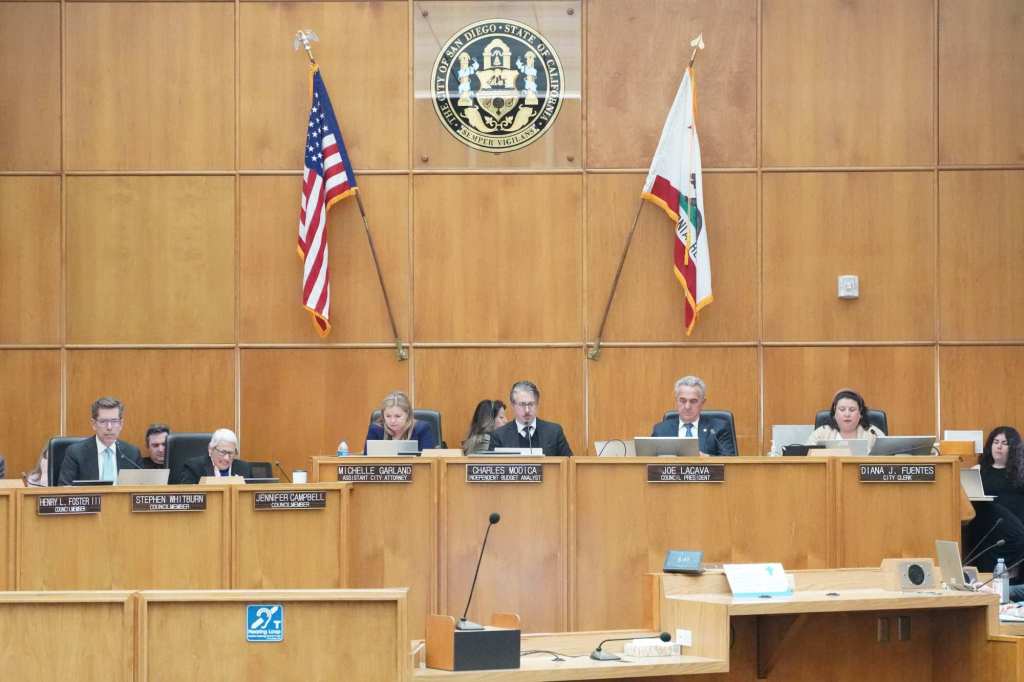
San Diegans are already paying more through new city-imposed fees and repeated revenue measures, yet residents are told that additional charges and service cuts are unavoidable due to a “decades-old structural budget deficit” plaguing our city.
San Diego’s deficit is neither mysterious nor unavoidable. It is the foreseeable fiscal consequence of deliberate governance choices. City leaders are now scrambling for new revenue to fill a budget hole widened by their own pay policies.
The city’s own actuary, Gene Kalwarski, recently warned that “doling out pay raises larger than expected has become a recurring theme and a recurring problem for the pension system’s long-term finances,” driven by “extra salary increases above and beyond assumptions during many of the past seven years.” Pension costs are salary-driven: when pay rises faster than projected, long-term liabilities increase automatically.
In December 2023, the Independent Budget Analyst flagged this trajectory in its review of the Mayor’s FY 2025–2029 Five-Year Financial Outlook. The IBA reported that the largest projected general fund cost increases are compensation and defined-benefit pension payments. These personnel-related costs were the primary drivers of projected general fund deficits forecast to approach or exceed $200 million annually. The IBA warned the city that it “must either seek a major new revenue source in the immediate future” or impose cuts and spending restraints.
City Hall’s response has been clear. Rather than confronting expenditure priorities, it has repeatedly turned to residents as the revenue source: the trash-fee con job, haphazard parking fees at Balboa Park, treating parking tickets as revenue, a proposed vacation-rental tax and a “citizens’ measure” sales tax increase backed by a $4 million campaign. Each extracts more from households while leaving embedded cost obligations untouched.
The city has prioritized compensation growth, allowing a structural deficit to persist. This reflects governance failure, not a revenue problem. Addressing this failure should begin with repealing or reforming a misguided law that provides the very city leaders responsible for the broken budget with regular and generous raises.
Measure L, approved by voters in November 2018, was promoted as a more ethical way to set elected officials’ salaries. Previously, compensation was set through a public ordinance adopted by the City Council, informed by an independent Salary Setting Commission. Effective December 2020, Measure L replaced that process with a formula tying the salaries of the mayor, City Council members and the city attorney to those of California Superior Court judges, with adjustments calculated by the city’s chief financial officer.
Those automatic increases are disconnected from city finances, service levels or performance. Judges do not negotiate labor contracts, expand departments or manage municipal deficits. City politicians do. Measure L treats the roles as interchangeable.
Since 2020, Mayor Todd Gloria’s compensation has risen to $244,727, roughly a 140% increase from the final annual salary earned by predecessor Kevin Faulconer. His retirement and health benefits rose from $23,899 to $92,507, a 287% increase. As of July 1, 2024, City Council salaries reached $183,545, nearly double 2019 levels. Collective retirement and health contributions for the council increased from roughly $202,000 in 2019 to more than $601,000 annually, according to publicpay.ca.gov, placing permanent strain on an already maxed-out general fund.
Charter Section 11.1 requires the City Council to consider residents’ needs, ability to pay and local economic conditions when setting employee compensation; those requirements do not apply to elected officials. Ordinance O-2025-110 authorizes elected officials to voluntarily reduce their salaries; no such reductions have been documented.
Rolling back parking fees is labeled “erratic decision-making,” while embedding automatic pay escalators into the budget during a structural deficit somehow qualifies as fiscal discipline.
The irony is hard to ignore. San Diegans are paying top dollar for elected officials while being told the city cannot afford libraries, infrastructure or basic neighborhood services.
Reforming Measure L will not, by itself, solve San Diego’s budget crisis. But it would restore something essential: accountability. Automatic pay escalators for elected officials during a structural deficit are indefensible. No elected official can justify near-doubling compensation while presiding over service erosion, charter disregard and the city’s worst fiscal outlook in decades.
That is bad governance. San Diegans deserve better.
Johnston, a registered nurse, resides in North Park.