
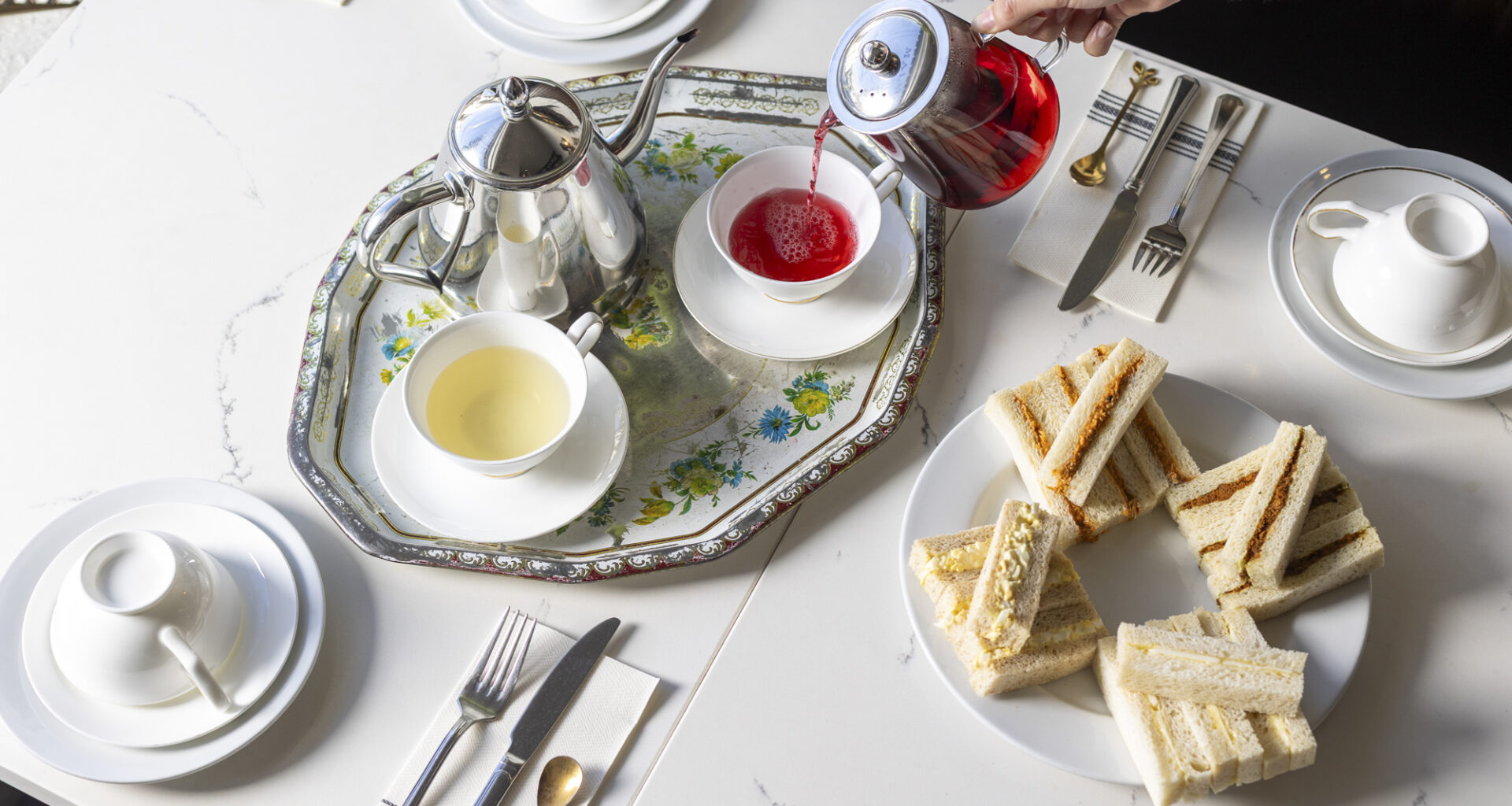
“It was such an intimate, beautiful experience,” she says.
Back then, in the ’80s and ’90s, most of the upscale hotel afternoon tea places in Malaysia still served food that was overwhelmingly British. At most, Lim recalls, maybe one item — say, a curry puff — would nod toward the local food culture. Because afternoon tea at the big hotels was “fancy” and expensive, Lim says even locals wanted the food to be authentically British. Why would anyone pay so much to eat a Malaysian snack they could buy down the street for just a few ringgits?
Lim estimates it’s only in the last 10 years or so that even the fanciest British-style tea rooms in Malaysia and Singapore have started leaning more into local flavors, adding sambals and curries and kuehs (assorted bite-size treats made with glutinous rice) into the mix with the scones and cucumber sandwiches that people still expect.
When Lim opened Malaya Tea Room in 2019, on a quiet stretch of Central Avenue in Alameda, she wanted it to be more of a hybrid. At the time, she didn’t know of any other businesses that were throwing Asian–inspired afternoon tea parties. Beloved local institutions like Lovejoy’s more or less replicate the British traditions.
Lim wanted to do both. She planned to do the British stuff just as well as, or maybe even better than, the purely Anglophilic places — to, for instance, be one of the only places that make their clotted cream from scratch. But she also wanted to introduce customers to elegant, afternoon tea versions of some of her favorite Malaysian street snacks — in other words, to serve food that actually tastes good. (She’d grown to find the British standards to be quite bland and boring.) Her menu included one finger sandwich that’s based on kaya toast, another that combines pork floss with a homemade basil spread, and yet another that features bakkwa (Malaysian pork jerky).
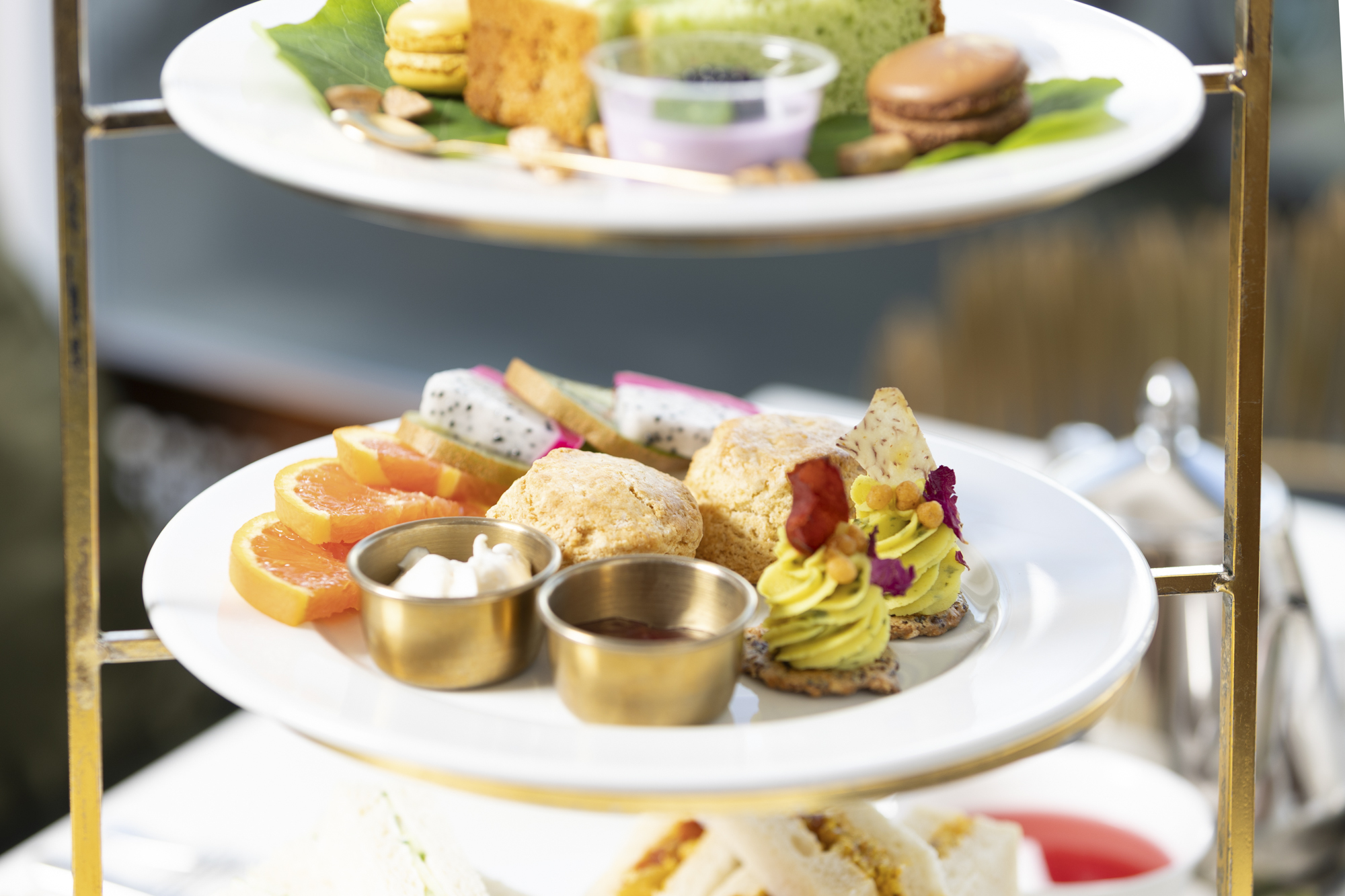 British-style scones with clotted cream and strawberry jam sit alongside curried potato canapés on gluten-free crackers during afternoon tea at Malaya Tea Room in Alameda on Feb. 6, 2026. (Gustavo Hernandez/KQED)
When my family arrived at Malaya on a recent Sunday, the atmosphere inside the cozy tea room was languid and vaguely tropical — lush greenery sprawled in every direction; a ceiling fan spun lazily up above. Nostalgic knickknacks (antique Chinese vases, an abacus, an old Hup Seng cracker tin) decorated the display cabinets. On the table was a little bell to ring when you were ready for your server to come take your order.
The sandwiches we loved best included the curry chicken, made with coconut milk and a secret spice blend, and a sardine-and-cucumber number that Lim makes by doctoring the canned sardines in tomato sauce that you can buy at Asian grocers. On the sweets side, we enjoyed an airy-light pandan chiffon cake that wasn’t too sweet — the ultimate compliment for an Asian dessert.
Even the egg salad sandwich, which we ordered off the British side of the menu, was uncommonly good — lush with Kewpie mayonnaise and served on fluffy milk bread. It tasted exactly like the ones you get at 7-Eleven in Japan.
Lim says that’s exactly what she was going for: a familiar flavor that reminds you of childhood.
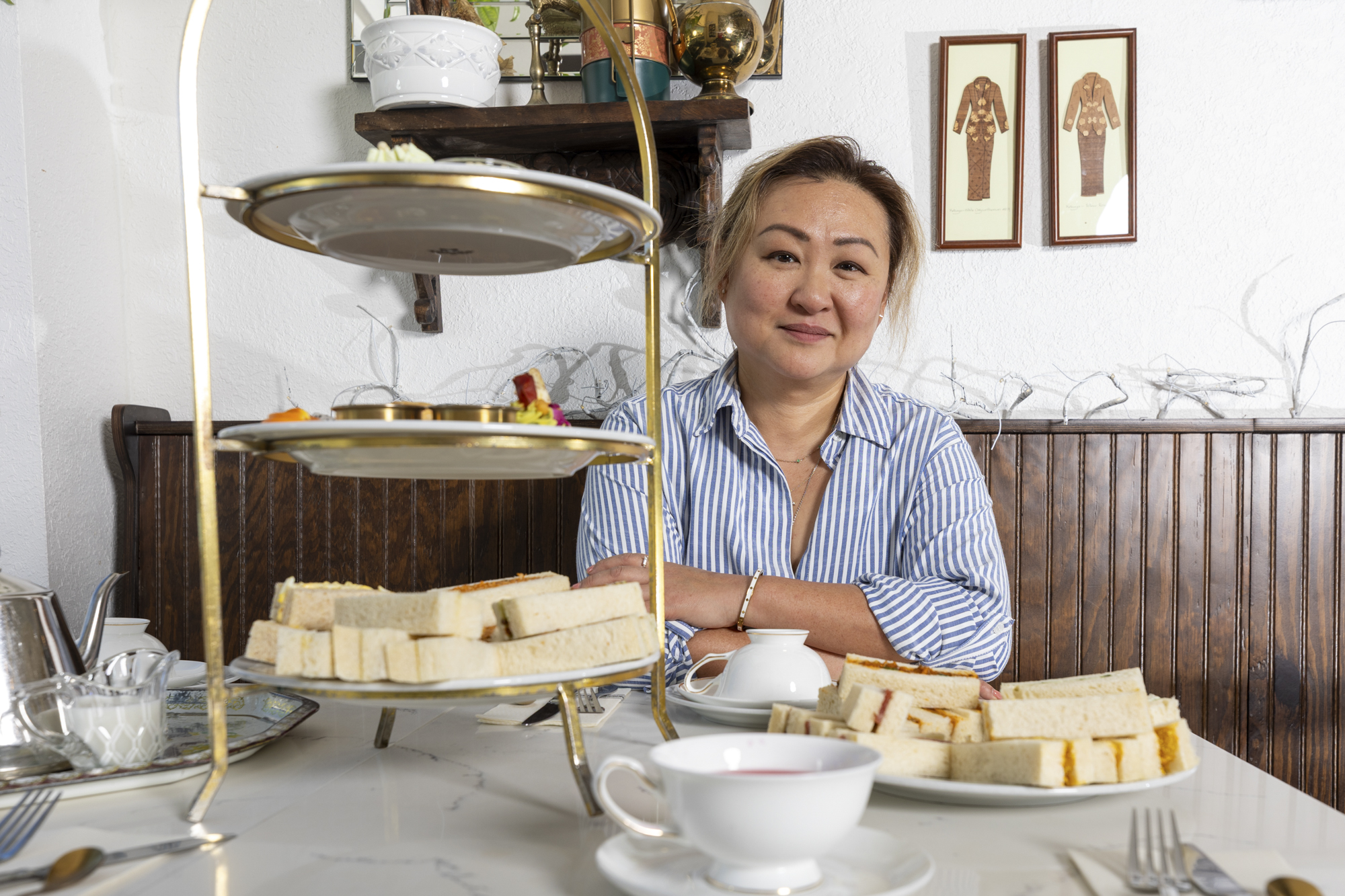 Leena Lim, owner of Malaya Tea Room, sits behind a table set for afternoon tea. The tea room opened in Alameda in 2019 and has become a destination for specialty tea service in the East Bay. (Gustavo Hernandez/KQED)
Her business has had its ups and downs over the past seven years, especially with the pandemic hitting just months after it opened. But she’s developed a loyal customer base, and people do seem to better understand Malaya’s afternoon tea offerings now than they did in the shop’s early days. Part of that, she says, just has to do with how much more popular Asian food is these days — how there’s now a cultural cachet to being the sort of person who understands pandan and ube: “Otherwise, it’s like who are you? Do you even live here?”
It helps that afternoon tea is the ultimate Instagram-friendly meal. Plus, Lim says, “people love dressing up,” and going out for tea provides a rare opportunity to do that. Every year, she has a big group that comes in cosplaying as anime characters.
During our visit, we spotted a group of three elderly women enjoying a quiet conversation, a table of Gen Z Taiwanese ladies chattering happily in Mandarin, and a group of white otaku having an intense debate about Dragon Ball Z.
“Now I even get groups of men who come in by themselves,” Lim says. “I think that’s awesome.”
Tea with a twist
The bakeries and cafes that offer Asian-style afternoon tea in the Bay Area all have their own charm — and their own little twists on the genre.
Little Moon Bakehouse owner Annie Wang says her pop-ups are a natural extension of the fact that she started baking bread for the first time in 2024, adding a variety of Chinese bakery–style buns to her repertoire of plant-based cookies and mooncakes. Unlike Wang’s other baked goods, the breads don’t have long enough of a shelf life to ship nationally.
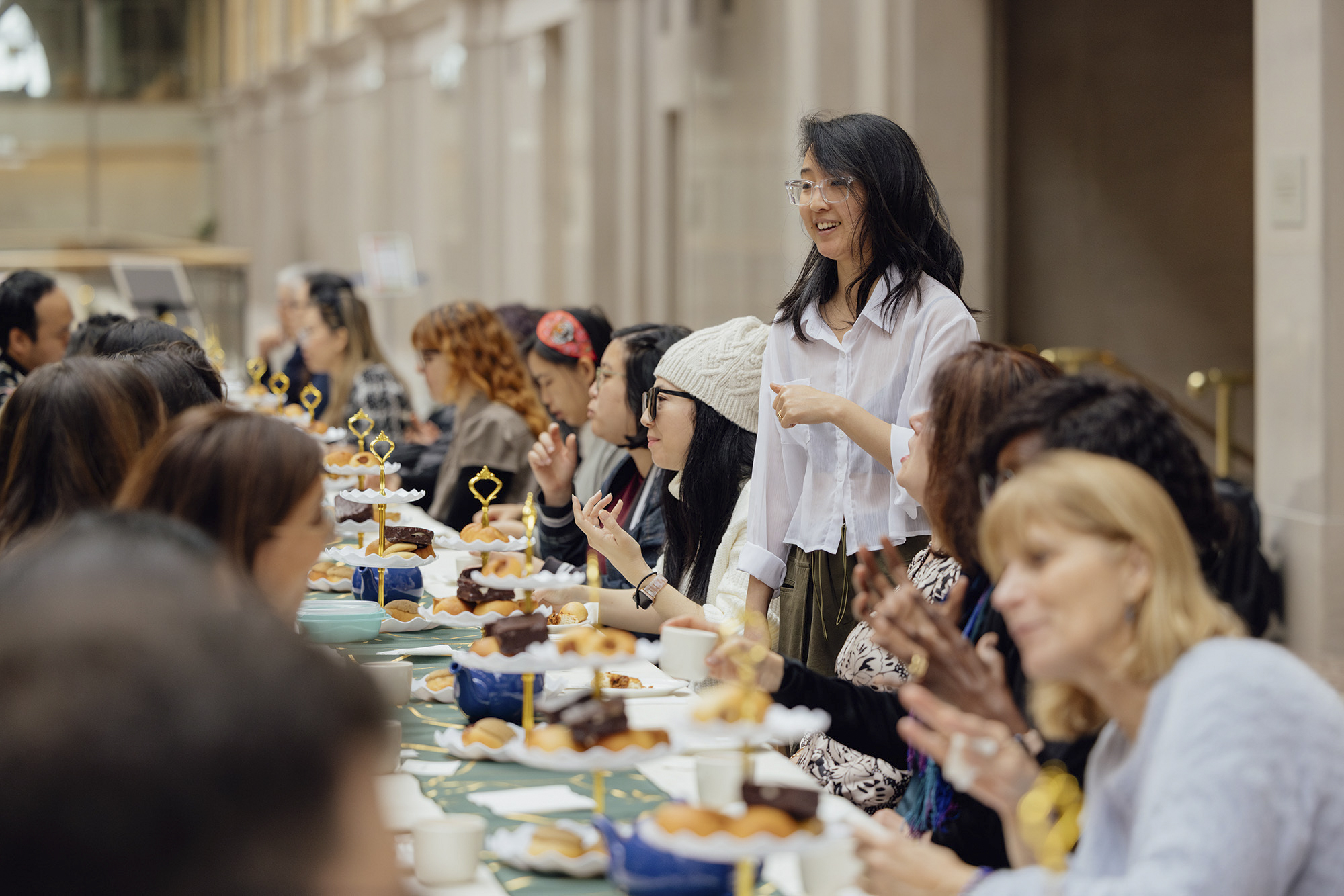 Little Moon Bakehouse owner Annie Wang (standing) mingles with guests at her afternoon tea pop-up at the San Francisco Ferry Building on Dec. 14, 2025. Featured items included plant-based mooncakes and mini pork floss buns. (Phil Stockbridge/SF Event Photo)
“I realized that this would be great for an experience,” she says. She started renting out venues across the Bay Area to host one-day afternoon tea pop-ups, filling up three-tier cake stands with an equal split of sweet and savory treats.
On Feb. 22, she’ll host her second tea pop-up in the San Francisco Ferry Building — a Lunar New Year–themed bash for 100 guests, seated at long tables that stretch the length of the festive second-floor Grand Hall.
The menu will include miniature pork floss buns, garlic butter buns, and citrus zest sugar cookies filled with soy sauce–spiked white chocolate (that one is a collaboration with Heydoh, a Taiwanese American soy sauce brand). In the coming months, she’ll host additional pop-ups in SF Chinatown, the Sunset District and San José.
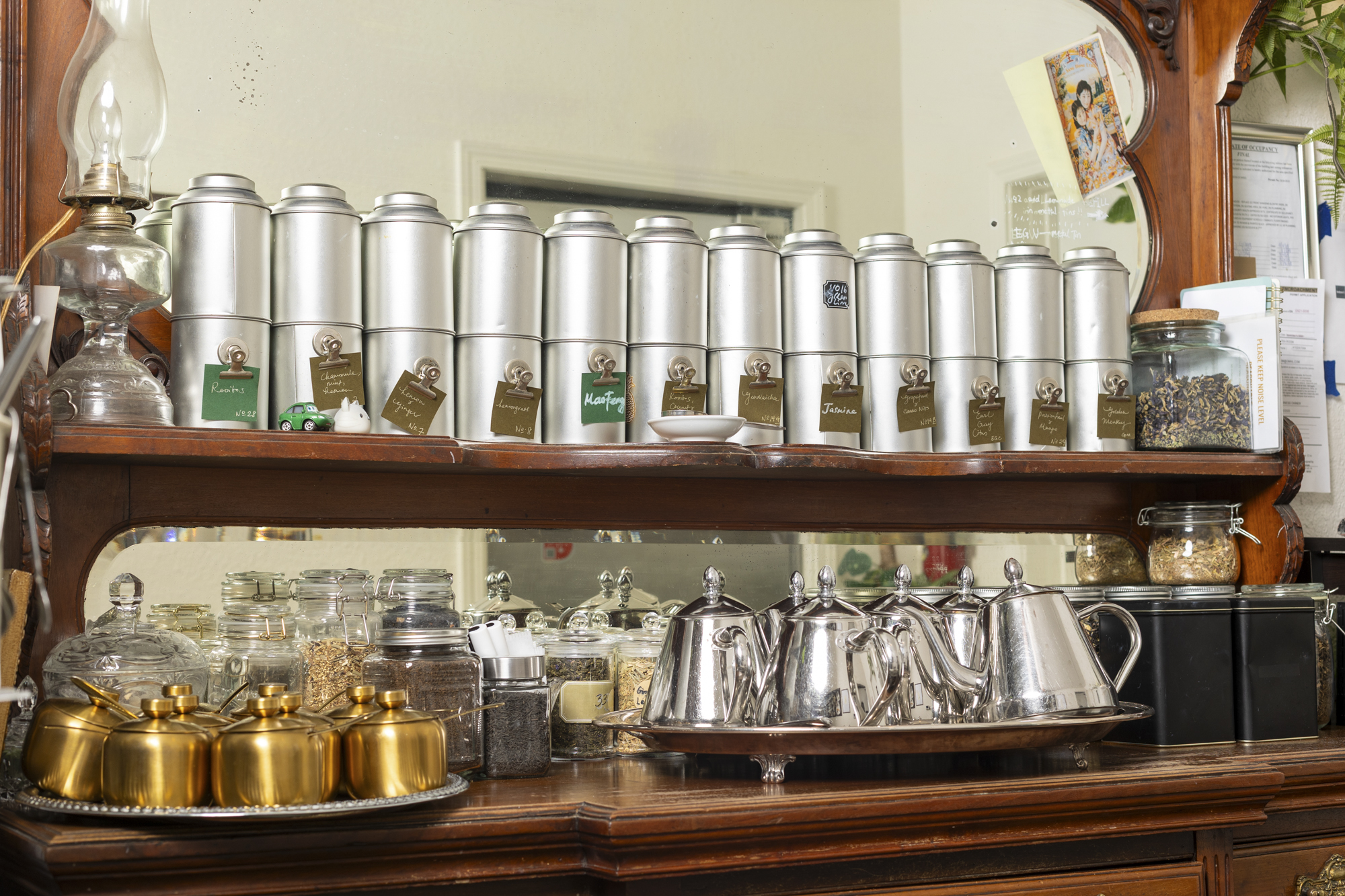 Loose-leaf teas line a wooden cabinet at Malaya Tea Room. The tea room serves a wide selection of teas in a space filled with nostalgic antique furnishings. (Gustavo Hernandez/KQED)
Meanwhile, Jai Kandayah, the owner of Pleasanton’s recently closed Curry Leaves Bistro, says he never intended to serve afternoon tea at his restaurant. He, too, grew up taking afternoon tea in Malaysia, but not the kind served at fancy hotels, which wasn’t accessible for working-class people. For the majority of Malaysians, afternoon tea — or high tea — was more of a home ritual.
(In Kandayah’s experience, Malaysians are more likely to talk about “high tea” than afternoon tea, referring to a heartier meal eaten later in the afternoon, at perhaps 4 or 5 p.m. after they get home from work — much more practical for working-class folks who can’t leave their jobs to eat cakes for an hour at 2 in the afternoon.)
These meals always featured local flavors, Kandayah recalls. “I remember my mom would make a big pot of tea in the afternoon and then usually a savory snack — banana fritters, fried yucca, fried yams, fried taro,” he says. Sometimes the bread man would come around, and they’d buy a loaf and dip the bread in the curry that was left over from lunch.
The local high tea buffets he remembers frequenting as a young man similarly skewed toward Malaysian flavors. Many of them would even serve fried noodles.
But again, Kandayah never had a high tea menu at Curry Leaves Bistro. Instead, regular customers — all of them older Malaysian immigrants — would knock on his door on Friday or Saturday afternoons, when the restaurant was closed.
“People would call and say, ‘Hey, there are eight of us coming in at 4 o’clock after our golf game. Can you prepare some tea and roti, and a plate of noodles?’” Kandayah says. “And we would do that.”
Curry Leaves Bistro wound up closing this past fall after the landlord increased the rent, but Kandayah has already scouted out a new location in the East Bay and hopes to reopen later this year.
This time, he says, afternoon tea on the restaurant’s backyard patio is going to come officially baked into the program.
A celebration of immigration
Meanwhile, Kopi Bar has leaned into the cosplay of it all. In addition to her Bridgerton series, Haron has also hosted Bollywood- and Arabian Nights–themed afternoon teas, and encourages guests to come dressed up to reflect the theme. People come for Haron’s stellar baked goods, sure. But they also come because the tea parties are joyful and extravagant — an all-out happening, as they say.
And for Haron, in the current political climate — while masked federal agents whisk soccer moms and five-year-old kids away to far-off detention centers — her tea parties aren’t just some frivolous, let-them-eat-cake moments to cosplay as British aristocrats. They’re important rituals that allow immigrants like her to come together and celebrate.
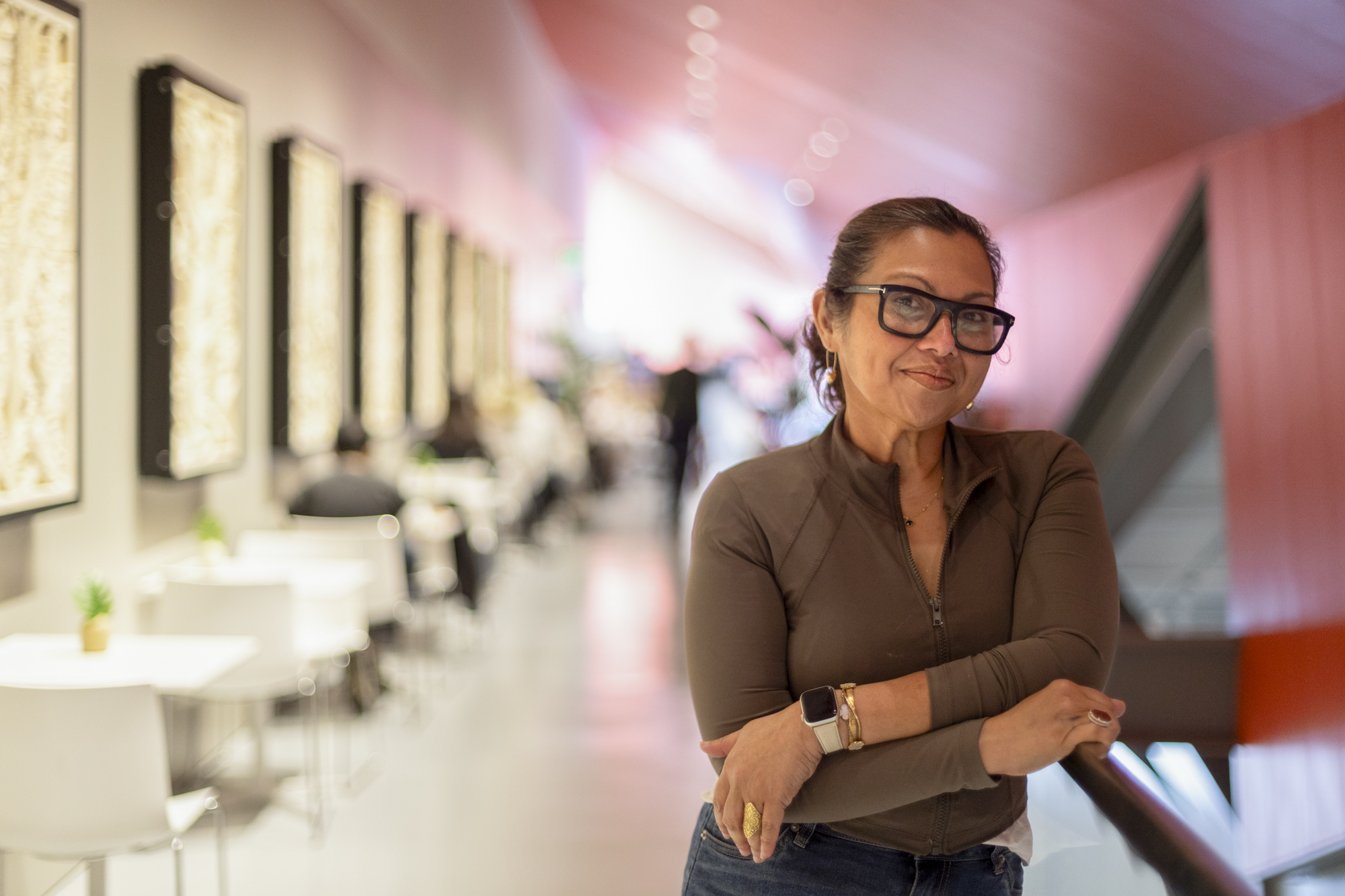 Chef Nora Haron, owner of Kopi Bar and Bakery, poses in her cafe on the second floor of BAMPFA. (Gustavo Hernandez/KQED)
“This idea of ‘illegal’ immigrants being criminals — that’s obnoxious. We’re doing something for the community. You know, we’re bringing people together. We’re creating jobs,” she says. “So it’s wonderful to be able to support one another this way.”
After all, she says, food is intertwined with the immigration process. And traditions like afternoon tea are a vital way for immigrants to maintain their cultural identity.
Back in Singapore and Malaysia, the history of afternoon tea followed the same path as so many other things in Southeast Asia: The colonizers brought it, but locals improved it.
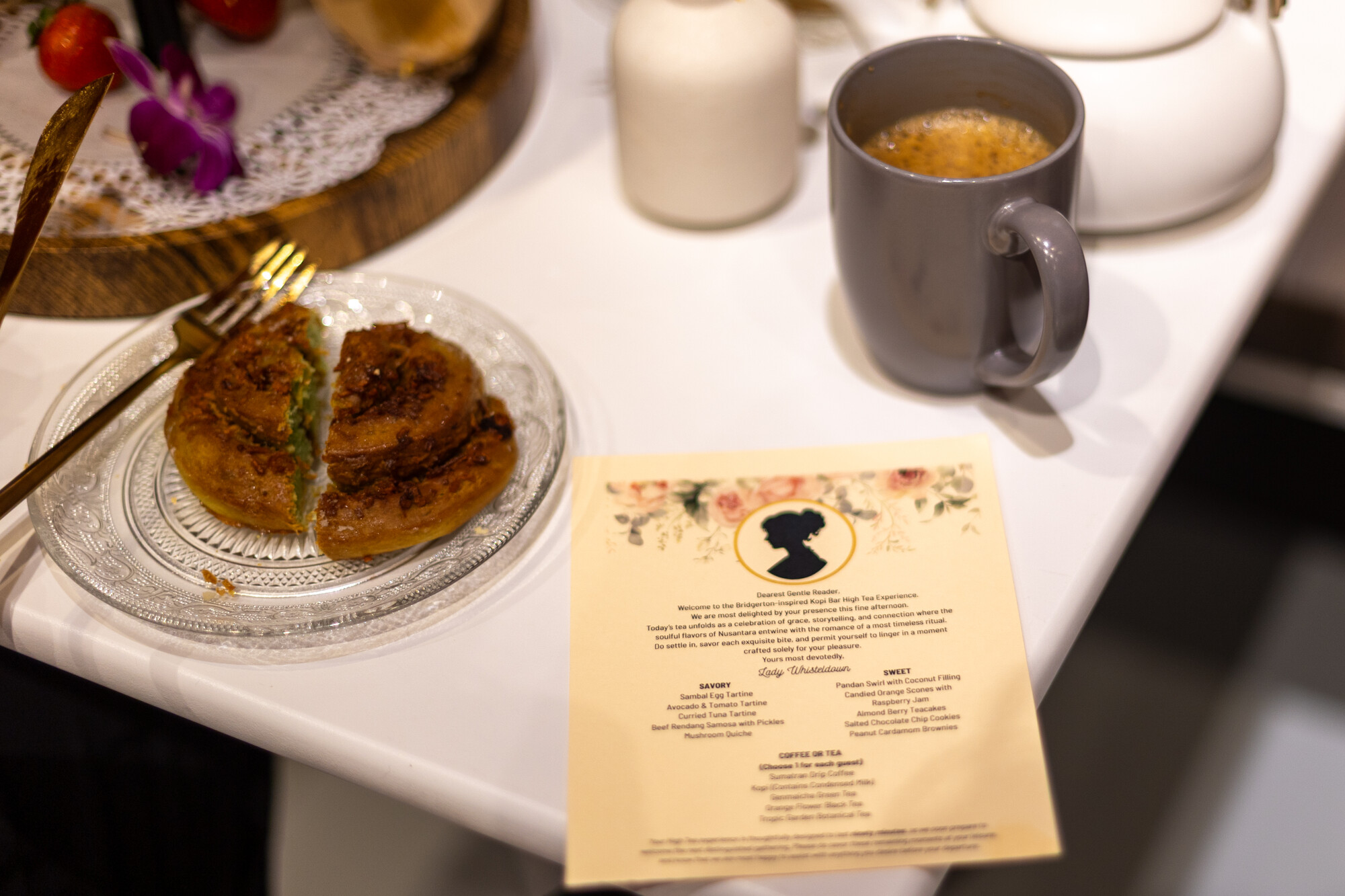 A pandan and coconut pastry swirl sits next to Kopi Bar’s “Bridgerton”-inspired high tea menu. (Gustavo Hernandez/KQED)
As the food writer Seetoh puts it, “You can still spend over a hundred bucks for the little pinky high teas at posh hotels flavored with affluence, but the majority, even the well-heeled, prefer a kueh salat, curry puff or ang ku kueh at local cafes.”
“It feels more like a Singapore story,” he says.
So it goes here in the diaspora, as Asian Americans create a new set of traditions replete with sourdough, vegan pork floss and the Bay Area’s own unique sense of swagger. They, too, are making afternoon tea their own.
Kopi Bar’s Bridgerton high tea series will run every Saturday through Feb. 28, plus an additional date on March 1, with seatings at 11 a.m., 1 p.m. and 3 p.m. Tickets are limited. The cafe is located on the second floor of BAMPFA, at 2155 Center St. in Berkeley.
Little Moon Bakehouse’s Lunar New Year–themed afternoon tea will take place on Feb. 22, 11:30-1:30 p.m., at the SF Ferry Building (1 Ferry Building, San Francisco). Tickets are limited. Future tea events are scheduled to take place in SF Chinatown, the Sunset District, and San José.
Malaya Tea Room has three seatings per day, Thu.-Sun., at 11 a.m., 1:15 p.m. and 3:30 p.m. It’s located at 920 Central Ave. in Alameda.