
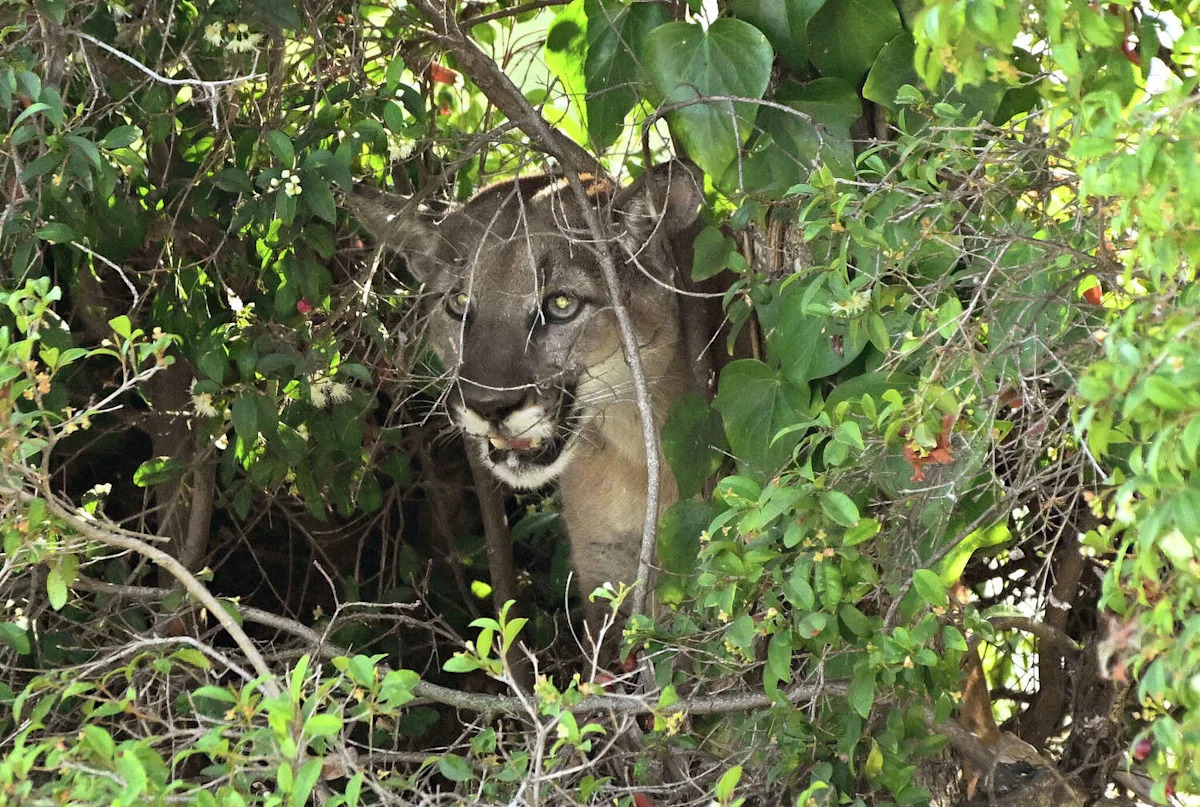
California wildlife regulators will decide Thursday whether mountain lion populations stretching from the Santa Cruz Mountains to Southern California should receive protections under the state’s Endangered Species Act, a step that advocates say is necessary to help pull the cats from the edge of extinction.
If the California Fish and Game Commission votes to list the lions as a threatened species, state agencies would be required to evaluate how development projects could harm the cats or fragment their habitat, and to minimize adverse effects. The protections could also spur more wildlife crossings and other projects to connect the animals’ habits, which would help avoid inbreeding.
The proposed protections apply to distinct populations in six regions: Santa Cruz Mountains, the Central Coast, Santa Monica Mountains, San Gabriel and San Bernardino Mountains, Santa Ana Mountains and Eastern Peninsular Ranges. The lions have remained under temporary protections since 2020, when the commission accepted a petition from wildlife organizations for formal review.
An estimated 4,172 mountain lions live in California, according to a state review of the petition, with the populations within the prospectively protected region at 947 mountain lions. 157M, the young, male mountain lion who wandered into San Francisco last month, would be among the protected lions.
Mountain lions in the Santa Monica and Santa Ana mountains in particular have been experiencing an “extinction vortex,” driven by a fragmentation of land that reduces genetic diversity, said Tiffany Yap, the Urban Wildlands Science Director at the Center for Biological Diversity. Her organization, along with the Mountain Lion Foundation, petitioned for protections in 2019.
Researchers estimated that the populations could die out within decades, with inbreeding as a particular concern, Yap said.
“Particularly in the Santa Anas and the Santa Monicas, we have records and data that show a mountain lion is mating with his daughter and then his granddaughter,” Yap said. “It’s horrible.”
Although mountain lions once moved freely across much of California, highways, urbanization and other habitat loss have restricted their movements over the past two centuries, according to a state report. Under ideal conditions, the state’s mountain lions would be a part of one large genetic population, Yap said.
Roads are one of the most lethal threats to the predators, with estimates of between 70 to 100 mountain lions dying each year in vehicle collisions statewide. The cats also face threats from rodenticides, which have been identified in nearly 94% mountain lion livers examined from 2016 to 2022.
The lions are also vulnerable to wildfires. In 2018, the Woolsey Fire burned through the Santa Monica Mountains, killing at least two collared lions, according to the state report.
“In places where the habitat is really fragmented, sometimes they’re more afraid of development than they are of the wildfires,” Yap said. “We’ve actually seen mountain lions come to the edge of development during a wildfire and then run back towards where the fire had burned.”
Protections under the state’s Endangered Species Act would provide comprehensive protections for the multitude of threats these predators face, Yap said.
The petition does not seek protections for Northern California mountain lions, which have access to a larger, more connected habitat, Yap said. But she warned without maintaining connectivity, the kind of genetic isolation seen in the south could spread north.
This article originally published at California could give extra protections to mountain lions, including the one that visited S.F..