
Capital Public Radio teetered on the edge of failure when a quiet plan emerged to reshape the NPR affiliate and alter the future of Sacramento’s public media landscape.
The plan was pushed by two organizations: the Capital Public Radio Endowment — a nonprofit operating separate from Sacramento State meant to financially support CapRadio — and the region’s PBS affiliate KVIE.
Both discreetly strategized a consolidation between CapRadio and TV station KVIE in late 2023 and 2024, in what would be a dramatic shakeup.
But Sacramento State, which holds the CapRadio’s licenses for KXJZ (90.9 FM) and KXPR (89.9 FM), refused to cede control of the broadcaster. CapRadio also rebuffed any consolidation push from the endowment and KVIE.
Still, the endowment and KVIE did not abandon their plans. Both kept pursuing the media integration as CapRadio reeled from financial blows, including alleged embezzlement at the hands of its then-general manager Jun Reina and millions of dollars in debt tied to its failed office relocation to downtown Sacramento.
In March 2024, an endowment board member discussed whether “legal action” could pressure the university to reconsider giving CapRadio to KVIE, according to emails, memos and internal documents reviewed by The Sacramento Bee.
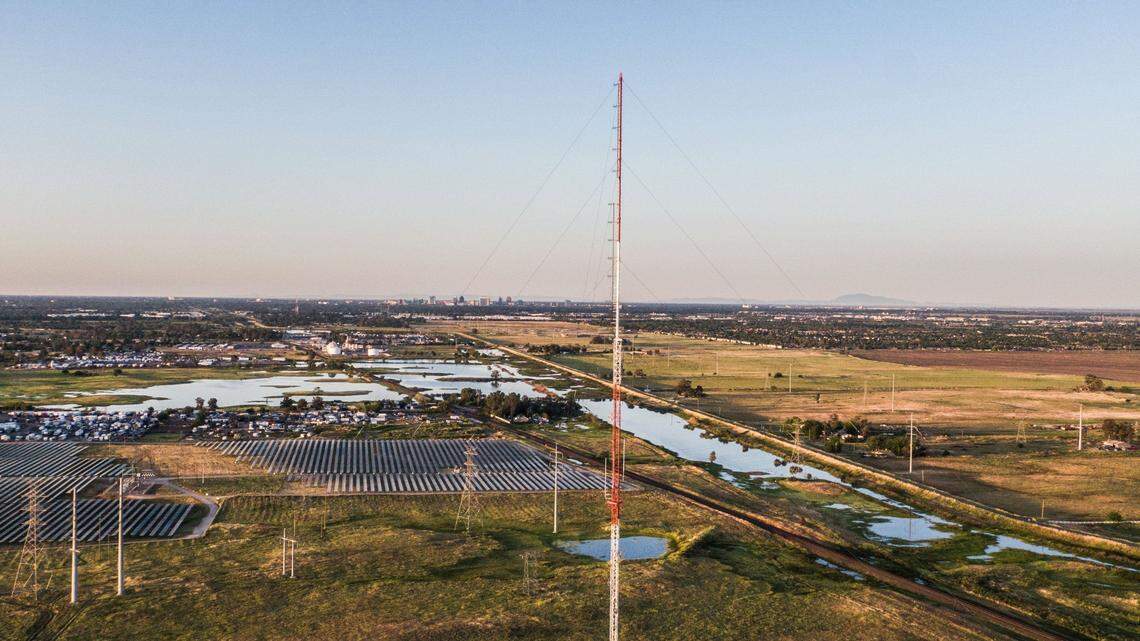
That same month, the endowment transferred ownership of land on which CapRadio’s key broadcast tower sits to KVIE. The donation triggered a legal battle between CapRadio and KVIE over who owns the infrastructure used to transmit the radio station’s journalism across the region, and whether the endowment had overstepped its authority with the gift.
The endowment’s actions came as the university moved to shut down the nonprofit, leaving the board members scrambling. Its board members, concerned about the tower’s alleged neglect, said it believed donating it to KVIE would place the equipment in the hands of an organization with experience maintaining broadcast infrastructure. KVIE has characterized the gift as similar to donations of cars or stock and that “by accepting this gift we keep this in the hands of public media.”
CapRadio has disputed those claims, saying the tower did not require major repairs. University officials asserted the tower was owned by CapRadio, not the endowment, and therefore it “wasn’t the endowment’s to give,” according to previous Bee reporting.
After KVIE and CapRadio reached an impasse, KVIE in October 2024 filed a lawsuit in Sacramento Superior Court seeking declaratory relief — asking the court to declare KVIE the rightful owner of the tower after receiving it from the endowment. Three days later, CapRadio filed a cross-complaint asking a judge to declare it the rightful owner of the property and to grant CapRadio an irrevocable license to use the tower.
Court filings show the two sides agreed to an out-of-court mediation session Jan. 26 of this year, signaling the possibility of a settlement prior to the next scheduled court hearing on March 23. As of Friday, no settlement conference had been scheduled in court.
Internal documents and email exchanges from October 2023 through April 2024 were given to CapRadio’s lawyers by KVIE during the discovery process as part of litigation and noted in court filings of the ongoing lawsuits. The Bee filed a public records request to CapRadio to obtain those internal documents. The endowment and both public media organizations declined to comment.
The communiques show the behind-the-scenes discussions and strategizing to reshape CapRadio’s future, detailing how the endowment and KVIE continued pursuing an integration despite repeated rejections. The documents also offer a glimpse into how players in Sacramento’s donor-funded broadcasting world sought an opportunity to reshape the capital region’s public broadcasting air waves in their own image — while the endowment board, KVIE and CapRadio each grappled with the threat of extinction.
It began, quietly, over a meal.
A fractured board and a private lunch
In October 2023, a former Capital Public Radio board member dined privately with KVIE President and General Manager David Lowe during a period of upheaval for both organizations.
CapRadio’s governing board was in disarray. More than half of its members resigned after Sacramento State President Luke Wood reportedly demanded the resignation of the board’s executive officers on Oct. 3, 2023. Thirteen members collectively resigned, signing a letter citing the university’s failure to engage the board in CapRadio’s financial woes. A 14th member resigned in a separate letter.
KVIE, meanwhile, was grappling with its own challenges. Former CapRadio General Manager Tom Karlo later argued in The Sacramento Bee’s opinion pages that the TV station had struggled to attract younger audiences and questioned its long-term sustainability.
Against that backdrop, former CapRadio board member Steve Weiss and Lowe met for lunch. From that conversation emerged a proposal to consolidate CapRadio and KVIE — a plan that would dramatically reshape Sacramento’s public media institutions.
“I provided him a briefing of what transpired and raised the issue of KVIE stepping in (at the right time) to explore purchasing the station,” Weiss wrote in an Oct. 18, 2023 email. Weiss, one of the 14 who had resigned, added that Lowe planned to assess “what the fair market value of the sale for this license might cost.”
What Weiss meant by “what transpired” is not fully clear. He declined to comment.
Karlo later told The Bee he had approached Lowe in August 2023 as well to discuss a potential partnership.
As CapRadio grappled with its financial crisis, the endowment board met Dec. 7, 2023, to consider “the potential to approach KVIE with the prospect of some kind of merger or operating agreement,” according to an email from endowment board chair Dan Brunner, who emphasized the idea was “highly confidential.”
Following that meeting, Brunner wrote that the board “took action” to support the concept of integrating the two public media organizations and that he had relayed that position to Lowe. “There was agreement among the parties that the idea of an integration of the two entities was highly desirable,” Brunner wrote on Feb. 2, 2024.
Records show that on Jan. 31, 2024, Karlo, Weiss, Lowe, members of the endowment board and a KVIE board member met at KVIE’s headquarters to discuss the proposed integration.
At that point, the endowment and KVIE still needed to persuade Sacramento State, CapRadio and KVIE’s own board to move forward.
The Capital Public Radio transmission tower stands in Elverta on May 2, 2024. CapRadio and Sacramento State are challenging the tower’s donation to TV station KVIE by the Capital Public Radio endowment board. Hector Amezcua Sacramento Bee file Selling integration as a solution
The effort soon turned toward persuading Sacramento State to relinquish control of CapRadio’s licenses.
Emails show endowment board members, communicating with KVIE’s Lowe, identified two pressure points: emphasizing CapRadio’s unstable finances and highlighting potential benefits to the university, including on-air recognition and expanded educational opportunities. A possible purchase of CapRadio’s license, board members suggested, could also help offset the station’s mounting financial strain.
Karlo, who was serving as CapRadio’s interim general manager, was described by endowment board member Buzz Wiesenfeld as “overwhelmed with day-to-day business.” In an email, Wiesenfeld wrote that the “operational, financial fatigue” Karlo described during meetings gave the endowment “considerable leverage.”
“CSUS has conveyed its financial fatigue with this problem,” Wiesenfeld wrote to Lowe and others on Feb. 5, 2024, adding that a license sale could serve as “an additional incentive to end its CPR financial nightmare.”
A Feb. 6 memo from the endowment titled “Integrated Public Media for Sacramento” laid out a proposal that would place CapRadio’s operations squarely under KVIE’s control.
Under the plan, according to the memo, Sacramento State would:
Transfer “full operational control” of CapRadio to KVIE.Make CapRadio employees vacate their offices on the university’s Folsom Boulevard campus and relocate to KVIE’s headquarters. Require CapRadio to transfer all broadcast equipment, towers, technology, donor information and office assets to the TV station. Have either the university sell CapRadio’s broadcast license to KVIE or enter into a long term management agreement for the PBS station to operate CapRadio.
In exchange, Sacramento State and the California State University system would assume all debt and lease obligations tied to CapRadio’s failed downtown relocation, during which the station leased two buildings, the memo said.
“This would be an opportunity for good news, bringing significant community goodwill to both CSUS and KVIE, for rescue of a valued community resource,” the memo said.
The internal document, dated Feb. 6, 2024, was sent to CapRadio’s Karlo, Sacramento State’s Wood and KVIE’s Lowe.
The proposal failed to gain traction. In a March 9, 2024, email, Wiesenfeld acknowledged the pitch had fallen flat.
“We have developed a compelling case for the integration of CPR with KVIE but can’t get them to the table as they apparently believe they can now run the station themselves,” the endowment board member wrote.
That rejection came at a critical moment for the endowment. The broadcast tower, at 820 W. Delano St. in Elverta, had been flagged by the endowment as needing maintenance. Emails show board members discussed demanding reimbursement from Sacramento State for the repairs. If the university refused, emails show Wiesenfeld contemplating suing Sacramento State for “damages or breach of the (lease) and administrative services agreement.”
“We are also considering the consequences of terminating CPR tenancy on the tower and asserting our entitlement to all lease payments, noting the station has collected around $100k/year but has been derelict in maintenance,” Wiesenfeld wrote on March 9, 2024.
Wiesenfeld wrote that further legal pressure might be necessary to force Sacramento State back to the negotiating table.
“We are working on a final attempt to communicate with to CSUS/CSU in order to persuade them of the wisdom of the KVIE/CPR integrated platform,” Wiesenfeld wrote on March 9, 2024. “My hunch is it will take more legal action to bring them to the table.”
Wiesenfeld also floated escalating the dispute by drawing the attention of NPR and the now-defunct Corporation for Public Broadcasting, suggesting in an email that Sacramento State’s FCC licenses could be challenged if those organizations believed the university had engaged in “yellow journalism” that harmed the station and its volunteers.
Sacramento State, however, remained unmoved. CapRadio also called off any desire in February 2024 to create a new public media partnership.
When persuasion failed, pressure followed
Records show the endowment contemplated conveying the tower to KVIE in early March 2024.
Before donating, the endowment tried once again to persuade Sacramento State to listen to its media integration proposal. But, its board members wrote in an email to Wood, the university “refused to respond to (its) telephone calls, emails and requests for meeting,” according to the endowment.
In a March 19, 2024, letter to Wood and CapRadio’s new board, the endowment raised concerns about the Elverta broadcast tower used by CapRadio. Endowment board members wrote that consultants had recently inspected the structure and identified more than $400,000 in deferred maintenance — a figure that later conflicted with court filings in which the Endowment cited roughly $35,000 in needed repairs.
The letter also foreshadowed the endowment’s donation to KVIE. It has “independent obligations to protect and properly steward its assets, and is already proceeding to do so, while reserving its rights to recover the costs that should have been expended by the station/CSUS to maintain the tower,” the letter said.
“These costs are not optional to defer, yet CSUS, since taking over, has treated them as such,” the March letter stated. “In spite of these facts, CSUS refuses to talk with us. This is a legal dilemma that will not last for much longer.”
That same month, Wiesenfeld contemplated “conveying the tower to KVIE in some form.” Emails show the endowment feared Sacramento State could sever its relationship.
“In light of current events and potential threats to our authority that may include attack on our ownership, it is my strong opinion that this needs to happen quickly,” Wiesenfeld wrote in a March 22, 2024, to KVIE’s Lowe and others in regard to donating the tower.
Lowe later responded that the tower’s alleged disrepair would serve as a “good talking point” if questions arose about the transfer. Sacramento State revoked the endowment’s standing and “we were put into a situation that became untenable,” Lowe wrote.
Brunner, the endowment board chair, in an April 2024 interview with The Bee maintained that the gift sought to protect CapRadio’s signal. “My concern and our concern was that there be an uninterrupted transmission of public radio on air.”
CapRadio used the transmission tower without charge, valued at $65,000 annually. It also collected tenant rental income of $126,000 annually, according to previous Bee reporting.
On March 29, 2024, Brunner filed a gift deed with the Sacramento County Clerk-Recorder’s Office, officially transferring the tower and the 36-acre parcel it sits on to KVIE.
CapRadio and KVIE filed lawsuits in Sacramento Superior Court that October.
The two organizations are currently engaged in settlement negotiations. But a failure to lead to a resolution would lead to a trial that would pit the region’s two largest public media organization against one another.
Where we are now
The internal turmoil at CapRadio unfolded as the station was reeling with revelations about its former leadership. Former CapRadio General Manager Jun Reina was arrested Jan. 29 on suspicion of embezzlement, grand theft and forgery charges after prosecutors alleged he misappropriated more than $1.3 million from CapRadio over several years.
According to the Sacramento County District Attorney’s Office, Reina orchestrated a multi-year scheme between 2016 and 2022 involving unauthorized credit card charges, payments to personal accounts and more than 140 transfers from CapRadio accounts. Reina, who has denied wrongdoing in a related civil case, posted bail and made his initial court appearance on Monday in Sacramento Superior Court.
He is expected to return to court to enter a plea April 1.
This story was originally published February 9, 2026 at 5:00 AM.
CORRECTION: The story has been updated to clarify that CapRadio’s endowment is a 501(c)(3) operating separate from Sacramento State.
Corrected Feb 9, 2026
Related Stories from Sacramento Bee
The Sacramento Bee
Ishani Desai is a government watchdog reporter for The Sacramento Bee. She previously covered crime and courts for The Bakersfield Californian.