
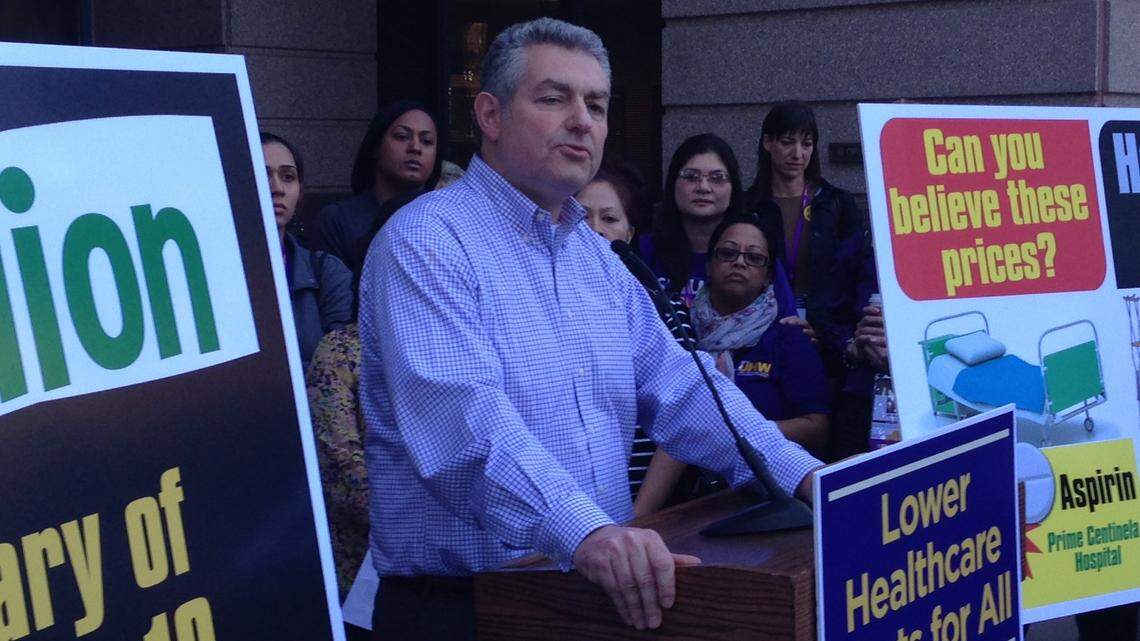
Dave Regan, president of SEIU-United Healthcare Workers West, unveils a pair of ballot initiatives in November 2013 outside the Attorney General’s Office in Sacramento.
Sacramento Bee file
The leader of the union championing a controversial effort to tax California billionaires has over the past decade floated a series of ballot initiatives that would benefit members, then later drawn back when lawmakers agreed to compromise or support similar legislation.
The Service Employees International Union-United Health Care Workers West union, led by President Dave Regan, has been organizing a ballot measure levying a one-time 5% tax on billionaires to generate $100 billion over five years and make up for a multibillion dollar hole created by Congress’ “One Big Beautiful Bill,” which gutted federal funding for state medical programs and added barriers to accessing public benefits.
Gov. Gavin Newsom and some in Silicon Valley oppose the tax effort, saying it will drive away top earners who already contribute much of their wealth in taxes. California is home to 85 of the 400 richest people in America, according to Forbes. The Teamsters union recently signed on in support of the wealth tax, as have gubernatorial hopefuls former State Controller Betty Yee and State Superintendent Tony Thurmond, and U.S. Sen. Bernie Sanders, I-Vermont.
UHW and Regan are pushing the tax forward as a solution to staving off hospital closures and preventing millions of Californians’ health insurance from lapsing.
“There’s no solution out there to figure out this hole of $20 billion per year,” said UHW Chief of Staff Suzanne Jimenez in an interview last month. “That kind of cut to a state of 39 million, that’s significant, and it’s only going to lead us to one place: a crisis of health care.”
Assemblymember Damon Connolly, D-San Rafael, announced a “water’s edge” tax this week that would prevent wealthy California companies from relocating offshore to avoid taxes. That effort has the support of SEIU, the parent union that is separate from UHW.
Newsom told reporters on Tuesday that he “hadn’t had any conversations” about Connolly’s proposal.
What if there’s an exodus of billionaires?
The nonpartisan Legislative Analyst’s Office said late last year that the wealth tax could result in revenues of “tens of billions of dollars spread over several years,” but those gains could dissipate as more billionaires cut ties with California. Regan said in October that the wealth tax would “stabilize” premiums and coverage for Californians and protect health care jobs. If successful, some dollars would also go to funding kindergarten through 12th grade education.
The New York Times reported that some billionaires — like Newsom allies and Google founders Sergey Brin and Larry Page — moved some businesses across state lines to avoid a Jan. 1 deadline as the tax, if successfully implemented, would retroactively apply to any in-state assets they owned at the time. After reestablishing himself in Nevada Brin gave $20 million to a coalition opposing the wealth tax.
Critics in politics and organized labor have criticized Regan, a longtime labor leader who first joined UHW in 2009, for using ballot initiatives and other tactics to cajole employers and lawmakers into negotiating with the union. Regan told The Sacramento Bee in 2017 that ballot measures were “the best bargain in American politics.”
That has paid off in some respects. In 2016, former Gov. Jerry Brown said the threat of a Regan-backed referendum forced lawmakers to act on legislation that eventually raised the minimum hourly wage to $15.
Accusations made against Regan
The same year, a process server accused Regan of shoving him down the front steps of Regan’s East Bay home trying to serve Regan with legal papers. Regan’s attorney at the time said the process server refused to leave his home when asked.
Former Assemblymember Richard Bloom, D-Santa Monica, told the Legislature Regan pushed him during a confrontation in 2018 at a restaurant in Sacramento. A UHW spokesperson told The Bee that the conflict with Bloom was “provoked” by a third person and had been blown out of proportion.
And in 2009, a year after he joined UHW as vice president, leaders of the rival National Healthcare Workers United union accused Regan of threatening to call immigration officials on undocumented members during a competitive campaign to organize home care workers in Fresno County, according to The Fresno Bee.
Chris Newman, the legal director of the National Day Laborer Organizing Network, recalled the “ugly” fight, which followed the ouster of Sal Rosselli, the former UHW president who founded NUHW.
“We all share a vision that all residents of California regardless of immigration status deserve access to health care and workers’ rights,” he said. “If it’s true that anyone used the threat of immigration status to coerce, it would be akin to treason.”
UHW spokesperson Nathan Selzer dismissed the accusations as false in an email.
“SEIU-UHW has always supported immigrants and immigrant communities, and is deeply committed to safeguarding the safety, dignity, and well-being of all healthcare workers and our communities, regardless of immigration status,” he wrote.
UHW floated three unsuccessful referendums between 2018 and 2022 to regulate the kidney dialysis industry, whose clinic workforces the union eyed as ripe for organizing.
The Information reported that some labor leaders reacted with lukewarm enthusiasm on a call with Regan shortly before UHW announced the wealth tax proposal last fall.
Selzer said “multiple unions” had signed on in support, and that UHW expected “hundreds more” to publicly announce their endorsements later in the year “to maximize impact later in the campaign.”
Supporters of the tax like former McKinsey consultant Scott Ellis and Tarzana attorney Drew Pomerance said a handful of billionaires fleeing the state “distracted” from the U.S.’s accelerating wealth divide.
Pomerance said he noticed that despite stagnating wages, wealthy people continued to amass more riches, leading to the creation of “an elite super class” while the middle class and homeless people struggled.
“It’s really coming into focus now as the evolution between the internet, globalism, finance and deregulation has allowed for an extraordinary accumulation of wealth by a few individuals,” Ellis said. “The main goal is, how much wealth is enough? These are guys who have millions, billions of dollars.”
This story was originally published February 11, 2026 at 11:03 AM.
Related Stories from Sacramento Bee
The Sacramento Bee
Lia Russell covers California’s governor for The Sacramento Bee’s Capitol Bureau. Originally from San Francisco, Lia previously worked for The Baltimore Sun and the Bangor Daily News in Maine.