
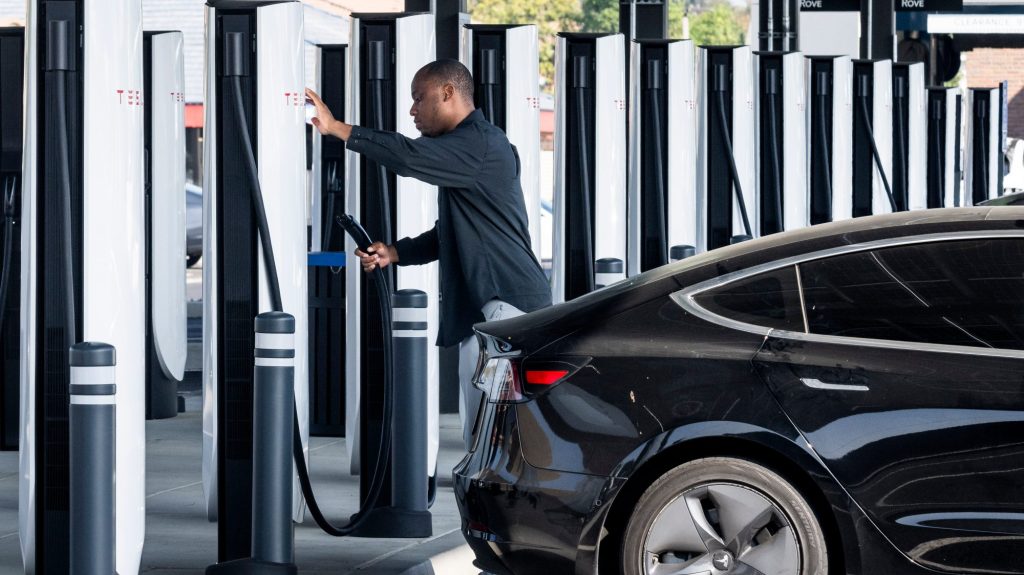
Oceanside has approved the construction of a high-speed, electric vehicle charging station on the site of a former automotive services yard on North Coast Highway near the Harbor Drive off-ramp from Interstate 5.
Several residents opposed the project at an Oceanside City Council meeting Wednesday, where they expressed concerns about the possibility of a fire in the large storage batteries at the facility. However, the Oceanside fire chief said there’s little danger to nearby homes and businesses.
“We’re OK with it,” said Chief David Parsons.
A burning battery can be difficult to extinguish, and in most cases the best solution is to allow the fire to burn itself out, Parsons said. However, the fire is unlikely to spread, any toxic materials released to the air dissipate within a short distance, and firefighters would monitor the blaze without getting too close.
The all-electric station will use two of the latest version of the Tesla Megapack. The batteries will store electricity taken from the grid when usage and rates are lowest, primarily at night, and use it to charge cars during the day when rates are higher.
The batteries have “a very sophisticated fire prevention system” in place, said Vaughan Johnson, chief operating officer at Rove Charging, the company that will build and operate the station.
“We find the Megapack to be the safest product,” said Johnson, adding that he expects the Tesla batteries to be widely used by electric vehicle charging stations across the country.
The City Council approved a development plan and permits for the project on a 4-1 vote, with Councilmember Eric Joyce opposed.
“I do have concerns about an uncontrolled fire,” Joyce said. “The model makes a lot of sense … I’m just not sure I want to test drive it here.”
Councilmember Rick Robinson, the city’s former fire chief, said an overturned truck on the freeway prevents a greater hazard to nearby residents than a fire at a vehicle charging station.
“We live every day with risk,” Robinson said. “These (charging stations) are things that help smooth out the grid. We all want electric vehicles … it’s going to come.”
Councilmember Peter Weiss had a similar view and said, “The technology is changing rapidly. At some point, we have to get used to these things.”
The Rove station with up to 50 high-speed charging stalls will be built on a 1-acre lot occupied for decades by the automotive services business Carpenter’s Towing, now closed.
A charge typically takes about 20 minutes to go from 5% to 80% of the vehicle’s capacity depending on the type of vehicle and the condition of its battery, Johnson said.
The new station would include a lounge, restrooms, and a high-end convenience market. It would accommodate all electric vehicles currently on the market, according to a city report.
In addition to the charging stalls, the lot will have eight parking spaces for non-electric vehicles, also one for handicapped drivers of electric vehicles and one for handicapped drivers of non-electric vehicles.
The property, which now has no trees, will be landscaped with 15 trees (eight coast live oaks, four strawberry trees and three Aleppo pines), shrubs and groundcover, according to the report.
The location is near several conventional service stations, restaurants, a hotel and a mobile home park.
Rove opened its first charging station in Santa Ana in October 2024, the first of the company’s 10 planned locations in Southern California.
California has more than 200,000 public and private vehicle charging ports, according to the California Energy Commission.