
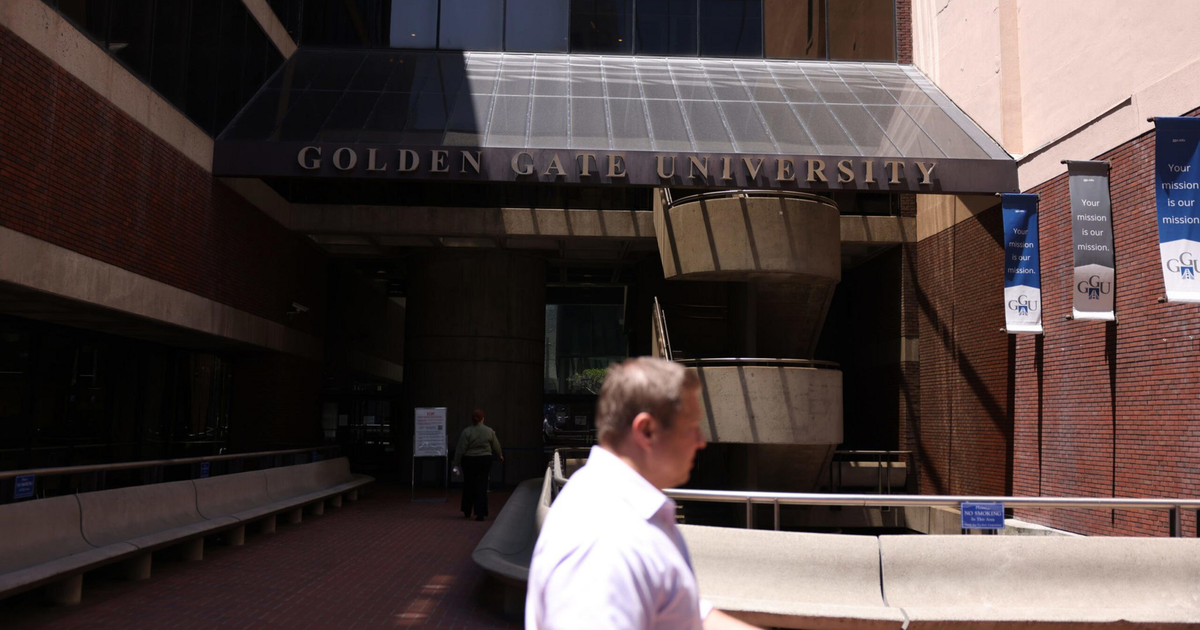
Last week, White — who served as GGU’s provost before working for several years the as chief global officer at the University of Hawaii — announced eight new members (opens in new tab) to the university’s board of trustees, including former UC Berkeley Chancellor Nicholas Dirks, China’s Sias University founder Shawn Chen, and investor Max Raskin, who has been buying up properties in Union Square.
The announcement comes in the wake of another shakeup to higher education in San Francisco, with Vanderbilt set to take over California College of the Arts in 2027.
The Standard spoke with White about GGU’s ambitions, its plans for maintaining its downtown presence, and the role of AI in higher education.
This interview has been edited for clarity and length.
You describe GGU as turning in a “new direction.” What does that mean?
Our core mission for 125 years has been to power economic mobility. We primarily serve working adults, many from nontraditional backgrounds, who are first in their families to attend college. Many are immigrants. It’s very typical of our students to be working and learning at the same time — many are building their own businesses while they get their degrees.
Now we’re growing globally and expanding our multilingual offerings. We’re investing more effort and resources into growing our purely online degree model to be accessible globally, in multiple languages, anytime, anywhere.
We already have over 2,000 students in China who earn 10 different GGU degrees in Mandarin. We’ve just signed an agreement to launch in Indonesia, where we’ll deliver multiple degrees in Bahasa Indonesia, and we’ll expand beyond that to Vietnamese, Spanish, and Arabic. It will be the same degrees, but it’s delivered in the language that the student needs and the place that they need it, and the price they can afford.
And so that is the vision for where we’re going and where we’re already headed.
Given those ambitions, what does the school’s future look like in SF?
One thing I can tell you is that we’re not going to leave San Francisco. We’re going to be connected to downtown. We’ve been here for 125 years, and we’re going to keep being here — we’re committed.
We’re also trying to align our space with our mode of teaching and the needs of our students: We’re hybrid, and we’re working-adult friendly. In the fall, we’ll be moving from hosting intensive campus weeks to campus weekends, which will happen twice a semester. During the rest of the time, most of our students are working, raising families, and finding time to study — they’re not hanging out on campus. We don’t need 220,000 square feet of space. But we will have a physical place.
Will the next place be our forever home? Maybe not. I have nothing to announce at the moment, but I can tell you that we’re looking for a space where students can come and gather, whether to work on a project or for those campus weekends. It’s important to have a sense of connection to a place, to a city, to fellow students.
And everything that’s going on in San Francisco right now with the AI revolution is what we also try to bring to our students. Part of the global attractiveness of Golden Gate University is that we’re in San Francisco.
 Brent White took over as Golden Gate University’s president in October. | Source: Courtesy of Golden Gate University
How is the school doing financially?
We’ve turned the corner, I would say. It’s not a secret that Golden Gate has had some financial challenges, but we are now, as of January, on not only a balanced budget but a budget generating a bit of surplus.
We had to make some difficult choices and make some changes, but we’re growing. We were 140% over target for new students this spring, and our overall student population is 120% of what we thought it might be. So I’m very optimistic and bullish about the future. We’re on the rise, we’re growing, and we’ve turned the financial corner.
What’s enrollment like? What’s the student makeup?
In 2022, we had zero students who were [international]. Now, that global program has grown to almost 5,000 students across 25 countries.
Our total annual headcount is approaching 6,500 students, about 1,600 of whom are located in the United States. The remaining students are earning their degrees online, with immersion opportunities in places like Mumbai, Beijing, Ho Chi Minh City, and the UAE.
What do you think about Vanderbilt buying CCA? Would GGU consider a sale to the right buyer?
We’re not for sale, I guess would be the answer. But we’d be open to collaborations and partnerships. For example, I just had a conversation with an East Coast university that offers programs that are distinctly different from ours to talk about what would happen if we formed an alliance. Could you offer those programs here in San Francisco?
We are very much open to partnering and thinking about how we can share space and share the infrastructure of a university to lower the cost for students. We’re also thinking about how we can partner with other international universities.
You brought up AI earlier. How is GGU thinking about AI in the classroom?
Our mission is to help students be career-ready, and right now that means AI-ready. You should be able to utilize the tools of artificial intelligence to be better at your job. We want every student who graduates from GGU to be ready to use AI in their career, because students who aren’t will be left behind immediately.
We have a large number of practitioner faculty who are launching AI companies. We have a [Doctor of Business Administration] degree in emerging technology, which focuses on AI, and we’re about to launch a school of emerging technology. We also already have an applied artificial intelligence master’s program (opens in new tab), so a student can graduate with actionable knowledge and competency for the workforce. A great reshaping of employment is coming, so you really think about how to prepare your students.
At Golden Gate University, we don’t punish you for using AI — we expect you to use AI, we train you to use AI, and we grade you on how well you do it. It’s a very different conception.