
At noon on Wednesday, the dining room at The Happy Crane was electric but not loud. Chairs were upended on tables, while staffers sat in a corner, sharing a family meal of soup and rice. In the semi-private dining room, chef James Yeun Leong Parry opened a plastic crate and removed a small, golden bowl, holding it aloft to show chef Alan Hsu. “These are great,” Parry said with a nod, inspecting the burnished surface.
Less than five hours later, dozens of diners would fill the room for a one-night-only collaboration between Parry and Sun Moon Studio, the Michelin-starred Oakland restaurant Hsu runs with his partner, Sarah Cooper. With just four tables and a growing list of accolades, the couple’s 18-month-old restaurant is known almost as much for stunning, California-inspired tasting menus as for being impossible to get into. The Happy Crane, meanwhile, was recently nominated for the James Beard Foundation’s award for best new restaurant.
Seats at the collaborative dinner were highly coveted among Bay Area dining aficionados, who each paid $195 for the privilege of eating a meal prepared by three of the region’s standout talents.
 Dungeness crab lo mein. | Source: Andria Lo for The Standard
 Source: Andria Lo for The Standard
Though Parry, Hsu, and Cooper spent weeks discussing the menu, there were no dry runs. Hsu and Cooper, who serve about 80 dinners at Sun Moon Studio every week, were preparing to do 108 covers at the pop-up. Parry and his team had home-court advantage but were preparing some dishes they hadn’t seen or tasted until that day — all while working in a kitchen crowded with more bodies than usual. The six-course menu had 15 dishes, some of which had been in progress for 72 hours.
As the clock ticked toward 12:20 p.m., Cooper rushed into the dining room. She was anxious to get to the kitchen to check on the crème fraîche ice cream she had made to go with Parry’s nian gao, a sticky rice cake traditionally eaten at Lunar New Year to bring prosperity.
“The ice cream is in the back walk-in,” Hsu said. “It looks good. I think it’s going to work.”
“It has to work,” Cooper said with a smile.
 Sun Moon Studio chef Alan Hsu in the kitchen at The Happy Crane. | Source: Andria Lo for The Standard
In the past decade, chef collaborations have become regular features of the dining scene. Though the events are not particularly lucrative due to the extraordinary amount of labor involved in pulling them off, Parry, Hsu, and Cooper see them as an opportunity to infuse energy into their work and get inspired by their peers.
“As young chefs, we got the chance to travel and stage at different restaurants,” Cooper said. “But then at some point you get a little bit more established, and it’s harder when you have your own restaurant. [Collaborations] are a really cool way to not become stagnant or in your own echo chamber of techniques, ingredients, or ideas.”
Parry said he approached Hsu and Cooper for the Lunar New Year dinner because he admires the couple’s work. Menu discussions covered traditional dishes, signature items from each restaurant, culturally significant ingredients, and how each dish would be plated and presented. “There’s a series of meetings that, like, start off really great — and become more and more frantic,” Parry said with a laugh.
In the hours before the first diners took their seats, the trio finished prep, carved out time for The Happy Crane team to taste and discuss each dish, ran through the plan for service, and took a final look at the plateware. With a long to-do list and just over four hours until showtime, Hsu somehow maintained a measure of calm. “We’re really confident in what we do,” he said. “I think my goal is to have fun.”
 Eva Huang digs in. | Source: Andria Lo for The Standard
 Sun Moon Studio’s egg custard tarts and The Happy Crane’s firecracker shrimp. | Source: Andria Lo for The Standard
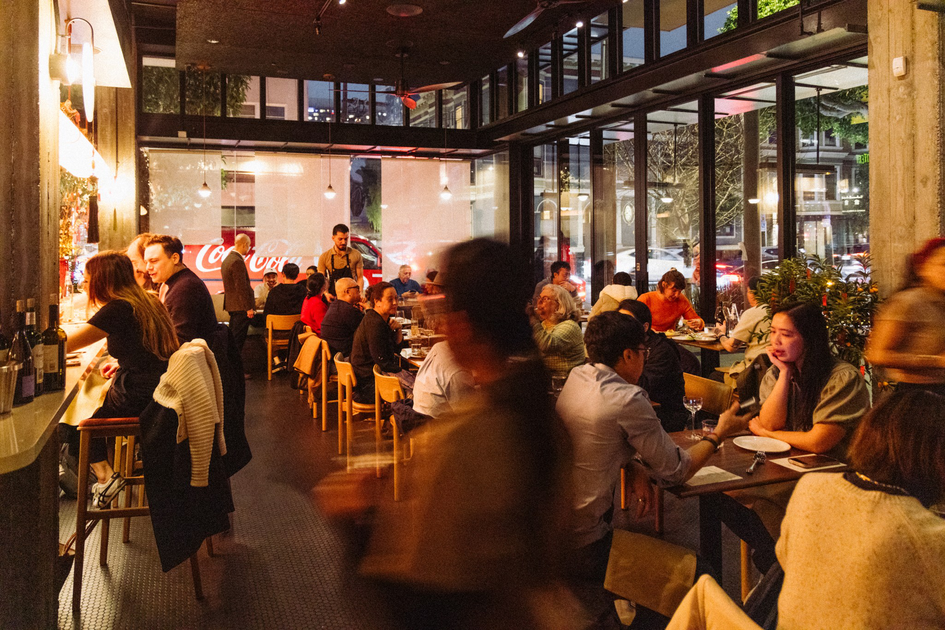
By 6 p.m., the glass-encased dining room was glowing like a lantern against the darkening sky. Designer Christine Trac of Abacus Row had hung red envelopes from a bonsai cherry blossom tree and rested colorful paper dragons atop the bar. In a corner, a compact tree was heavy with mandarins, which symbolize good luck, wealth, and prosperity.
One hour into the evening, guests had been seated at nearly every table — at one, a woman wearing a rhinestone-covered denim jacket pulled a tangle of lo mein noodles out of a Dungeness crab shell; at another, a trio of diners lifted delicate lobster-filled dumplings from a bamboo steam basket. They were Parry super fans, they said, and have followed the chef since he ran the kitchen at Palette Tea House at Ghirardelli Square.
The first course brought a series of four dishes to the table, including an ivory orb of tofu in shaoxing wine topped with Santa Barbara uni and a lively version of lo hei, a Cantonese-style salad traditionally eaten at Lunar New Year. The salad emanated a symphony of textures: tender raw hamachi, batons of ginger, and crispy sunchokes in green Sichuan oil. The second course included firecracker shrimp — a Parry creation that’s a fan favorite at The Happy Crane — as well as Sun Moon Studio’s savory egg tart: tender custard cradled in a flaky, butter-rich shell buried under a layer of briny trout roe. It was a bite you could revisit a hundred times and still want more.
 Salt-and-pepper squab. | Source: Andria Lo for The Standard
As the next two courses arrived, the early diners began to trickle out, and the growing cluster who’d been waiting in the doorway took their seats. Two women slid into their seats and spoke quietly into fuzzy lavalier mics pinned to their shirts as they filmed their meal on a camcorder. At the pass, the counter where finished dishes are placed before being picked up by servers, Parry studied a row of white tickets, his brow slightly furrowed as he crossed off courses that were ferried to tables.
A platter of salt-and-pepper squab arrived with a plate of little gem lettuce and a compressed apple.Wrapped in the small leaves and layered with hot mustard, the fatty pieces of bird were a lesson in contrast — crisp skin and fatty flesh, savory meat and sweet fruit. The meal culminated with rich crab lo mein noodles and a dish called Buddha Jumps Over the Wall, which Hsu wanted to cook after tasting it during a recent visit to Taiwan. The luxurious stew is typically served in an ornate urn. On this night, it was portioned into individual bowls, crowded with deeply savory chicken broth, local abalone, black cod, and dried scallops.
Dessert was abundant: black sesame and peanut cream puffs, The Happy Crane’s signature mochi rocher, and a Lunar New Year cake the three chefs created together. The springy red-bean cake was artfully adorned with citrus wheels and mint leaves and accompanied by a small bowl of the crème fraîche ice cream, a tangy counterpoint to the earthiness of the red bean.
It was Parry’s idea to end the meal with the traditional dessert, and Cooper’s suggestion that the crème fraîche component come in the form of ice cream. “I was thinking that we would put it through his soft serve machine,” Cooper said, looking at Parry with a smile. “But he was like, ‘Yeah, great. You should make that.’”
Parry looked slightly embarrassed. “Oh, I missed that entirely.” In the end, it all worked out.