
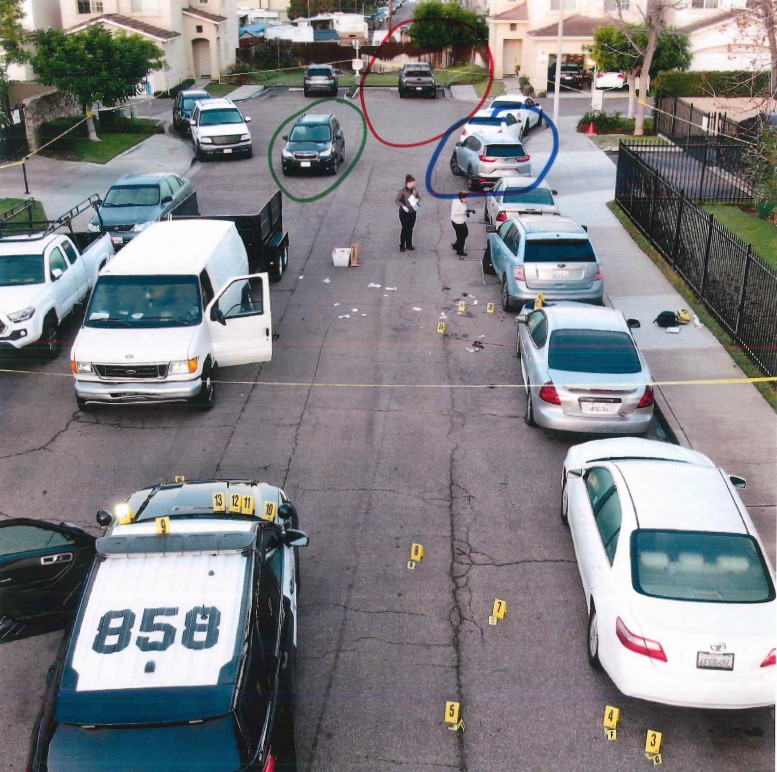
Two San Diego sheriff’s deputies who opened fire on a vehicle-theft suspect in 2022, inadvertently striking a National City police detective in the process, testified that they saw the detective and one other officer “downrange” behind their target but fired at the suspect anyway, according to recently unsealed records in one of two lawsuits related to the shooting.
A defense expert hired by San Diego County to evaluate the incident also concluded that if National City Detective Rowdy Pauu was standing at the time of the shooting, as he has said he was, rather than crouching, then at least one of the deputies “would have had direct line of sight to at least Mr. Pauu’s head” when that deputy and his partner squeezed off 17 shots at the suspect.
Those new revelations were part of a recent court filing by Pauu’s attorneys in his lawsuit against the county and the two deputies, David Lovejoy and Jonathon Young. The theft suspect who was shot that night, Erik Talavera, has also sued. Both cases are pending.
Attorneys for the county and the deputies have asked a judge to dismiss Pauu’s case. On Thursday, U.S. District Judge Todd Robinson held a hearing to determine whether to grant that dismissal, known as a motion for summary judgment. The judge did not make a ruling Thursday, stating that he will issue a written order in the future.
Attorneys for the county and the deputies argued that Pauu, who has since been promoted to corporal, cannot prove the two deputies violated his 14th Amendment substantive due process rights. They argued that in order to win on such an argument, Pauu would have to prove that Lovejoy and Young meant to hurt Pauu under a legal standard known as “purpose to harm,” and that their actions “shocked the conscious,” another legal threshold.
Pauu’s attorneys argued that a big-picture view of the incident would prove that a 14th Amendment violation occurred. Euguene Iredale told the judge that the deputies shot at Talavera as he was obeying their commands and moving toward the ground with his back to them, all while they fired 17 shots toward fellow officers and nearby residences in a densely populate cul-de-sac.
“That is shocking to the conscious,” Iredale argued.
Thursday’s hearing came on the heels of two recent closed-session meetings the county Board of Supervisors held with legal counsel to discuss the cases. According to the board’s agendas, the supervisors held a conference with legal counsel Tuesday to discuss Pauu’s lawsuit and Jan. 28 to discuss Talavera’s lawsuit.
A county spokesperson declined to comment on the nature of those discussions, citing a policy against commenting on ongoing litigation.
The incident at the heart of both lawsuits occurred late at night on Feb. 16, 2022, as Pauu and his colleagues on the San Diego County Regional Auto Theft Task Force — known as RATT — were patrolling El Cajon in plainclothes and unmarked vehicles, according to the lawsuits and previous details provided by authorities.
Late that night, Pauu and other RATT detectives began tracking the movements of a GPS device installed in a “bait trailer” that they had set up as a trap to catch would-be thieves. As they tracked its movement, they requested that uniformed sheriff’s deputies pull over the driver of the van towing the stolen trailer.
Eventually the deputies pulled over the van’s driver in a cul-de-sac at Ballard and Decker streets, just south of Main Street in El Cajon, where Talavera allegedly exited the van armed with a knife.
A review of the incident by the District Attorney’s Office, which cleared Lovejoy and Young of criminal liability, concluded that both deputies believed the item in his hand could be a small gun.
Footage from the deputies’ body-worn cameras showed Talavera, who was about three car lengths away from the deputies, appeared to be moving toward the ground when both deputies opened fire. After dropping to the ground wounded, the footage showed Talavera pushing his upper body slightly off the ground and grabbing the knife. Lovejoy then fired two more shots.
Investigators determined Lovejoy fired 12 rounds and Young fired five, according to the district attorney’s review. Talavera was shot 16 times and survived. One shot struck Pauu in his lower left leg.
Pauu’s attorneys contend that Lovejoy and Young didn’t see Talavera’s knife until after they shot him. In an opposition to the county’s motion for summary judgment, they argued the deputies had no need to use any force, much less deadly force, to subdue Talavera.
They also argue that both Lovejoy and Young fired at Talavera despite seeing Pauu behind him. In a deposition conducted in December 2024, Pauu testified that a few days or weeks after the shooting, he was at a dinner with Young and Lovejoy when Lovejoy made a comment that caused his heart to sink.
“He told me … that he saw me and he thought that he could make the shot,” Pauu testified. He went on to say that was the moment he began thinking differently about the two sheriff’s deputies “and how this incident really unfolded.”
Pauu also testified that Lovejoy made a similar comment at a different time shortly after the shooting, during a debrief session at the Santee sheriff’s substation.
“There were several people there, and he essentially told me that he thought that he could make the shot,” Pauu testified during the deposition.
Attorneys representing the county and the two deputies said Lovejoy “absolutely denies” making that comment, but argued that if he had said it, it “would actually confirm that it was not his purpose to harm Pauu, but to hit the suspect, Talavera.”
In a deposition conducted last May, which was recently unsealed as part of a filing by Pauu’s attorneys, Lovejoy testified that when he first got out of his vehicle at the scene and began giving commands to Talavera, he saw two plain-clothes officers “standing in my backdrop.” He said the officers moved out of his line of sight before he fired.
Lovejoy gave a similar accounting during an interview with El Cajon detectives hours after the shooting, while accompanied by an attorney from his union, the Deputy Sheriff’s Association.
“I did identify that there were two officers immediately in my line of fire, but they abruptly moved out of my line of fire and I couldn’t see anybody else downrange at that point,” Lovejoy told the El Cajon detectives, according to a transcript of that interview included in the court record.
When Young was deposed, he also testified that before he fired his gun he saw two individuals that he perceived to be RATT members. He also testified that he believed they were moving out of the way, and that “at the time that I pulled the trigger the only person that I saw was Mr. Talavera.”
Young gave a similar account of the shooting in his interview with the El Cajon detectives, during which he was also accompanied by the union attorney. While describing the actions of Talavera just before he and Lovejoy shot him, Young said “at that time I could see some individuals that were like downrange from where I was positioned. I believed them to be law enforcement officers that might’ve been associated with this RATT taskforce.”
During a deposition conducted in October, Geoffrey Desmoulin, an expert hired by the county, said that were he to testify at trial, he would tell the jury that if Pauu had been standing upright, “he would be in (Lovejoy’s) field of view.”
Asked by an attorney if “Lovejoy would have had direct line of sight to at least Mr. Pauu’s head,” Desmoulin confirmed that was correct. He said Young’s view was more obstructed, but his angle “may still have allowed line of sight to (Pauu’s) head.”
In a report he prepared, Desmoulin also concluded that it was “unclear if the lighting conditions or visual attention would have allowed (both deputies) to perceive Mr. Pauu.”
In addition to arguing that Pauu cannot establish a constitutional violation, the county has argued that the deputies are entitled to qualified immunity, which protects government officials, including law enforcement officers, from civil liability for their official actions unless those actions violate “clearly established” statutory or constitutional rights.
Robinson did not give a deadline on when he will rule on the motion for summary judgment.