
San Diego County’s hotel real estate market slumped a bit last year, as measured by the number of transactions and overall dollar volume, which both declined, compared to a year earlier.
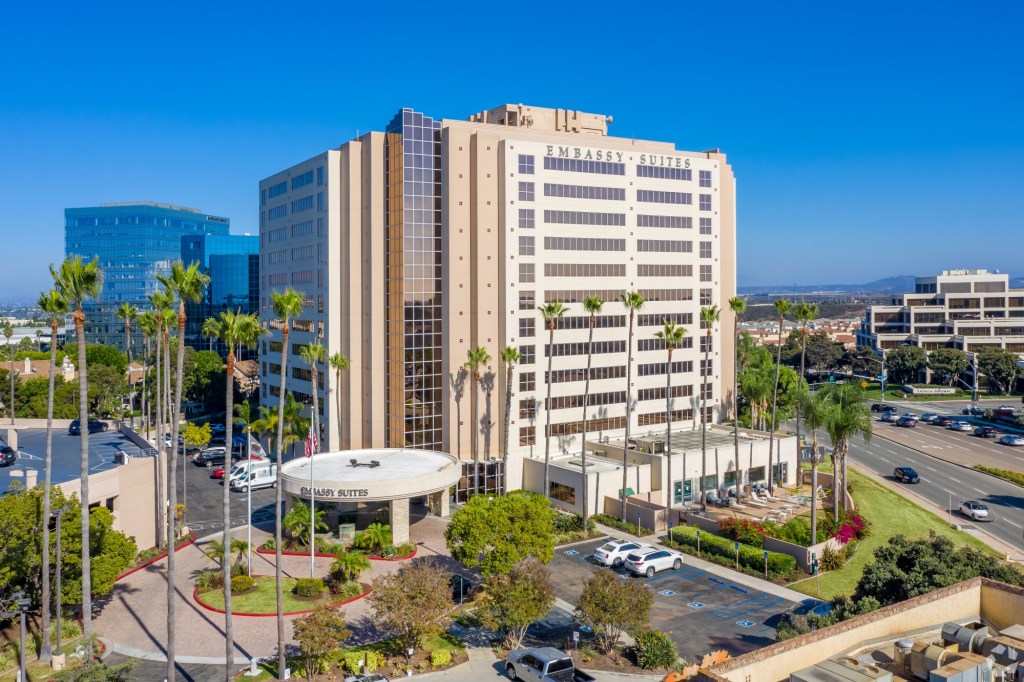
The good news, though, is that the median price paid per room for the 17 hotels that sold in 2025 jumped more than 20%. That’s due in part to the county’s single largest hotel transaction — the 340-room Embassy Suites La Jolla.
A newly released report on 2025 hotel sales statewide shows San Diego County was something of an outlier. Taken as a whole, California hotel sales rose more than 4% compared to 2024, while the dollar volume of those transactions shot up 22%. But unlike in San Diego, the median price paid per room in California slipped 7%.
Statewide, only three counties — Alameda, Fresno and San Francisco — saw bigger percent increases than San Diego in the median price per room, reported Atlas Hospitality Group, an Orange County-based brokerage firm that tracks the California hotel real estate market.
“Yes, sales were down in San Diego, but that’s because prices got pushed up,” explained Alan Reay, president of Atlas Hospitality. “The higher the asking price the lower the volume. There’s only one reason a property won’t sell and that’s price. The property can be empty with structural problems, but it’s still just a function of price.
“In San Diego, the price expectations for sellers were higher than what buyers were willing to pay last year. Some did pay those prices but we’re seeing a lot of investors now looking at alternative markets, whether it’s San Francisco or San Jose, in terms of what they can buy on a price-per-room basis.”
Last year’s sales, the vast majority of which were consummated in the second half of 2025, were down 19% compared to 2024, Atlas said. They ranged from two large La Jolla-area hotels to small inns and motels scattered throughout the county. The total sales volume was $469 million, compared to more than $603 million in 2024. The median price paid per room, though, rose to $248,000, considerably more than the median of $201,802 a year earlier.
The county’s biggest sale, which closed in December, was notable for the much-discounted price paid by the new owner, a Los Angeles-based investment company. The $111 million purchase price for the Embassy Suites amounted to slightly more than half what was paid four years ago by San Diego firm BioMed Realty, which is focused more on the life science and technology industries and had bought the hotel as part of a redevelopment plan that never materialized.
“Overall, the San Diego market in 2025 saw good price appreciation,” Reay said. “Yes, Embassy Suites sold for less than what it was purchased for, because it was purchased by a life science company, and I could argue they way overpaid for it in the first place.”
While the California hotel real estate market was dampened by widespread economic uncertainty earlier this year that was triggered by on-again, off-again tariffs, some counties like San Francisco and Los Angeles had their own unique troubles, says Ray Martz, chief financial officer of Maryland-based Pebblebrook Hotel Trust. The real estate investment firm owns eight hotels and resorts in San Diego County.
Post-COVID, San Francisco, once a top-tier market, experienced a steady decline, fueled by the retreat of big corporations, large retailers exiting downtown, and rising homelessness — although Martz points to signs of a rebound. And Los Angeles, he says, was impacted hugely by last year’s wildfires. While the fires were confined to Altadena and Pacific Palisades, the perception was that Los Angeles was no longer an appealing tourist destination, he said.
“Market by market, what’s happening in San Francisco is different from what’s happening in Los Angeles,” he said. “San Francisco now is having a huge resurgence, which is continuing, while Los Angeles took a big step back because of the fires. And when they were really done, the perception by travelers was that all of L.A. burned down and you can’t go there. So that makes it hard for a buyer to underwrite a transaction.”
While San Diego County didn’t face those sorts of challenges, the city of San Diego’s new hospitality minimum wage, which is much higher than the citywide minimum wage, is starting to impact hotel operating revenues, Martz said, and could likely dampen interest in real estate acquisitions.
“We’re looking now more to sell (than buy) in San Diego, but not for just this reason,” Martz said. “It’s a better use of capital. There have been challenges in California in general, with Los Angeles being the largest. Even though we’re looking to sell properties, we will be disciplined.”
Two notable distress sales in California last year were in San Francisco, where Park Hotels & Resorts’ former Hilton San Francisco Union Square and Parc 55 sold for $408 million, a roughly 75% discount off their appraised values in a 2016 financing.
Still, Martz believes there’s room for optimism in the hotel market this year.
“I think the economy is poised to do well, interest rates are lower, and there will be a stimulus from the new tax bill, so positive things should be driving the economy,” he said. “So we should have less uncertainty than in 2025, but who the heck knows?”