

This essay and interview appear in this week’s The Book Pages newsletter. For more information and book coverage, sign up for the free newsletter.
Terms like “artificial” and “robotic” aren’t words associated with satisfying romance, which seems to prefer the warmth and connection of a human touch.
But hey, we could always ask AI about generating passion and desire and see what it outputs. (Don’t worry, we won’t.)
Seeing as today, Feb. 13, is an important celebration of love – yes, I mean Galentine’s Day – and then there’s that other heart-shaped holiday tomorrow, let’s chat about a heated new romantic entanglement.
Earlier this week, the New York Times published a story about Coral Hart, a romance novelist who turned to AI (and 21 pen names) to churn out more than 200 romance novels last year. Before using AI, Hart’s previous rate of production, per the story, had been an impressive 10-12 books per annum, so it’s unclear why she felt she needed to increase output.
Is more better? Hart said she’s making six figures from selling 50,000 books, though when you divide that by 200, the results seem a bit less impressive. Hart, in fact, is not even the author’s name; the piece says she didn’t want it to be associated with AI publishing, which is interesting.
(If you want a deeper dive on AI, romance and consciousness, check out Michael Pollan’s new book, “A World Appears,” in stores next week. In one interesting exchange, he asks an expert about the possibility of humans falling in love with a seductive AI, and gets this sharp response: “And what’s wrong with that?!”)
The New York Times story, which includes an AI-using romance publisher saying things like, “If you hide that there’s AI, it sells just fine,” will likely make you feel things – disturbed, dispirited, depressed – but romantic? Probably not. (Though if sexy robots charge your batteries, no judgment here, especially if a human author dreamed that scenario up and wrote it down.)
The online response to the New York Times piece seemed pretty negative from what I saw – especially since many noted that AI programs had been trained on human-written novels without permission or compensation.
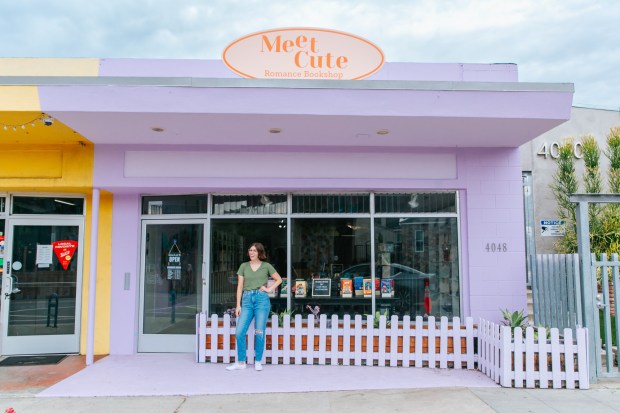 Meet Cute Romance Bookshop founder Becca Title poses in front of the shop in North Park. (Robin Dayley)
But I wanted to hear from some local experts, so I reached out to romance booksellers in Southern California to get their take.
Becca Title, the owner of Meet Cute Romance Bookshop in La Mesa, responded with genuine enthusiasm via email, “I sure do have some thoughts about that New York Times piece!” when I reached out.
“A romance novel is a work of literature like any other novel. It is about humanity, both in its text and in its function as a work of art. Fiction is about communication. About empathy,” said Title, whose store is a queer- and woman-owned, feminist bookshop focusing on genre romance.
“Romance novels, in particular, are about people’s need for love and connection. I do not believe that an algorithm trained to regurgitate millions of pirated texts can write a good work of fiction because there is no possibility for real communication, real empathy, real sharing of wisdom between a reader and what is just a cunning facsimile of an author,” she said.
“And, I think it’s worth asking, why would we want it to?”
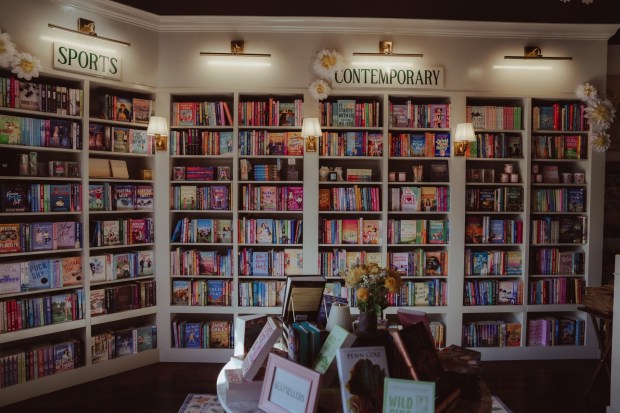 The interior of In Bloom Bookery which opened earlier this year in Old Town Temecula. (Courtesy of Katie Mullin.)
Katie Mullin, owner of In Bloom Bookery in Temecula, also responded quickly by email to my questions.
“I wholeheartedly believe that there is no place for AI in romance novels,” says Mullin. “Not only is the use of AI harmful to authors and artists who dedicate themselves to writing original work, but it is also unfair to readers who trust that they are purchasing original content. The heart of a romance novel is the human connection. Readers crave originality and admire the craft that authors pour their hearts into; I don’t believe AI can replicate that.
“The fact that writers and artists feel AI programs have exploited their work already is a huge problem. Hundreds of authors have already experienced their work stolen and pirated to train AI without their consent, and it’s simply not right,” says Mullin. “I hope that publishers will protect and support authors of original material and provide readers with an authentic human experience, not something formulaic generated by AI.
“We support artists who invest their time and creativity in producing original work,” she says.
Meet Cute bookseller Title agrees, drawing attention not only to the text but also to the artwork.
“Many authors have spoken out about their concerns that their copyrighted works are being fed into LLMs without their consent to generate marketing materials.
“Cover art is already being generated by AI rather than created by paid artists. AI-generated books are not being labeled as such, and readers who would like to make ethical choices when picking their next reads are struggling to do so,” says Title. “The constant push to squeeze out an extra dollar of profit is going to destroy not just the romance genre but fiction more generally unless we can collectively take a stand against it.”
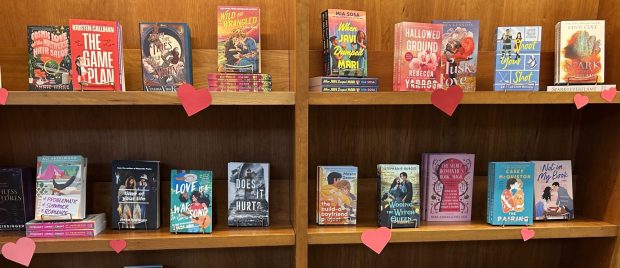 Romance novels on display at Vroman’s Bookstore in Pasadena on Bookstore Romance Day on August, 9, 2025. (Photo by Erik Pedersen)
And here’s something to consider: If even a small percentage of people start publishing books at the pace of Coral Hart, it’s easy to imagine the onslaught of AI books overwhelming actual author-created works. And who would have time to read all that? You can foresee overproduced AI novels being read by AI bots to dispense AI synopses while we … doomscroll articles about the death of reading? None of this sounds good.
Currently, it can feel like billionaires and bots are making all the decisions affecting our lives online and in the world, but remember: Readers remain in control of what they read, and so it’s important that we continue to speak out and support actual authors, independent bookstores and our library systems to ensure that this continues.
Look, I don’t know much about AI, but my guess is that there may prove to be some fantastic uses for it that we haven’t even discovered yet. I hope so.
But generating AI novels that mimic the way actual authors write and readers read (and feel) probably ain’t it.