
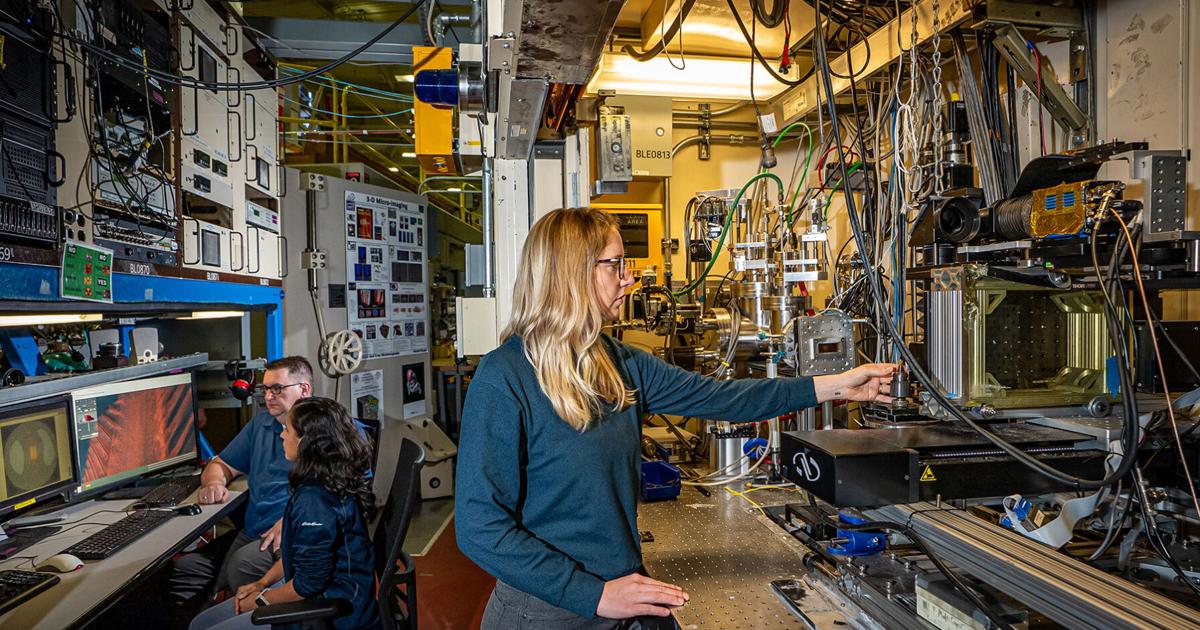
Lawrence Berkeley National Laboratory is spearheading the development of three projects to advance scientific research in AI.
The initiatives are a response to President Donald Trump’s Nov. 24 executive order dubbed the “Genesis Mission.” Under Trump’s directive, the Department of Energy is funding the use of AI to accelerate discovery and development in the areas of national security, energy and science. Berkeley Lab is specifically working on AI integration in particle accelerators, imaging data and biotechnology research.
According to Jonathan Carter, Berkeley Lab’s associate laboratory director for computing sciences, the Genesis Mission aims to “fundamentally change how scientists work with AI, moving it from a passive tool into an active partner in discovery.”
“Rather than using AI primarily for summarizing literature, coding assistance, or post hoc data analysis, the projects will embed AI directly into the scientific workflow—where decisions are made, experiments are designed, systems are operated, and discoveries unfold in real time,” Carter said in an email.
The first of these three projects is using AI to develop more efficient particle accelerators, which are machines used in physics research that propel charged particles at high speed.
According to Jean-Luc Vay, the project’s team lead, particle accelerators have historically required complicated designs that take a long time to build out.
“We anticipate that AI will enable us to streamline the design workflows,” Vay said in an email.
The incorporation of AI into designing complex particle accelerators will also enable researchers to run physics experiments 100 times faster than a human could, according to a Berkeley Lab press release.
Daniel Ratner, head of the machine learning department at SLAC National Accelerator Laboratory said particle accelerators are a “great test case” for AI in science because of their complexity and high level of automation. Ratner is not affiliated with Berkeley Lab.
“It’s a great test case before you deploy to things like the grid or nuclear power plants or other types of complex, high-consequence environments,” Ratner said.
Berkeley Lab’s second project is spearheading a multi-lab initiative on imaging data from X-ray and neutron instruments that will apply AI to unify data from many national laboratories to make it easily accessible.
“It is enabling us to interconnect the synergistic but previously disparate efforts across the various national labs,”said Chris Tassone, associate laboratory director for energy sciences at SLAC National Accelerator Laboratory. Tassone is not affiliated with Berkeley Lab.
The third project is building AI models to accelerate biotechnology in order to create better tools for agriculture and mineral recovery. Researchers plan to gather data of biological systems from different types of organisms into a bigger and more precise dataset.
“Across all three of the Lab’s projects, scientists are no longer ‘asking AI questions after the fact,’” Carter said. “Instead, AI systems are trained on DOE-scale scientific data, models, and domain expertise and deployed as intelligent assistants that help design experiments and systems; integrate simulations, data streams, and theory; monitor complex facilities and instruments; and identify patterns, risks, and opportunities faster than humans alone.”