
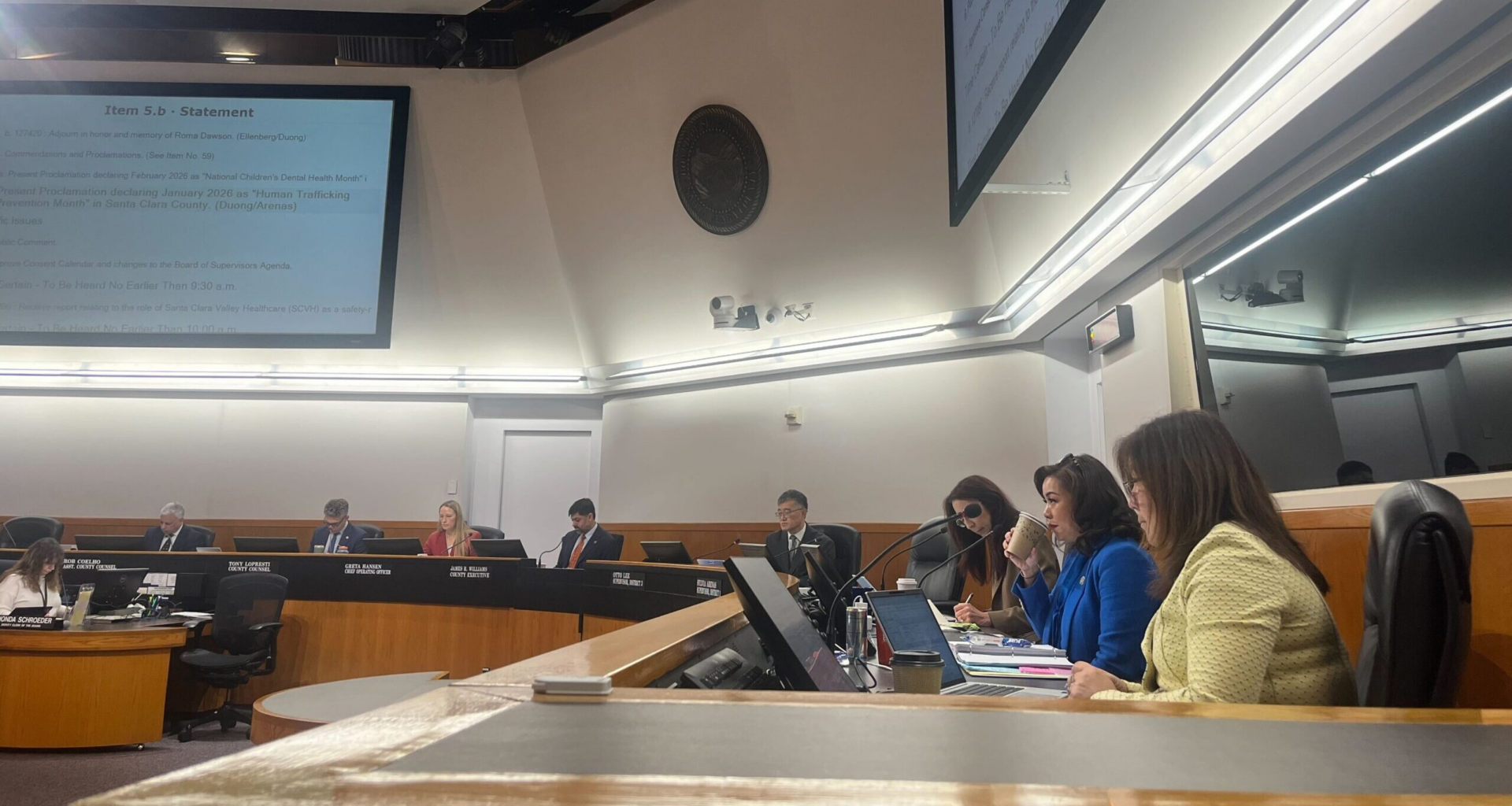
 The Santa Clara County Board of Supervisors is dealing with a $470 million budget shortfall due to federal cuts and minimal state support. San Jose Spotlight file photo.
Santa Clara County leaders are looking at a $470 million deficit in the upcoming fiscal year — forcing the largest midyear budget adjustment in more than a decade as they look to close $200 million of the gap.
The Board of Supervisors voted unanimously Tuesday to reshuffle 60 employees — mostly out of the public hospital system — to other county roles without laying them off. County leaders in total eliminated 365 full time positions, of which 305 are unfilled across several departments. Officials have also found $60 million in additional revenue projections to help cut down the budget shortfall for fiscal year 2026-27.
That still leaves a remaining — and difficult — gap of roughly $270 million to address in the upcoming budget process.
“These are very tough cuts,” Board President Otto Lee, who represents District 3, said to county employees at the meeting. “You’ve gone through all these (departments) to find places for those who have been affected and fill positions so that no one in this county is being laid off.”
This significant shortfall comes even as county leaders successfully campaigned for a voter-approved, five-eighths cent sales tax increase, known as Measure A, which is expected to bring $330 million in extra revenue per year until it expires in 2031. The measure was introduced to offset the impacts of unprecedented federal spending cuts under H.R. 1, President Donald Trump’s “One Big Beautiful Bill.”
“Once we were able to recognize the overwhelming magnitude of these unprecedented federal cuts and impact they would have, we put forward a three-part strategy to bridge this extraordinary gap,” County Executive James Williams told San José Spotlight.
Measure A was one part of that strategy. But even with the cushion of the voter-approved revenue, county leaders expect their structural deficit to balloon over the next several years. The 2027-28 fiscal year is projected to pose even more pain, with another $500 million in funding losses expected. Salary and benefits for county employees are also going up due to future pension obligations, contributions for retiree health and substantial increased costs for health insurance.
District 4 Supervisor Susan Ellenberg said the numbers would be worse if the county didn’t have the foresight to “dial back” certain expenses several years ago.
“We saw the economy turning. We saw those years of enormous and exponential growth in property tax revenue slowing down and, frankly, as dire as the situation is right now, I think without the choices we made over the last couple years it would be exponentially worse,” Ellenberg said at the meeting. “I know that’s not very comforting for most folks, but as we move through this process, it will be important to keep all stakeholders — patients, clients, service program recipients, community partners, county employees and the public — clearly and consistently informed about any changes that could affect them.”
District 5 Supervisor Margaret Abe-Koga questioned why the county’s lobbying team, the Office of Intergovernmental Relations, would see a $1 million spending increase while other departments face cuts.
“In light of the cuts we’re looking at, it’s hard for me to support adding money into something like (the lobbying office),” Abe-Koga said at the meeting. “As elected officials, I found the most effective advocacy going to Sacramento is using us. I know we’re all busy, but I think we have relationships with our legislators so I would look (for it) to be more utilized.”
Williams said he’s reached out to each supervisor’s office to schedule strategy briefings along those lines. He said the spending increase is to ramp up efforts to help state lawmakers realize the importance of Northern California’s largest public hospital system — and push for more funding to offset the county’s fiscal woes.
“It is a one-time investment and an effort we believe has the potential to pay significant dividends,” Williams said.
Williams said lobbying the state is one of the county’s most vital strategies.
“We need to make sure the state steps up and does its part to ensure the 6% of hospitals in California that are public — and which provide more than 50% of the burn and trauma care in the state and form the backbone of health care for all Californians — is able to continue to deliver that service,” Williams told San José Spotlight.
This story was written by Brandon Pho for San José Spotlight. The original version of this article can be viewed here.
Contact Brandon Pho at brandon@sanjosespotlight.com or @brandonphooo on X.
Most Popular