
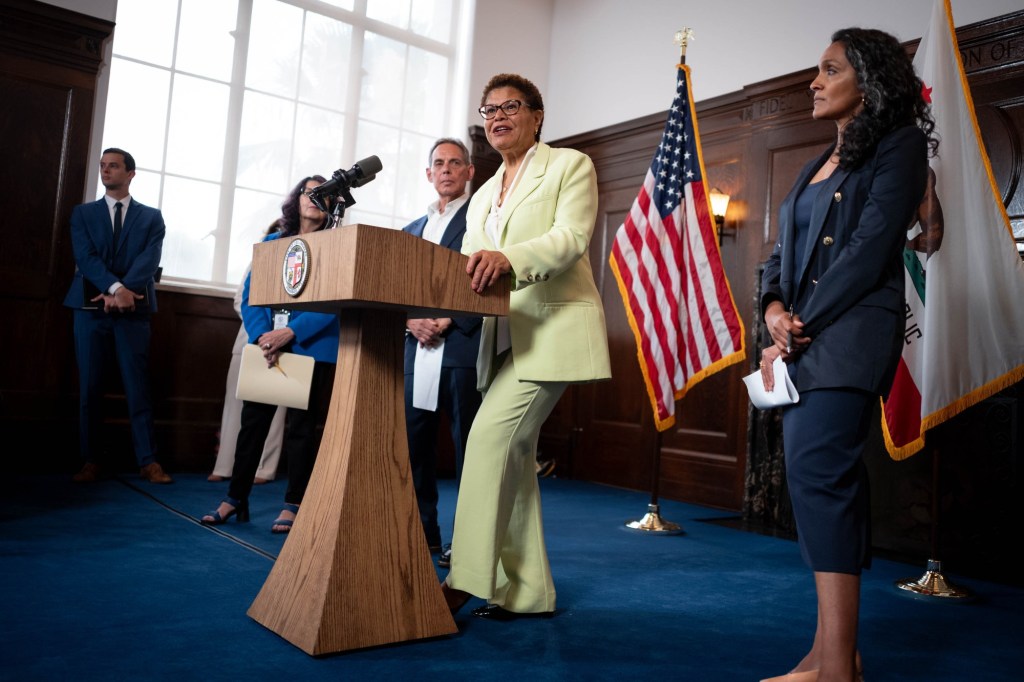
An eleventh-hour entrant into the race for Los Angeles mayor figures to turn the nation’s second-largest city into another battleground in a fight that’s been brewing within the Democratic Party: insurgent progressives versus the establishment.
Indeed, the announcement from Councilmember Nithya Raman that she will challenge Mayor Karen Bass has set off a firestorm, as the embattled mayor now faces a credible challenger. Moreover, coming after Zohran Mamdani — who Raman has drawn comparisons with — won his own longshot bid, Raman’s candidacy is a sign that the progressive wing of the Democratic Party is increasingly trying to flex its power.
Plainly, should Raman win — or even lose a close race — it would further upend American politics, marking another sign of the rising influence of progressives at the expense of moderates. To be sure, despite the similarities between Raman and Mamdani — including shared ties to the Democratic Socialists of America and drawing intense criticism from business leaders — there are also critical differences.
Unlike Mamdani, who had virtually no name recognition prior to his mayoral bid, Raman has a deeper record. Raman also has a history of focusing on the “nuts and bolts” of government, something Mamdani was — justifiably — criticized for having little experience with. Further, whereas Mamdani’s top opponents — former Mayor Eric Adams and former Gov. Andrew Cuomo — were genuine moderates, Bass is considerably further to the left, making it harder for Raman to draw distinctions between herself and the incumbent.
That being said, even if the contest in Los Angeles does not feature a true moderate vs. progressive matchup, that Raman felt confident challenging Bass — who Raman endorsed just weeks ago — underscores the potential for tectonic shifts within the Democratic Party and our political climate. Eventually, progressives’ growing influence at the state and local level will filter up to the national Democratic Party, continuing to push the party further to the left and thus marginalizing more moderate candidates who remain more electable in national elections.
To that end, while it is entirely too early for polls to reflect the impact of Raman’s candidacy, the betting markets do, and there are reasons Bass should be concerned. Prior to Raman’s entrance, Bass’ odds of winning had hovered between the high 50s and low 70s on political betting site Kalshi. In the days after Raman threw her hat in the ring, Bass’ odds dropped from 60% to 41%, while Raman currently sits at 32%.
Worse still for the mayor is that recent developments have exacerbated existing vulnerabilities that otherwise may have only had a marginal impact were Bass not facing a genuine challenger. Recent accusations that she altered a critical report on the Palisades fire to downplay the city’s role have reignited anger at the mayor over the city’s handling of the destructive fires. That frustration is almost certain to grow after a judge ruled that a “blockbuster” lawsuit against the city could proceed.
With the city already struggling to close its budget deficit, the potential for a ruling that could cost the city billions of dollars would be extremely damaging for Bass’ reelection. On Tuesday, after promising to “answer tough political questions,” Bass appeared to have “fled” rather than face questions on either the fire or Raman, according to a report in the New York Post.
Importantly, there is plenty of time for Bass to reassert herself, and she enjoys strong support from the police union and business leaders. In that same vein, Raman also has an uphill battle, beginning with needing to rapidly scale up a campaign with very little time.
Raman’s relationship with the progressive base — which helped her win her city council seat — has been rocky at times, much more so than Mamdani’s was in New York. According to Politico, Raman has alternated between winning “a tremendous amount of goodwill among progressives” for her support of rent control rules, but she has also “irked key members of her coalition” with her efforts to amend LA’s “mansion tax” in ways that would have expanded exemptions from the tax.
Notably, the complex relationship between Raman and her ideological allies on the far-left — as well as perceptions of disloyalty in challenging Bass — have already blunted some of the momentum she may have otherwise had. Councilmember Hugo Soto-Martinez, a key member of the council’s progressive caucus, refused to back Raman, declaring that he continued “to strongly support Mayor Bass.”
Likewise, despite Bass’ missteps, the city’s progress in combatting homelessness — which has declined for two years — and her combative approach to the Trump administration have lifted her approval numbers according to the New York Times. Whether or not those issues are enough to overcome Raman’s far-left populism remains to be seen, although Bass likely still has the inside track.
Ultimately, however, even if Bass does win, there is no denying the rise of progressives, coinciding with the growing weakness of the “moderate brand” of the Democratic Party. Should Los Angeles go the way of New York City, it would signal a potentially transformative shift in America’s political landscape.
Douglas Schoen is a longtime Democratic political consultant.