
Over the course of her career, Sarah Lacy has been a hard-charging tech journalist, an author, a startup founder and a writing consultant.
Her latest act has taken something of a different turn: She’s now a bookseller.
But Lacy remains every bit as ambitious as she was while covering the early days of Web 2.0 companies like Facebook or running tech outlet PandoDaily and is already applying her lessons learned along the way.
After opening The Best Bookstore in Palm Springs on Black Friday of 2022, Lacy and her partner, Paul Carr, opened their second shop in Union Square on the same day three years later. Now they’re aiming to eventually open as many as 15 statewide.
“I do think there’s a very big opportunity,” Lacy told The Examiner in an interview this week.
The couple didn’t set out to be booksellers, much less be the founders of a nascent bookstore chain. It just kind of came together.
In 2022, three years after retiring as a journalist and while winding down a startup she founded in 2017 that offered an online community for working mothers, Lacy and Carr found themselves in Palm Springs wondering why it had no bookstore. Longtime San Francisco residents, the pair bought a home in Palm Springs in 2019 and had temporarily moved there so her children could be close to their father, her ex-husband.
“We were like, ‘This is crazy,’” Lacy said. “We kept being like, ‘Someone’s got to open a bookstore.’”
To finance the business, the pair pulled about $150,000 in equity out of their house and found a few outside investors. But they didn’t exactly have high hopes for the venture; they thought they’d be lucky if they broke even, she said.
The peak tourist season in Palm Springs, when shops make almost all their money, is only about five months long; business is dead much of the rest of the year, she said. And women, who tend to be much bigger book readers than men, are far outnumbered by men in Palm Springs.
But the store was an instant hit, she said. Its initial sales were six times higher than she had forecast, and it posted $1 million in revenue in its first year, she said.
“We were astounded, and the market was astounded,” Lacy said.
Lacy said she and Carr approached the business kind of like a startup, experimenting with a lot of different things to see what worked. They created a mobile-ordering service, for example, designed to serve customers faster and better than Amazon, but then decided to drop it when they realized it would be too expensive to build out and it wasn’t a hit with customers, she said.
All told, the couple blew through about $150,000 with their experiments, Lacy said, but they ended up hitting on a winning formula: focusing on making the store a hospitable place for customers.
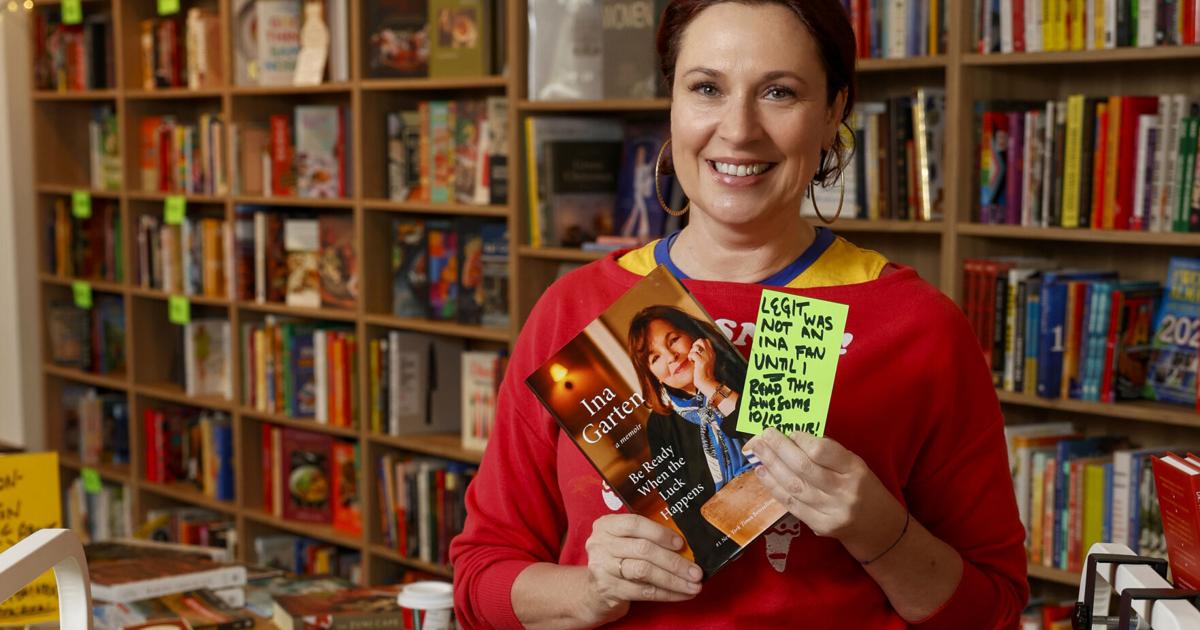
The Best Bookstore’s recommendation cards, which began after Lacy’s last-minute realization before opening in Palm Springs, are placed atop books so customers have to interact with them to see the tomes. She put her own spin on them, writing “you-based messages” — “here’s why you should buy this book” — that she learned from writing subject lines for her startup’s marketing emails.
At the suggestion of an early investor who’s an architect, all the stores’ shelves are against their walls. In the middle of the stores, no table or display is taller than waist-high. With that design, one employee can monitor the entire sales floor of the shop, meaning Lacy and Carr can have fewer workers but pay them more and give them better benefits, she said.
The design also gives the shops an open feel. Customers and staff can talk about books out in the open, and others can join in, she said.
“Instead of like, one copy, we’ll sell six copies, because everyone kind of gets in on the conversation,” Lacy said.
It took Lacy and Carr several years to figure out how to make the Palm Springs store a sustainable success, she said. Summers were tough; because they didn’t want to let go employees during the off-season, they were typically overstaffed and bleeding money in those months.
Last summer, they decided to cut staff, but that meant that Carr had to work every day over the summer, she said. And then the air conditioning broke in July, and their landlord refused to fix it. At that point, they were wondering if they should throw in the towel, she said.
“We were like, ‘Do we even want to do this anymore?’” Lacy said.
But they decided to take on the landlord, using Instagram to publicize their plight. The town rallied around them, and the landlord eventually relented, promising to both fix their AC unit and allow them to end their lease.
They took him up on the latter offer, finding a space a block away that was far less expensive, and making the business much more profitable and sustainable, she said. That convinced them they were in the bookselling business for the long haul, she said.
“That was the turning point,” she said.
Lacy and Carr chose a good time to start selling books.
Bookstore sales have actually grown at about a 1.6% annual rate over the last five years and are projected to continue to grow at that pace through 2030, according to IBISWorld, an industry research firm. Independents account for around 70% of sales in the market, according to IBISWorld data, and the share of those smaller stores is growing, said Jack Curran, a senior analyst at the firm.
Independent stores have gained loyal followings by offering a feeling of community and curating their selections for local tastes, he said.


The Jackson Square speakeasy-style restaurant and bar serves up classic cocktails while keeping its menu fresh with seasonal produce and new twists

The number of marchers in favor of the ultrawealthy at Saturday’s event was more than matched by reporters and counterprotestors

Advocates warn Department of Public Health reductions will be felt in programs serving vulnerable
Independent bookshops offer “a kind of tangible browsing experience that a lot of other industries are kind of giving up on,” Curran said.
The opening of Lacy and Carr’s San Francisco location was nearly as serendipitous and unlikely as in Palm Springs. They had talked about opening a second store, but it wasn’t a pressing issue, Lacy said. And because The City has so many great bookstores, they weren’t focusing on opening one here, she said.
But around August, Lacy’s kids insisted on moving back to San Francisco from Palm Springs so they could attend school in The City. Soon after, she and Carr had dinner with a friend, Lillian Van Cleve, then a manager at Bookshop West Portal. During the meal, they started talking about opening another bookstore, but doubting there was room for one in The City.
Van Cleve convinced them otherwise, and the possibility of opening one downtown in Union Square excited Carr and Lacy.
Foot traffic in the area, which plunged during the COVID-19 pandemic, already seemed to be increasing. Though the district seemed to be reviving, it hadn’t turned around enough to make rents unaffordable.
And while the area had previously supported as many as three bookstores, it had none at that point.
“By the end of that dinner, as often happens with Paul and I, we were like, ‘We should totally start a bookstore downtown!’” Lacy said.

Sarah Lacy, pictured in 2014 during her time as the founder and editor-in-chief of the Silicon Valley news site PandoDaily, is applying the lessons learned from her time working in and covering tech to running a bookstore.
Jason Henry © 2014 The New York Times Company
Within about two weeks, they’d raised around $100,000 from friends and family and were already talking with people at SF New Deal, the nonprofit that runs the Vacant to Vibrant downtown revitalization program, about finding a location, Lacy said.
SF New Deal Chief Program Officer Jacob Bindman helped them find their space on Powell Street just south of the square, and the nonprofit’s Kate Yachuk quickly negotiated an affordable lease for them. And as part of the Vacant to Vibrant program, SF New Deal essentially guaranteed their one-year lease.
Thanks in large part to the nonprofit’s help, Lacy and Carr had opened the second location of The Best Bookshop within four months of deciding to do so.
A big piece of SF New Deal’s effort to revitalize Union Square is encouraging locally owned small businesses to open stores there, said Simon Bertrang, the organization’s executive director. Lacy and Carr’s storefront was a perfect fit for that effort, he said.
“We’re really excited that Best Bookstore was able to bring their business downtown, Bertrang said. “It’s been a really exciting addition to Powell Street.”
Customers seem to think so, too. On a rainy Tuesday night near closing time, the store consistently had a handful perusing books, despite the weather. Many left the shop with purchases in hand.
Janet Mendoza, who is in her 20s and recently moved to Sacramento after studying at UC Berkeley, said she seeks out bookshops whenever she goes to a new city. She headed over to The Best Bookstore soon after she checked into her hotel and searching for local ones nearby, she said.
She walked out with a copy of “Intermezzo” by Irish author Sally Rooney, a book she had decided to buy if she found it at the store, because she was feeling nostalgic for the time she spent in Ireland, she said. Mendoza said she was impressed with the shop, its selection of books and general vibe.
“The energy is really dope in here,” she said.
Nob Hill resident James Dixon first visited Lacy’s store after hearing about it at another bookshop. He has been returning about once a week ever since.
Dixon said he likes how the store’s selection of books has been carefully curated rather than just reflecting what’s popular at the moment. He also likes Lacy’s recommendation cards, the fact that the signs indicating different categories of books are Post-It notes, and the “great music” playing in the store. And he appreciates that it’s clean and new and doesn’t have “stinky rugs or fetid cat puke,” he said.
“It has a feel of a real business that is owned by people who love books,” Dixon said.
Although Lacy loves having the store in Union Square, it’s an open question whether it will remain there, she said. She’s optimistic that she and Carr timed it right, but she’s concerned their rent could rise faster than foot traffic and revenue.
The store saw strong sales over the holidays, but things have been slow — as she expected — in January and February. Lacy anticipates a surge of customers in the summer tourist season. Meanwhile, she’s excited that the store has already attracted regulars from the nearby neighborhoods like Dixon.
“There’s just so many people who are really, really happy and grateful to have a bookstore downtown,” she said.
Lacy said she and Carr are already in talks to open a third store in Southern California, but they’re not in a hurry to do so. As they did with Palm Springs, they want to make sure the San Francisco location is profitable and stable first, although they might jump if the right opportunity comes along, she said.
She’s hopeful that getting the San Francisco store in the right financial place won’t take as long as it did in Palm Springs, because of the lessons they learned along the way. But she doesn’t have a concrete plan for the pace at which they’ll open new stores, she said.
Lacy said she thinks there’s room in the market not only for The Best Bookstore to develop into a 10-to-15-store chain but for other independent booksellers to do the same thing.
“Indie bookstores just have a better product,” Lacy said.
“Every one has sort of their thing that makes that local bookstore special,” she said.
If you have a tip about tech, startups or the venture industry, contact Troy Wolverton at twolverton@sfexaminer.com or via text or Signal at (415) 515-5594.