
California faces first major storm in weeks with heavy rain, feet of snow
A month’s worth of rain and mountain snow could fall across California as two storms line up for the state, starting this weekend. The first will arrive Sunday into Monday, with another possible by midweek, increasing the risk of travel disruptions.
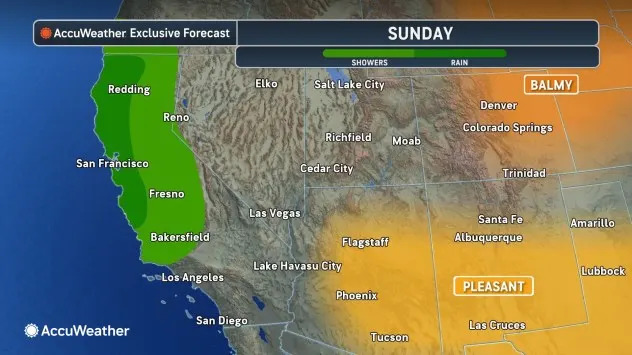
Rain will spread over the state, starting in northwestern California on Saturday night and becoming more widespread from Sunday to Monday. In the Siskiyou and Sierra Nevada, heavy snow will fall.
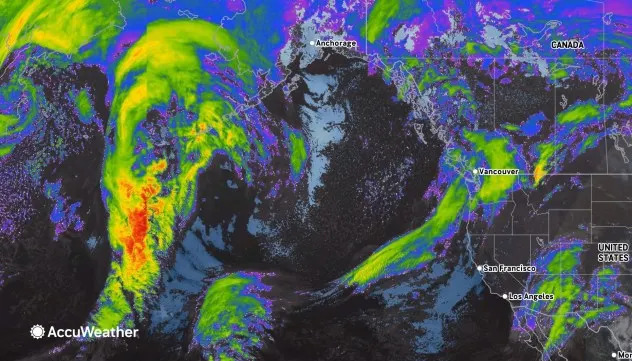
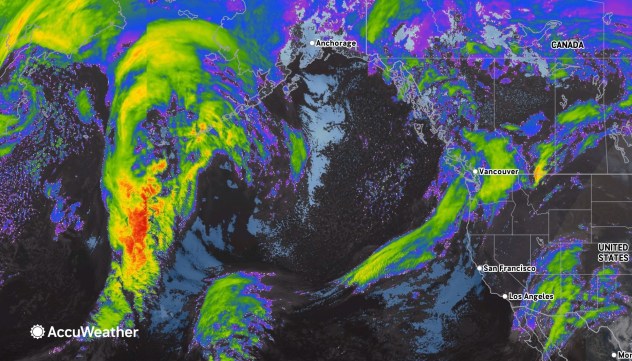
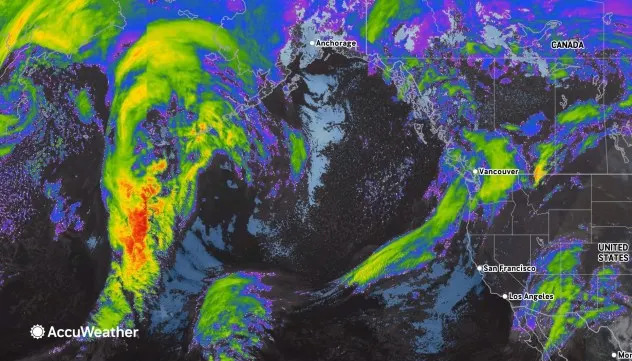
This image of the central and eastern Pacific and western North America was captured on Friday, Feb. 13, 2026. (AccuWeather Enhanced RealVue™ Satellite)
The heaviest and steadiest rain in San Francisco will be from late Sunday through Sunday night and into Monday, when a few inches may fall, enough to cause flooding in poor-drainage areas and minor debris flows. San Francisco typically receives just under 4 inches of rain during all of February.
AccuWeather.com
Farther south, “the commutes on Monday could be nasty in Los Angeles, especially lunchtime and the afternoon,” AccuWeather Senior Meteorologist Heather Zehr said. Rain will become heavy at times on Monday, with the heaviest rain reaching San Diego during the afternoon and evening on Monday.
Enough rain will fall in coastal Southern California to cause flooding on streets and highways that drain poorly. There will be a risk of mudslides and other debris flows.
Sacramento and Palm Springs, California, will also receive significant rainfall.
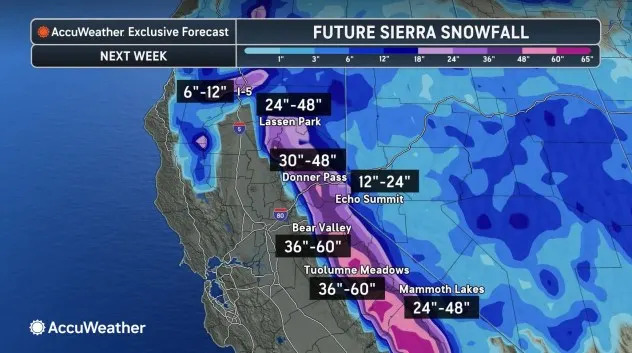
Freezing levels will reach well down below the passes in Northern California so that a major snowfall occurs over the higher elevations. Along Interstate 80 through the Sierra Nevada, a general 2-4 feet of snow will fall, with the high potential for Donner Pass to close for a time from late Sunday night to Monday night.
AccuWeather.com
Enough snow will fall along I-5 from Northern California to southern Oregon to make for slippery travel and the risk of road closures.
Many of the ski resorts in the Sierra Nevada will pick up 3-5 feet of snow from the storm, with locally higher amounts, into Tuesday.
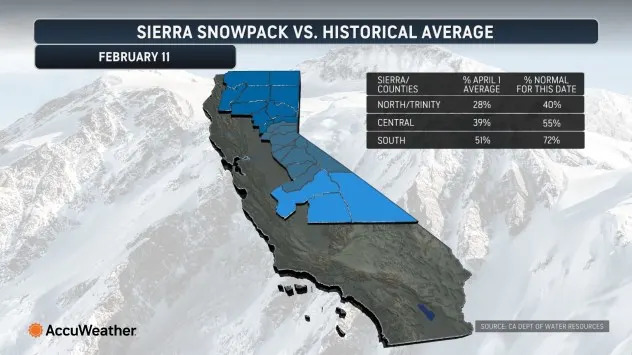
The snow will be a tremendous boost for seasonal snowfall. The Sierra Nevada has experienced little snowfall in over a month and has slipped well behind the average pace for the season to date.
AccuWeather.com
Snow is a major component for replenishing runoff in area streams, rivers and reservoirs during the summer.
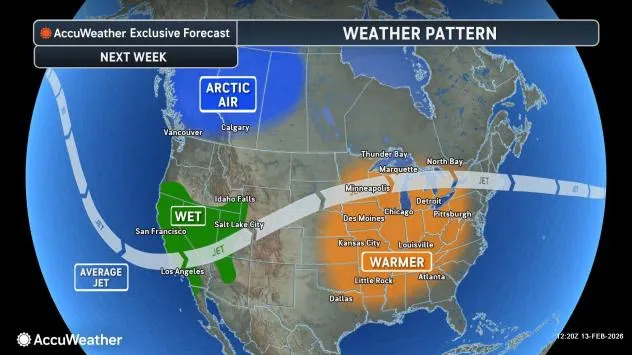
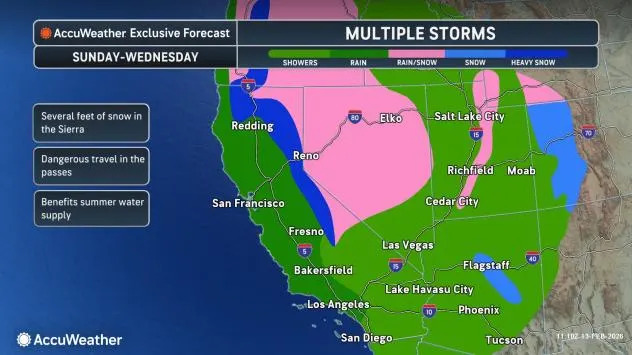
The same storm will pivot inland after dropping southward over California. Low-elevation showers and mountain snow will sweep across Nevada, Arizona, Utah, New Mexico and Colorado during the middle days of the new week.
AccuWeather.com
“Any moisture at all will be welcomed over the Colorado River basin and the Great Basin in general,” Zehr said. Utah and Colorado are near their record low for snow cover and the amount of water locked up in the snow.
“Salt Lake City has received only 0.1 of an inch of snow all winter, compared to a historical average around 37 inches through mid-February,” Zehr said. “It is possible that the metro area picks up its first inch of snow or more from Tuesday night to Wednesday morning.” Several inches to a foot or more of snow may fall over the Wassatch Range.
AccuWeather.com
A second storm is forecast to drop in along the California coast around the middle of the week. Since moisture will be limited with this second storm, widespread heavy rain and mountain snow are not foreseen with it. However, it appears as though it will be a colder storm with lower snow levels that may reach down to intermediate elevations.
Some rain and mountain snow may be spread more widely across the West Coast by the middle and latter part of the week, with low-elevation rain showers and intermediate- and high-elevation snow showers from California to Oregon and Washington.
Want next-level safety, ad-free? Unlock advanced, hyperlocal severe weather alerts when you subscribe to Premium+ on the AccuWeather app. AccuWeather Alerts™ are prompted by our expert meteorologists who monitor and analyze dangerous weather risks 24/7 to keep you and your family safer.