
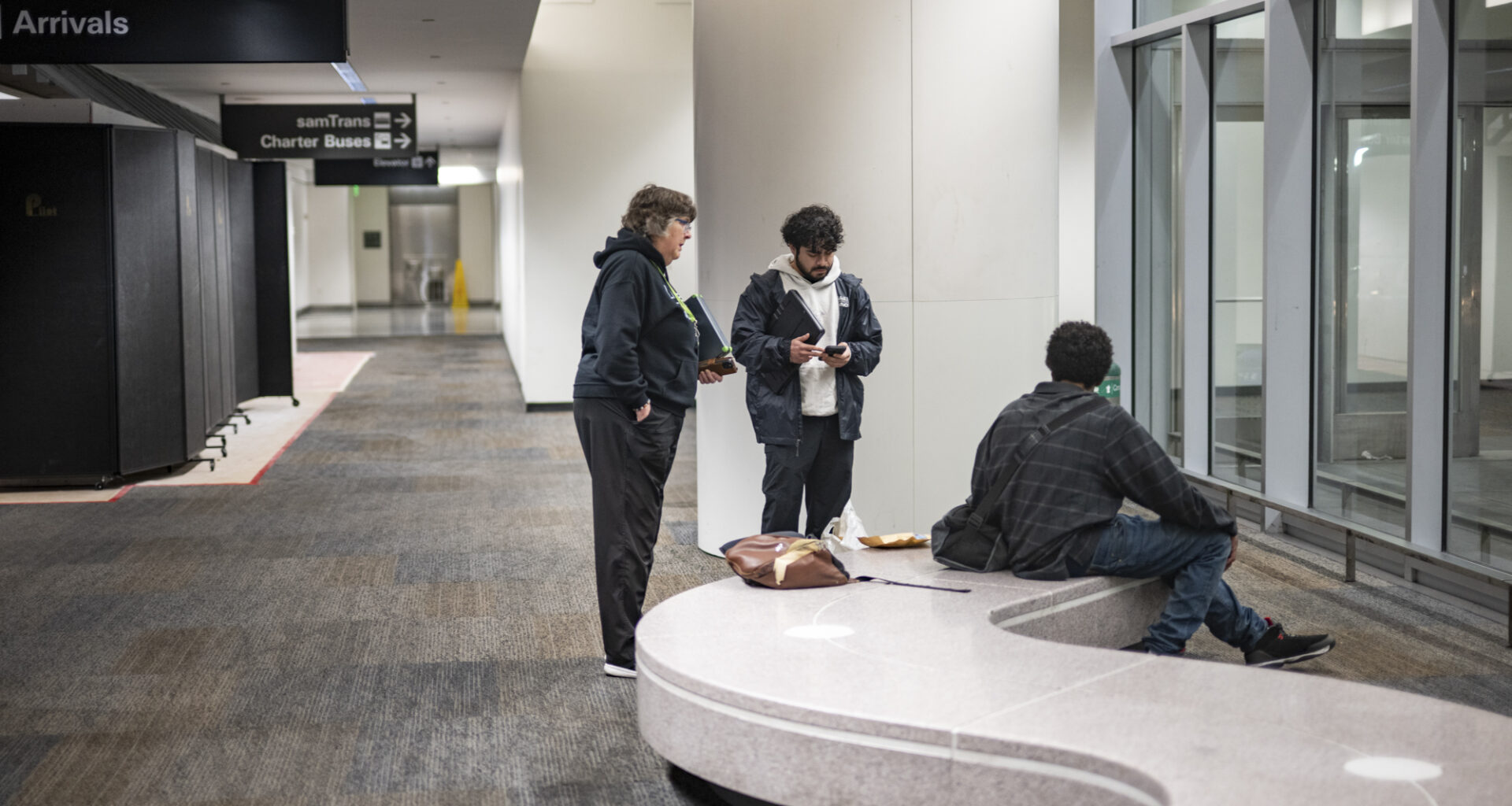
Paxton offers him a snack pack with fruit, a Danish and beef ravioli. The man takes it, along with a hygiene kit filled with products like soap, a toothbrush and an eye mask. But the unhoused man does not accept Paxton’s offer of shelter.
“He is a San Francisco native,” Paxton says. “He said that he’d like services in San Francisco. That’s where he’s from.”
But LifeMoves cannot offer shelter in San Francisco, because the organization operates in San Mateo County — where the airport is located — and connects folks with services there. And that’s a problem: Unhoused people arrive at SFO from all over the region, just like travelers do — and 95% of the Bay Area’s unhoused population lives outside of San Mateo County.
While the local homeless community is fluid, the Bay Area’s housing strategies are not. The region’s homelessness efforts are largely siloed by county, and this fragmentation challenges the Bay Area’s ability to provide services to unhoused folks where they need them, when they need them. So, when people experiencing homelessness at the airport want shelter, LifeMoves cannot house most of them in the county where they need it.
The SFPD says none of the unhoused folks officers encountered in December received “admonishments” or “citations”; none were arrested.
At the SamTrans stop, SFPD Officer Erik Whitney also spots the unhoused man.
“You can get on the bus,” Officer Whitney tells the man. “Out there. Not here. It’s trespassing.”
The SFPD and LifeMoves share a goal: They both want people experiencing homelessness at the airport to leave. But there’s a key difference. Paxton and his team attempt to get them shelter beds in San Mateo County before they go, while the police usually just give unhoused folks a bus ticket to go somewhere else.
And at certain hours, it seems that the police make sure unhoused folks don’t get into the airport in the first place.
V. MARTIN, SFO BART STATION, 1:15 a.m.
When the last train of the night pulls up to the SFO BART station at 1:15 a.m., about a dozen police officers on segues greet it. But no unhoused folks come off the train, and the cops whiz back into the airport on their two-wheelers.
“They’re here to make sure anybody [that] gets off the last train is flying,” BART station agent Martin Croskery says. As he locks up, he says that SFPD officers are there every night. “Cause there used to be a problem with a lot of homeless coming off the last train and then staying in the airport overnight.”
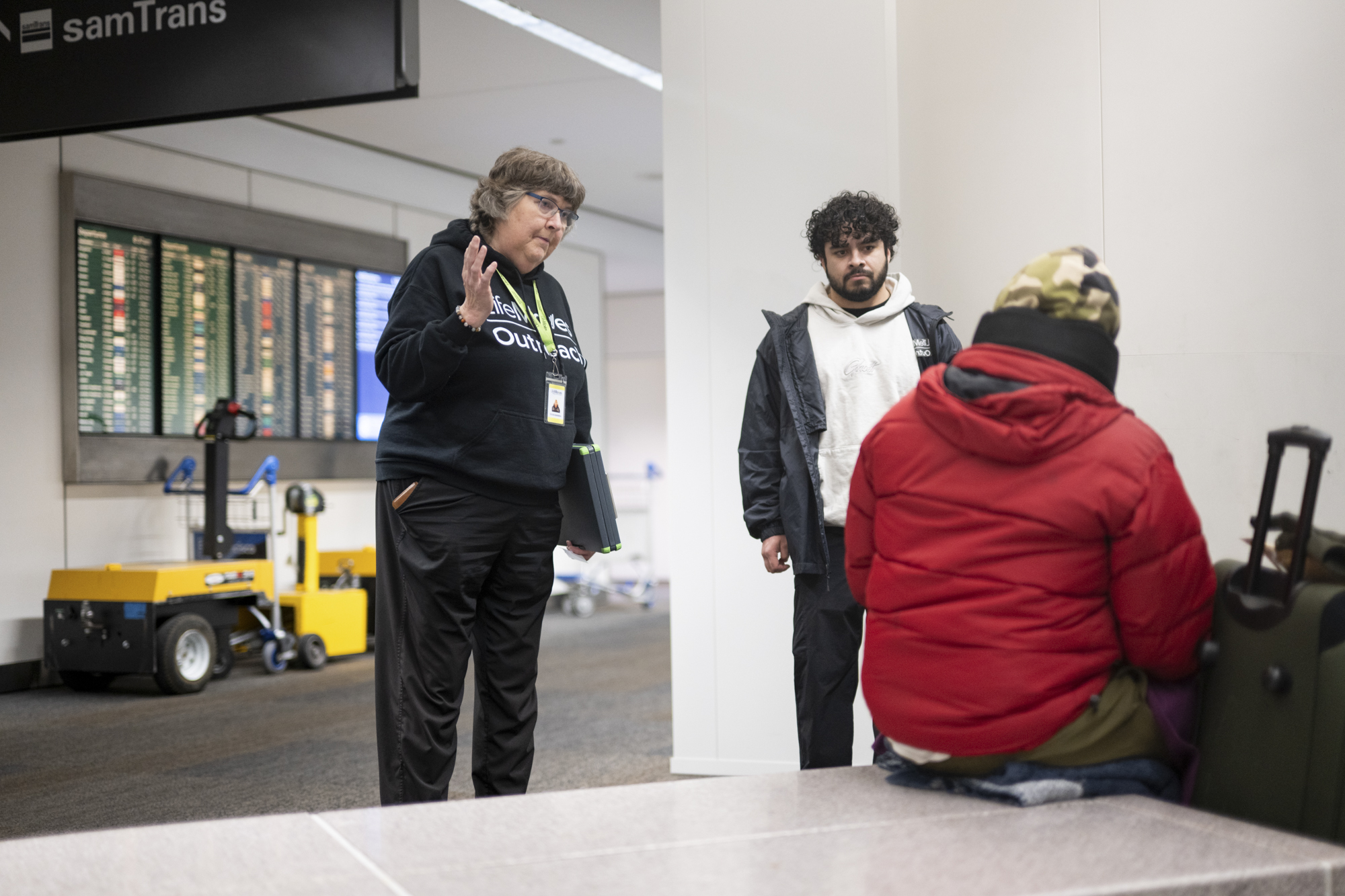 Sylvia Bambra (left) and Ivan Marquez, case managers with the LifeMoves Homeless Outreach Team, speak with an unhoused person during an outreach visit at San Francisco International Airport on Feb. 9, 2026. (Beth LaBerge/KQED)
According to public records, the SFPD made contact with nearly 100 unhoused people coming off of the last two BART trains of the night during the first week of December. But Croskery says he hardly sees people experiencing homelessness get off the last train these days, in part because the line no longer ends at SFO. In 2021, BART changed the train route to end in Millbrae, further south in San Mateo County.
“Millbrae now has issues, but the last train has to go somewhere,” Croskrey says. “The problem has shifted from — it’s gone back and forward for years. It used to be the airport, then it was Millbrae, then back [to] the airport. And the airport says, ‘We can’t have this.’”
VI. JAMES, MILLBRAE BART STATION, 8:30 a.m.
At the end of Paxton’s monthly homeless outreach shift at SFO, he heads out to find more unhoused people right where Croskery says they’d be: at the Millbrae BART station. There, Paxton easily finds two people who want services in San Mateo County. They fill out LifeMoves intake forms and begin the process of getting shelter.
And with that, Paxton’s four hours of monthly outreach come to a close. But soon, the LifeMoves team may be working longer hours.
In June, the SFO Airport Commission approved a contract to staff a homeless outreach team at the airport 40 hours a week. The SFO contract is still being amended, but is expected to take effect in the spring.
Still, Paxton knows that solving the Bay Area’s homelessness crisis is beyond LifeMoves’ capacity. The region needs more housing to ensure that people like Snodgrass have permanent places to live after their time at shelters runs out.
“We do need more housing, I believe, in order to help this problem,” Paxton says. “That seems like that would be the best answer to help. But [we’re] just going to have to wait on that.”
Erin Bump is a radio reporter and podcast producer who lives in San Francisco. Find more of her work at kalw.org or in the Century Lives podcast feed.