
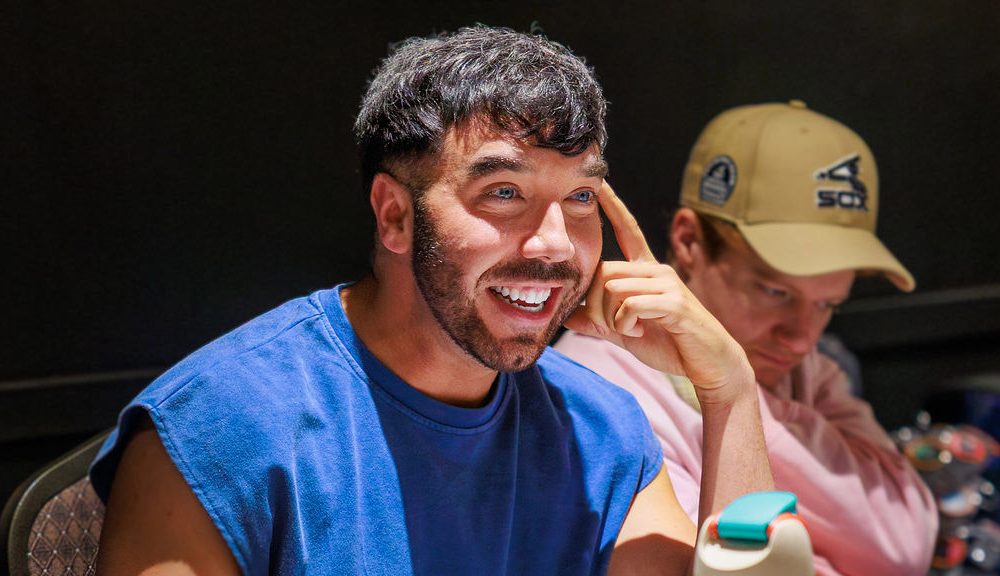
If you haven’t heard the name Marc Shaiman, you’ve most likely heard his music or lyrics in one of your favorite Broadway shows or movies released in the past 50 years. From composing the Broadway scores for Hairspray and Catch Me if You Can to most recently working on Only Murders in the Building, Hocus Focus 2, and Mary Poppins Returns, the openly queer artist has had a versatile career — one that keeps him just an Oscar away from EGOT status.
The one thing the award-winning composer, lyricist, and writer credits with launching his successful career? Showing up, time and time again. Eventually, he lucked out in finding himself at the right place at the right time, meeting industry figures like Rob Reiner, Billy Crystal, and Bette Midler, who were immediately impressed with his musical instincts on the piano.
“Put my picture under the dictionary definition for being in the right place at the right time,” Shaiman says. “What I often try to say to students is, ‘Show up. Say yes to everything.’ Because you never know who is in the back of the theater that you had no idea was going to be there. Or even when you audition and don’t get the part. My book is an endless example of dreams coming true, and a lot of these came true just because I showed up. I raised my hand. I had the chutzpah!”
Recalling one example from his memoir, titled Never Mind the Happy: Showbiz Stories from a Sore Winner ( just hit bookshelves on January 27th), Shaiman says he heard Midler was only hiring Los Angeles-based artists for her world tour. At the young age of 20, the New York-based Shaiman took a chance and bought the cheapest flight he could find from JFK. Once landing in L.A., he called up Midler and simply asked: “Where’s rehearsal?”
“Would I do that nowadays? I don’t know,” Shaiman admits. “But when you’re young and you’re fearless … I was just obsessed, I guess you could say. Maybe I was a stalker! Luckily, I was a stalker who had the goods to be able to co-create with her and live up to my wanting to be around.”
On the occasion of Never Mind the Happy’s official release, The Blade had the opportunity to chat with Shaiman about his decades-spanning career. He recalls the sexual freedom of his community theater days, the first time he heard someone gleefully yell profanities during a late screening of The Rocky Horror Picture Show, and why the late Rob Reiner was instrumental to both his career and his lasting marriage to Louis Mirabal. This interview has been edited and condensed.
Naturally, a good place to start would be your book, Never Mind the Happy. What prompted you to want to tell the story of your life at this point in your career?
I had a couple of years where, if there was an anniversary of a movie or a Broadway show I co- created, I’d write about it online. People were always saying to me, “Oh my God, you should write a book!” But I see them say that to everybody. Someone says, “Oh, today my kitten knocked over the tea kettle -” “You should write a book with these hysterical stories.” So I just took it with a grain of salt when people would say that to me. But then I was listening to Julia Louis-Dreyfus’ podcast, and Jane Fonda was on talking about her memoir — not that I’m comparing myself to a career like Jane Fonda’s — but she felt it was time to take a life review. That really stuck in my head. At the time, I was sulking or moping about something that had not gone as well as I wished. And I guess I kind of thought, “Let me look back at all these things that I have done.” Because I have done a lot. I’m just weeks short of my 50th year in show business, despite how youthful I look! I just sat down and started writing before anyone asked, as far as an actual publisher.
I started writing as a way to try to remind myself of the joyous, wonderful things that have happened, and for me not to always be so caught up on what didn’t go right. I’ve been telling some of these stories over the years, and it was really fun to sit down and not just be at a dinner party telling a story. There’s something about the written word and really figuring out the best way to tell the story and how to get across a certain person’s voice. I really enjoyed the writing. It was the editing that was the hard part!
You recall experiences that made you fall in love with the world of theater and music, from the days you would skip class to go see a show or work in regional productions. What was it like returning to those early memories?
Wonderful. My few years of doing community theater included productions that were all kids, and many productions with adults, where I was this freaky little 12-year-old who could play show business piano beyond my years. It was just bizarre! Every time a director would introduce me to another cast of adults, they’d be like, “Are you kidding?” I’d go to the piano, and I would sightread the overture to Funny Girl, and everybody said, “Oh, OK!” Those were just joyous, wonderful years, making the kind of friends that are literally still my friends. You’re discovering musical theatre, you’re discovering new friends who have the same likes and dreams, and discovering sex. Oh my god! I lost my virginity at the opening night of Jesus Christ Superstar, so I’m all for community theater!
What do you recall from your early experiences watching Broadway shows? Did that open everything up for you?
I don’t remember seeing Fiddler on the Roof when I was a kid, but I remember being really enthralled with this one woman’s picture in the souvenir folio — the smile on her face as she’s looking up in the pictures or looking to her father for approval. I always remember zooming in on her and being fascinated by this woman’s face: turns out it was Bette Midler. So my love for Bette Midler began even before I heard her solo records.
Pippin and The Wiz were the first Broadway musicals I saw as a young teenager who had started working in community theater and really wanted to be a part of it. I still remember Pippin with Ben Vereen and all those hands. At the time, I thought getting a seat in the front row was really cool — I’ve learned since that it only hurts your neck, but I remember sitting in the front row at The Wiz as Stephanie Mills sang Home. Oh my god, I can still see it right now. And then I saw Bette Midler in concert, finally, after idolizing her and being a crazed fan who did nothing but listen to her records, dreaming that someday I’d get to play for her. And it all came true even before I turned 18 years old. I just happened to be in the right place at the right time, and met one of her backup singers and became their musical director. I was brought to a Bette Midler rehearsal. I still hadn’t even turned 18, she heard me play and said, “Stick around.” And I’ve stuck around close to 55 years! She’s going to interview me in L.A. at the Academy Museum. Would I have ever thought that Bette Midler would say yes to sitting with me, interviewing me about my life and career?
That’s amazing. Has she had a chance to read the book yet?
She read it. We just talked yesterday, and she wants to ask the right questions at the event. And she even said to me, “Marc, I wasn’t even aware of all that you’ve done.” We’ve been great friends for all these years, but sometimes months or almost years go by where you’re not completely in touch.
In the book, you describe moving between New York and Los Angeles, especially when you started working more in film. As a queer artist, what was your experience finding LGBTQ+ community between the two coasts?
As far as gayness, they’re equally gay! I guess New York tilts a little more. I came to New York in 1976, so during the ‘70s in New York, anything goes! That was the height of sexual freedom and expression, then the ‘80s brought the hideousness of AIDS. For a long time, part of being gay was the endless death that I was surrounded by — losing just about every friend and colleague. My god, when I first started living in L.A., coming out there to work with Bette in the ‘80s, almost every single person I met died by the mid ‘90s. Everyone, everyone was gone. That was unfortunately a huge part of my life, and anyone my age can relate to that. God bless everyone not my age that will hopefully never ever have to experience anything close to the devastation of a funeral every week. Even to say it now, it’s hard to imagine or believe that happened.
But you know, I’m in show business, so there are gay people everywhere and happily so. I’m lucky that I grew up without any kind of shame about that, or a feeling that I needed to hide it. Although I didn’t come out to my parents. It wasn’t until I finally told my mom one day that I had been to yet another funeral, as I was sharing with her about AIDS. That was when she finally said, “Scott is more than your roommate, isn’t he?” And I was like, “Yes.” Why did I pretend? I never pretended anywhere else, and I never pretended about anything else. But I still grew up in a time when – well, I mean, I’m not naive, I know it’s still a time now where a lot of people can’t come out to their family or parents — but I certainly came out a time long before there were people coming out on TikTok for the whole world to see. It was a bit more of a private thing, but I was always happily gay. And dare I say, as I even say in the book, when my libido took off at around 15, and all the other 15 and 16-year-olds were around me, I was the pied piper!
In the spirit of being at the right place at the right time, you almost accidentally became part of The Rocky Horror Show and the immersive, theatrical performances that emerged in those midnight screenings.
We actually started that, which, once again, is hard for me to believe. I went to New York with my friend from community theater, Sal, and we walked by the Waverly Theatre. He said, “Oh, I heard that this movie just opened, I hear it’s really outrageous.” We got in line and really hit it off with these other guys and gals. We went to see it and loved it and said, “Let’s come back tomorrow night!” These strangers that we just met came back too. When Susan Sarandon (who played Janet) holds a newspaper over her head in the rain, Louis Farese is the first person to yell out anything. He yelled, “Buy an umbrella, you cheap bitch!” The audience exploded in laughter. Sal and I were big hams and were like, “We’ve gotta get a laugh. We’ve got to figure out something to say and get a laugh like this!”
You started working in film through your collaborations with director Rob Reiner, who recently passed. What was it like stepping into scoring and making that leap with films like Misery and When Harry Met Sally…?
I was lucky enough, by Billy Crystal introducing me to Rob Reiner, to get the job doing the music for When Harry Met Sally…. But that was arranging existing songs, arranging and orchestrating with Rob. I worked on Beaches (starring Bette Midler) at the same time, and that was the same thing — arranging songs, orchestrating them, co-producing the recordings. Suddenly, I had these two hugely successful soundtrack records I had co-produced, but I had never written a film score or done a student film. Since I was a kid, I had a little theme for when my cat walked across the room. If somebody walked into the room at a party, I would play something funny as they walked in.
Rob had an inkling and called me, “Hey buddy, you want to score my next movie, Misery, a psychological thriller?” I was wondering why he thought I could do that. I had just gotten an agent as I moved to L.A., and even my agent said to Rob, “What makes you think Marc can write a film score?” Rob simply said, “Talent is talent.” That became my agent’s mantra as he got me one job after another, and Rob’s faith in me was just an overwhelming, life-changing thing. He became so important to me, and someone I’ll be thankful for as a colleague and even more so as a friend. For the rest of my life, I’ll be thanking him for that.
He was a true advocate for the LGBTQ+ community, fighting against California’s Proposition 8 same-sex marriage ban by co-founding the American Foundation for Equal Rights in 2009.
Very likely, I wouldn’t be married if it weren’t for Rob and Michelle Reiner. They were intensely a part of the fight to get to the Supreme Court. They were a part of that in all ways — financially, fighting, and showing up vocally. So, besides everything else, I’m the most happily married man on the face of the earth. And I can thank Rob and Michelle for that.
That’s beautiful. As we look back on your career, you’ve worked on everything from Broadway musicals like Hairspray to more recent revivals/sequels like Mary Poppins Returns, which you describe in your book as your dream job. What do you make of how the landscape for these filmed musical adaptations has evolved? It seems like studios are now more apprehensive about promoting them as actual musicals.
Isn’t it crazy? Even after Wicked making billions of dollars, I bet with the next movie musical, they’ll still pretend like it’s not a musical. Even Wicked had commercials where they didn’t sing! It’s so schizophrenic. There’s clearly an audience for them and yet the studios are so afraid. I don’t know. Can you explain it?
I don’t know if I can.
I mean, Mamma Mia! Hairspray the movie was very successful, but did they show singing for the commercials for Hairspray? I don’t remember, but I don’t think they did.
In the book, you mention Cole Escola and other queer artists who are doing exciting things today. Are there any particular actors or recent films and shows that you’ve been impressed by?
Well, god knows Heated Rivalry. My god, what’s going on with that? It’s just so fantastic watching these videos of the straight podcasters crying at episode five. Of course, I watched it for the sexiness of it all, but then I got caught up in it. I cried my fucking eyes out at that episode when he calls his lover down to the rink. I was just like those guys watching those reaction videos.
It shows how schizophrenic this world is. There are so many mean people full of hatred, yet there are also many people full of love who are open to a show like that. It’s phenomenal. I don’t know what’s going to become of this world, but I’m happy I got to live the life I’ve gotten to live. I hope we’re not entering a world where our worst fears are all coming true. This may sound superficial, but even something like Heated Rivalry — I don’t think that’s superficial. It shows there are large numbers of people who get it.
How do you feel as you’re getting ready to share this book and your stories with the world?
It’s not just about me tooting my own horn, though I’d be a hypocrite to say that I’m not to a certain level. It’s also about showing people — if you want to do something, just go out and fucking do it. Just keep at it. I wanted to quit a million times but I didn’t, and just like people told me, something did happen because I just kept showing up.
Never Mind the Happy: Showbiz Stories from a Sore Winner is now available wherever books are sold