
Mayor Daniel Lurie’s office continues to resist scrutiny over a call with President Donald Trump in October that the mayor said averted a looming federal immigration enforcement surge. Despite a ruling last month from the San Francisco Sunshine Ordinance Task Force that the mayor’s office improperly withheld records, staff maintain that they are not obligated to share even partially redacted records with the public.
The mayor’s office argues that because withheld documents involved lawyers from the city attorney’s office, the mayor could invoke attorney-client privilege. At a Jan. 7 public hearing, the task force found that the privilege claim was applied too broadly.
The San Francisco Public Press sought records in October related to the mayor’s call with Trump, but his office denied the request in full under a claim of attorney-client privilege. On Jan. 8, the Public Press filed a second request, citing the task force’s ruling that the office must segregate and release non-privileged material. In a Feb. 3 response, the mayor’s office again refused to disclose any additional records.
At the Jan. 7 hearing, task force members criticized Dexter Darmali, Lurie’s legislative and ethics secretary, for treating the presence of city attorney staff on documents as sufficient grounds to withhold them, rather than separating protected legal advice from factual or administrative material.
Task force member Dean Schmidt, himself an attorney, said it was “inconceivable” that no non-privileged records existed, even in a redacted form that would allow oversight bodies to see what categories of documents were being withheld. The task force’s determination came as a result of a complaint filed on Oct. 29 by Hazel Williams, a longtime transparency advocate, under the name Rick Sanders.
Darmali responded to the complaint by informing Williams in an email on Nov. 17 that the city attorney’s in-house supervisor of records sided with the mayor’s decision, and urging Williams to “withdraw your complaint.” That would keep the issue from appearing before the Sunshine Ordinance Task Force at a public meeting. In an interview, Williams said Darmali’s response showed that from the start, City Hall’s approach reflected an effort to close the matter without a public hearing.
“I find that extremely offensive,” Williams said in an interview. “It really does feel like, in many ways, public records law is there in name only. They’re basically saying, ‘Our internal decision trumps everything else.’”
The task force’s compliance committee is expected to review whether the mayor’s office has complied with the panel’s ruling at a meeting that has not been scheduled. If the office fails to comply, the task force can refer the matter to the ethics commission for enforcement.
In the meantime, public pressure has mounted. The task force has received 100 signatures on a form letter circulated by the local Democratic Socialists of America chapter urging members to order full disclosure of all records related to the mayor’s call with Trump, arguing that secrecy around the decision to halt the federal immigration surge undermines public trust.
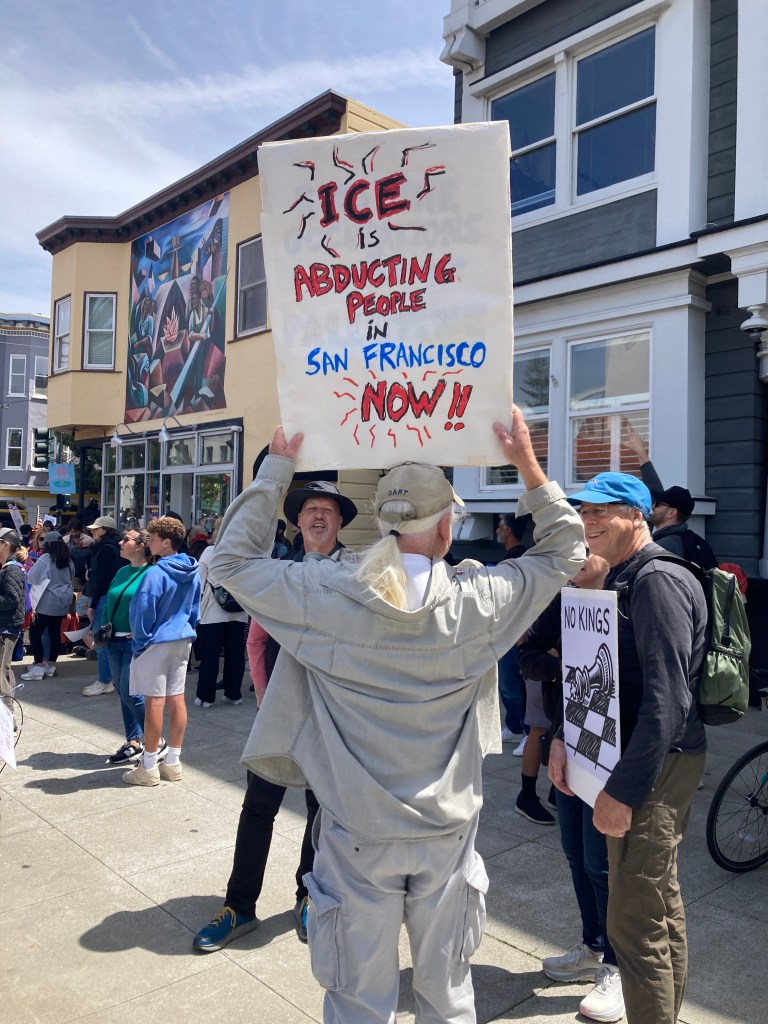 Protesters mustered near Dolores Park for a demonstration calling attention to the ongoing attack on immigrants by federal forces across the country. Credit: Sylvie Sturm / San Francisco Public Press
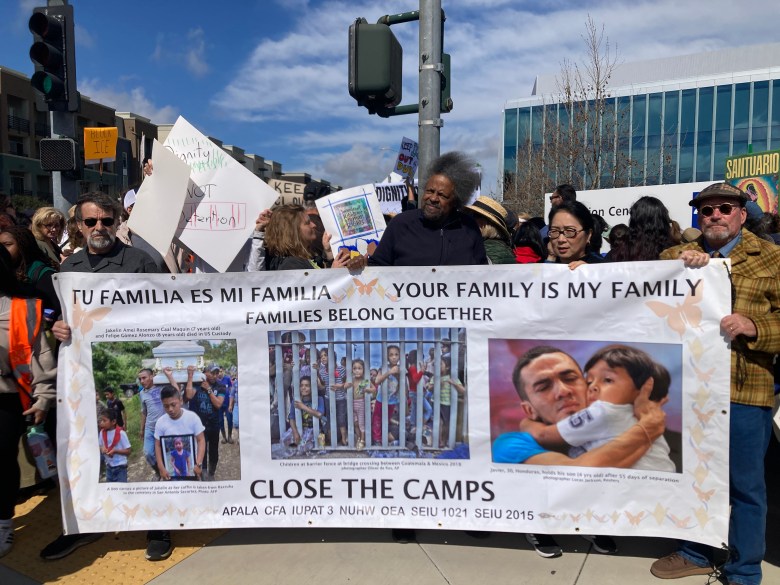 Credit: Sylvie Sturm / San Francisco Public Press
The Trump call is not the only matter the mayor’s office is keeping mum about.
Documents released through a records request by the Public Press on Feb. 3 show that city and federal officials exchanged emails coordinating an Oct. 23 conversation between Lurie and U.S. Attorney General Pam Bondi. The scheduling emails exist, but the mayor’s office produced no notes, summaries, call logs or follow-up communications from that conversation in response to records requests.
Lurie also said at an Oct. 23 press conference that he had spoken with Secretary of Homeland Security Kristi Noem as federal enforcement decisions were unfolding. The mayor’s office produced no records, scheduling emails, internal memoranda or contemporaneous notes reflecting that exchange either.
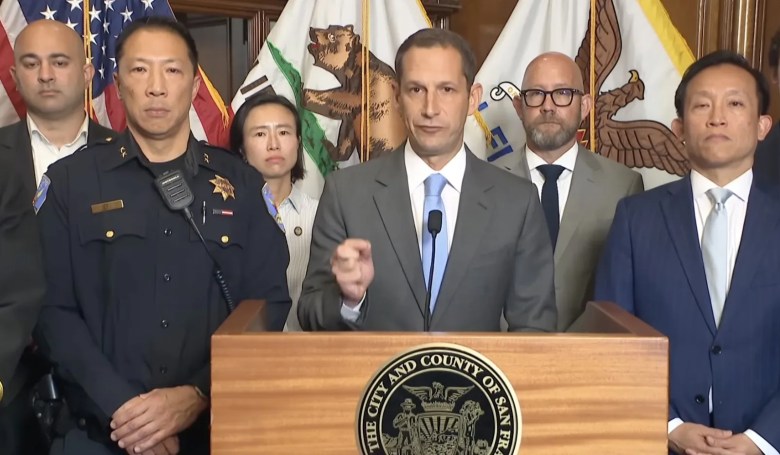 Mayor Lurie said his October call with President Trump prevented an imminent troop deployment to the city. Credit: SFGOV TV
Williams said transparency is not an abstract good-government principle, but a goal inseparable from the real-world consequences of raids and surveillance by Immigration and Customs Enforcement and other agencies.
“We know how devastating the ICE raids have been around the country,” she said. “I live in San Francisco. I’ve seen the impacts of it here. The public really deserves to know this.”
Williams said public suspicion of back-channel influence and “shadowy politicking” makes transparency even more critical. “We just have to trust that they know what’s best? That’s very concerning. That’s very oligarchical, not very democratic.”
The limited disclosure of records has taken on added importance amid reporting that billionaire business leaders’ conversations with Trump contributed to his decision to call off the enforcement surge.
Julien Ball, an immigrant justice organizer with the Democratic Socialists of America’s local chapter, told the Sunshine Ordinance Task Force at the January meeting that the sequence of events — outreach from wealthy elites, a mayoral call, the sudden cancellation of federal action, all excluding affected immigrant communities from the conversation — raises questions about whose voices carry weight in moments of crisis.
“Do we have a system where our elected officials from federal, state and local governments make decisions based on input from the people, which is the way democracy is supposed to work, or is it based on back-channel discussions between a few billionaires?” he said in an interview.
Business leaders and immigrant advocates share an interest in avoiding aggressive federal crackdowns, he said, noting that agents roaming the streets of San Francisco would be “bad for business.” But alignment is not the same as democratic governance. “It shouldn’t be private,” he said. “Immigrant communities should be at the table.”
Related