
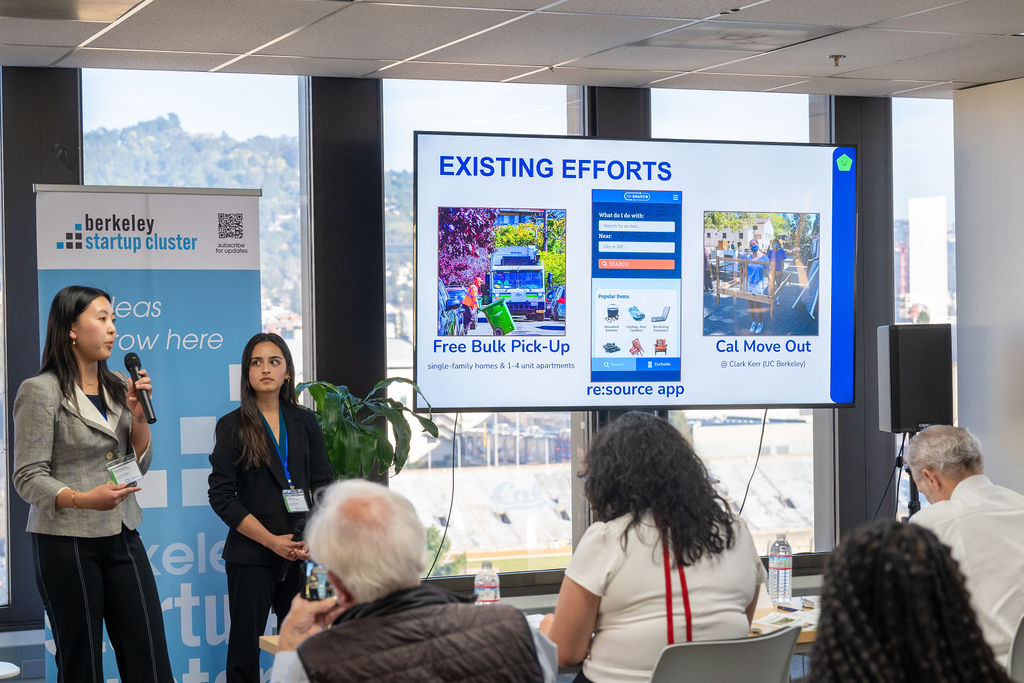
Berkeley faces hurdles like many other municipalities. But the city also has an advantage: UC Berkeley students known for their tech savvy and world-changing innovations.
That potential was on full display last Friday, when an AI-powered accessibility coach to help overhaul city websites and a plan to rid streets near campus of mattresses abandoned during student move-out took top honors at the inaugural Berkeley Civic Innovation Challenge at UC Berkeley.
The contest brought together more than 70 students who split into 15 teams and confronted some of the biggest challenges facing the city of Berkeley. After city leaders outlined a range of challenges, students went to work. They had one week to interview stakeholders, research existing solutions, develop their ideas and build prototypes that included slick web portals and AI-powered tools.
After an initial round, the sprint culminated Friday in Shark Tank-style pitches at Berkeley SkyDeck to judges who picked the two winners — a move-out assistant called ReMove and an accessibility tool, AccCo.
“I think we all came out of this contest better equipped to tackle real-world problems,” said Joon Choi, a first-year student majoring in environmental engineering science. “That in itself is super rewarding.”
Choi was part of the team that created ReMove, an AI and outreach program to help connect residents to services and reduce the piles of mattresses and other bulky items that get left behind during student move-out each May. While the campus and city have some existing efforts to help transport bulky items to proper facilities, resource limitations and educational gaps persist.
It was the kind of project that fit well with Choi’s interests. In high school, he helped develop a cafeteria waste recycling program. He wanted to use the Civic Innovation Challenge to better understand the constraints around scaling similar kinds of initiatives.
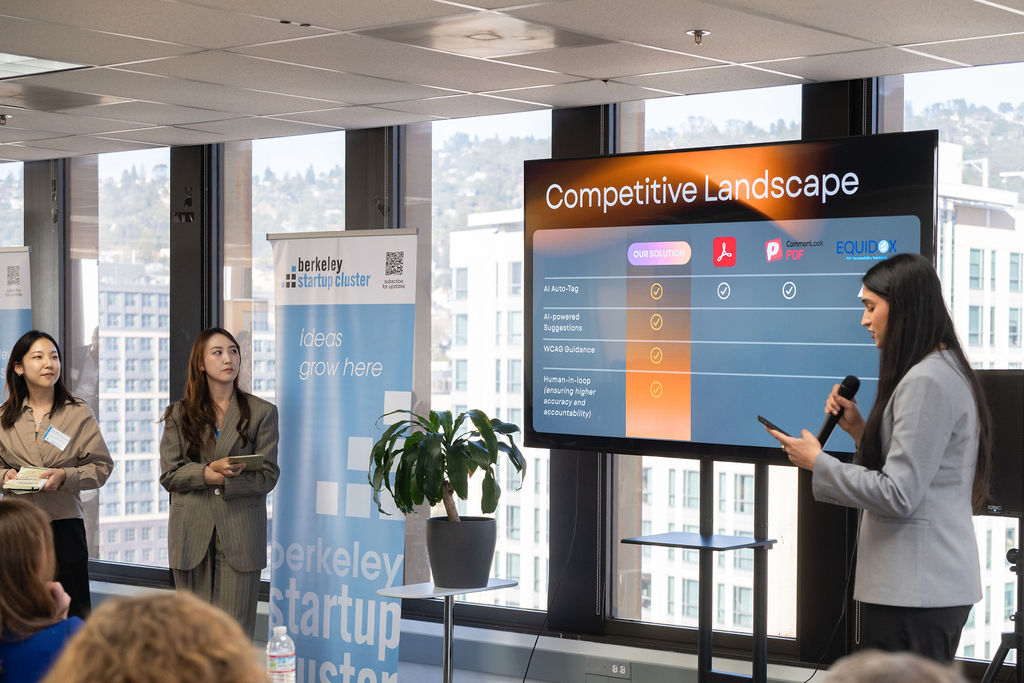 Sejin Kim (left), Ayoung Cho (center) and Harvir Kaur (right) explain how their project, AccCo, compares to existing accessibility tools. The team, which also included Suk Min Hwang, shared top honors at the Berkeley Civic Innovation Challenge and will be fast-tracked into the final round of the Big Ideas Contest.
Brandon Sánchez Mejia/UC Berkeley
Curiosity about using technology and innovation to solve municipal challenges was widespread. One team envisioned a wildfire readiness platform that could help Berkeley Hills residents adapt to changing policies around defensible space near their homes — and use AI to reimagine their gardens in fire-safe ways. Another pitched a website, helpline and in-person option to streamline personalized assistance for residents at risk of becoming homeless. Students also created a prototype of a platform to alert small businesses to new city contracts they could be eligible for, with the intent of supporting businesses that call Berkeley home.
While there is no guarantee that the city will implement the top ideas, program and city leaders said there is real interest in supporting the most promising solutions.
“We are a place that wants to welcome entrepreneurs and your entrepreneurial ideas,” said Berkeley Mayor Adena Ishii, a Berkeley alum who was one of the contest judges. “We want to encourage you to think about these civic challenges that we face in our city and how you all can actually help us solve some of these problems.”
Chancellor Rich Lyons, who was also a judge, said the event was a remarkable showcase of the collaboration and relationship between the campus and the city.
“I’m not sure it’s been stronger in my lifetime,” he said.
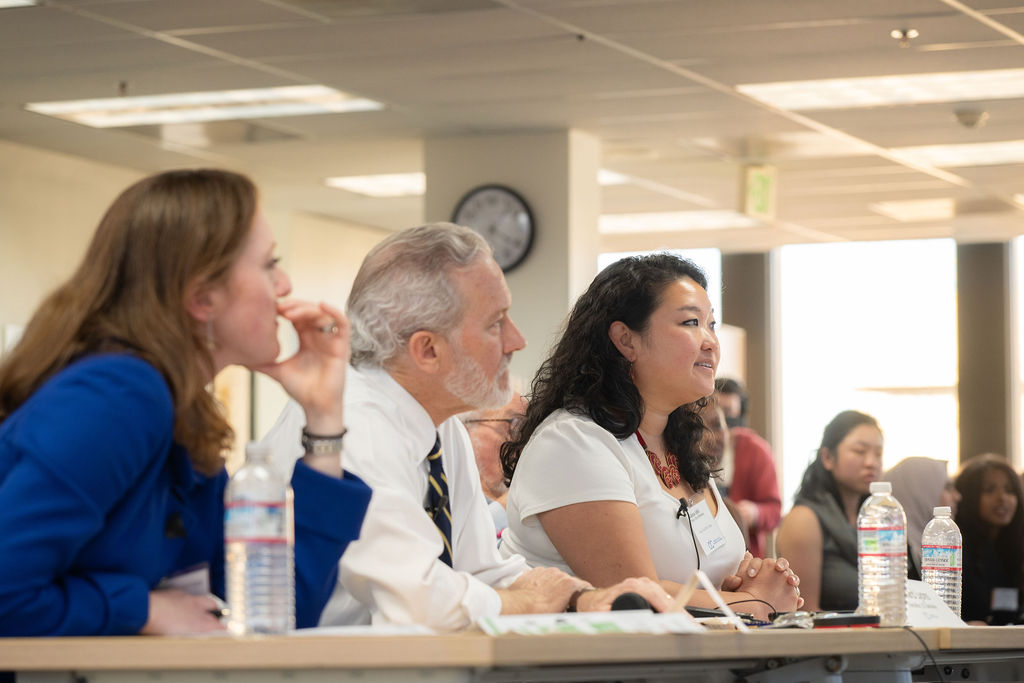 California’s chief technology innovation officer Vera Zakem, UC Berkeley Chancellor Rich Lyons and Berkeley Mayor Adena Ishii were judges for the Berkeley Civic Innovation Challenge final round Friday, Feb. 6, at Berkeley SkyDeck.
Brandon Sánchez Mejia/UC Berkeley
The contest’s other winner, AccCo, proposed a fix that could have applications far beyond the city. Some 2,000 Berkeley residents are visually impaired, yet many websites and critical city documents are not accessible. That’s why the team created an “accessibility coach” — AccCo for short. Integrated AI technology can help improve existing documents that aren’t accessible while also training staff to upload new, accessible ones.
Sejin Kim, a second-year master’s student in information management and systems, has been interested in accessibility issues for years. The prospect of contributing to a solution motivated her to join the challenge.
The team spent the bulk of their week interviewing city employees and visually impaired people. It wasn’t until the day before the deadline that they landed on a way to overcome the difficulties with existing tools. They realized the focus needed to be on designing a solution for people who create documents — not just for people who consume them.
It was an opportunity to understand the problem in a new way, she said.
“I wanted to participate in this event because I saw it as a great opportunity to work on a real, meaningful problem in collaboration with the city of Berkeley,” Kim said. “Recognizing this shared pain point helped us clarify our direction and create a more focused, meaningful solution.”
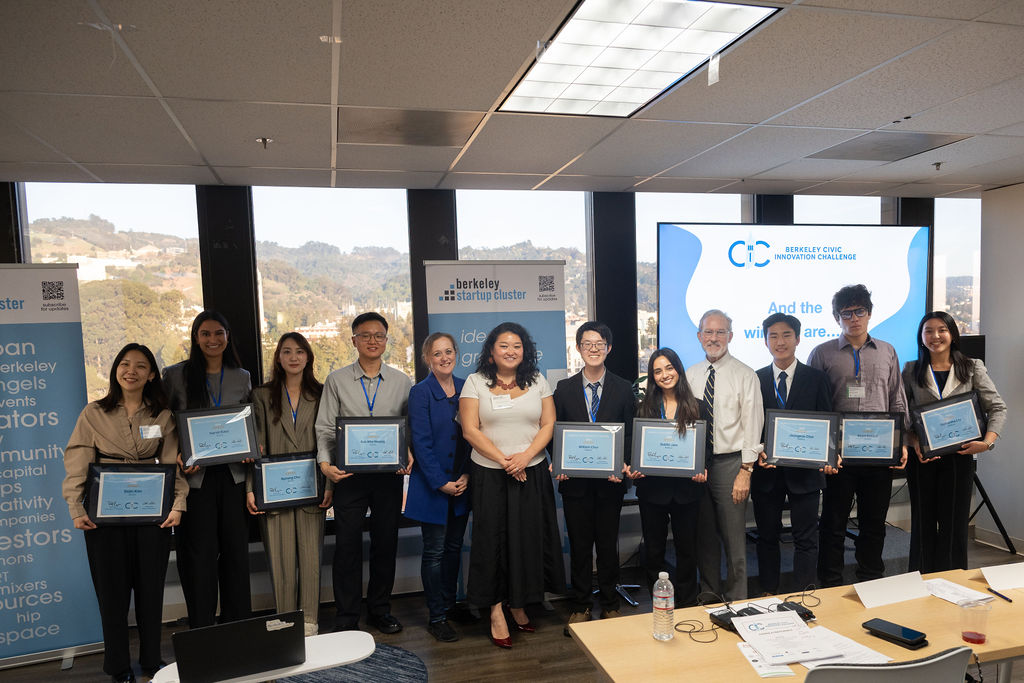 Teams from AccCo, left, and ReMove, right, gathered with judges after winning the inaugural Berkeley Civic Innovation Challenge. The final round was held Friday, Feb. 6, at Berkeley SkyDeck.
Brandon Sánchez Mejia/UC Berkeley
In coordination with the city’s Office of Economic Development, the new competition was led by the UC Berkeley Big Ideas Contest, the campus’s 20-year-old accelerator program housed within the Blum Center for Developing Economies. Phillip Denny, director of the Big Ideas Contest, said it was inspiring to see how the new contest focused students’ creative energy on local issues.
“The real energy came from the students this week,” Denny told attendees on Friday. “You put in time. You put in energy. You put in wisdom. It was just amazing to see how much you put into this.”
In addition to taking top honors, the teams behind AccCo and ReMove will be fast-tracked into the final round of the Big Ideas Contest, which has led to the launch of more than 550 social ventures spanning 50 countries since its inception. They will continue developing and refining their ideas for the rest of the semester, receive structured mentorship and guidance, and be eligible to compete for up to $20,000 in funding to support the next phase of their work.
“It blows me away that these projects are one week old,” said Darren Cooke, the campus’s interim chief innovation and entrepreneurship officer. “The students didn’t know each other a week ago. I can’t wait to see what they do when they’ve worked together for a full semester.”