
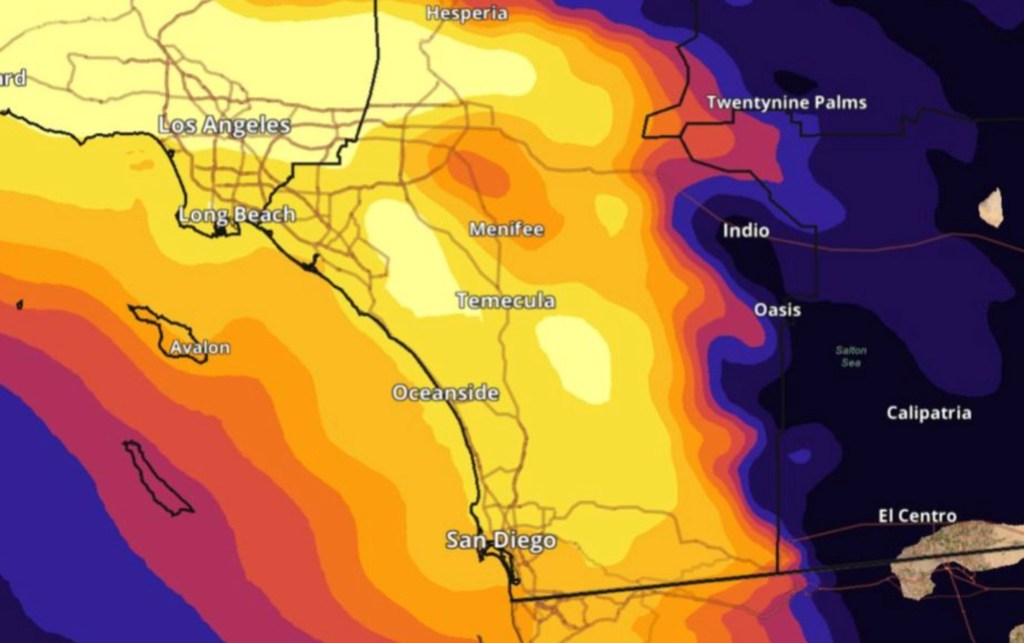
An Alaskan storm will cycle through San Diego County Monday through Thursday, dropping 1 to 2 inches of rain in some areas, a half-foot of snow on Mount Laguna, winds gusting to 45 mph, and waves in the 8-to-10 foot range at local beaches, the National Weather Service says.
The system also could trigger perilous thunderstorms and lightning, prevent daytime highs from rising above the low 60s, and provide Anza Borrego Desert State Park with rain that would produce a more lustrous bloom among desert wildflowers.
Forecasters say the storm could be even more consequential across other parts of Southern California, making driving tricky in the Cajon Pass and dropping 2 to 3 feet of snow at some ski resorts, notably Big Bear.
The storm could be the start of a longer period of cold, wet weather that could last through the end of the month. “The storm window is open,” said Adam Roser, a weather service forecaster.
Early forecast models suggest that the first wave of the storm will arrive Monday morning, then intensify in the afternoon and evening as it spreads across the county. The rain will fall on and off on Tuesday and Wednesday with additional moisture likely on Thursday and possibly even Friday.
San Diego could get about an inch of rain during that period, although forecasters cautioned that the figure could be significantly below or above that level. Rain will be heavier in the mountains.
San Diego International Airport has recorded 8.05 inches of precipitation since the rainy season began on Oct. 1. That’s 2.28 inches above average.
Snow will begin following at the 6,000-to-7,000 foot level on Monday, then drop down to 5,000-to-5,500 feet on Tuesday and down to 4,000 feet on Wednesday. Alpine and Anza Borrego could get a dusting of snow.
Winds will be sharpest in the local mountains late Monday, reaching 45 mph or higher. It’s possible that equally strong gusts could hit coastal cities. Huge, choppy waves will produce “Victory at Sea” conditions along the entire coastline.
The heavy rains the county received in December and January helped generate a moderate-to-heavy wildflower bloom at Anza Borrego, and the new precipitation could make things even better. It is unclear if it will lead to a super bloom, a phenomenon in which huge numbers of dormant wildflowers bloom at the same time.
“Rainfall alone doesn’t determine the outcome,” said Todd Michael, a plant biologist at the Salk Institute in La Jolla. “The timing and spacing of storms, spring temperatures, wind, and even what happened in recent bloom years all influence which specifics emerge from the seedback and successfully flower …
“This season is particularly interesting because while rainfall has been promising, January temperatures were unusually high. That creates a natural experiment: we can see which species are true ‘bet hedgers,’ responding primarily to abundant rain regardless of temperature, and which require a more precise combination of cool, wet conditions to produce a large display.”