
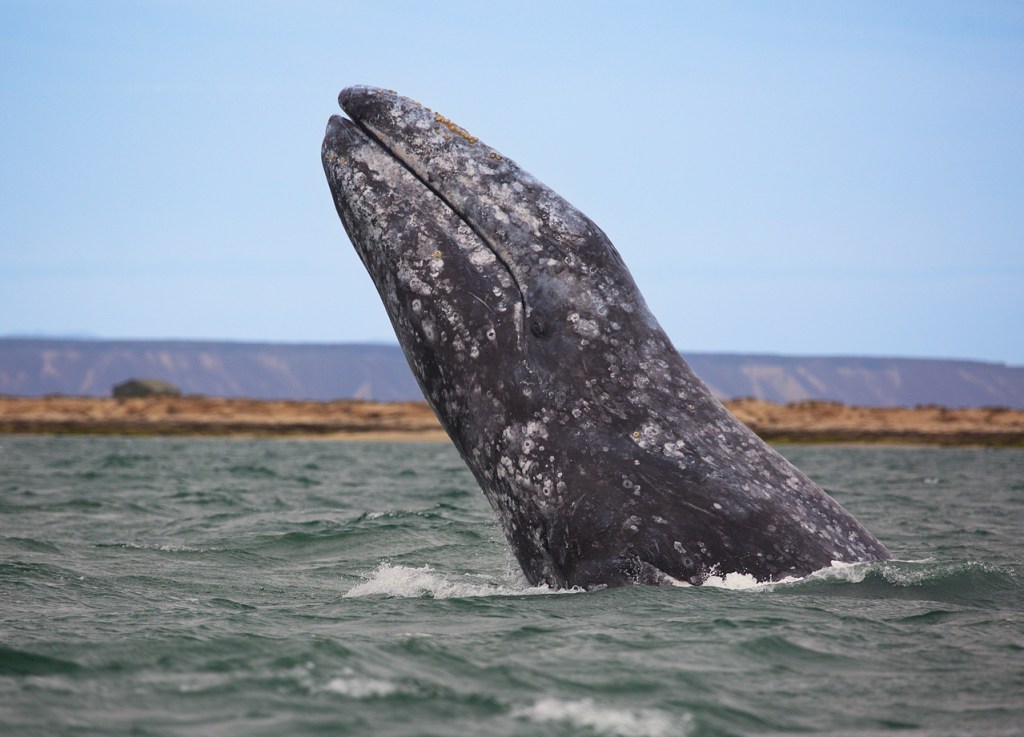
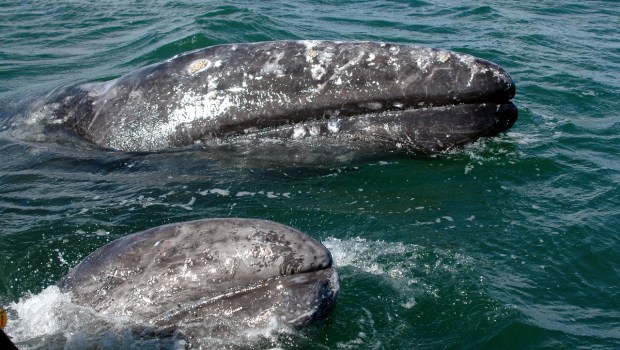
 Whale watching aboard the Kuyima panga, San Ignacio Lagoon. (Photo by Diane Alps)
Registration is open for the trip billed as “the journey of a lifetime” by its sponsors, the Cabrillo Marine Aquarium in San Pedro.
The on-sea adventure — from March 6 to 14 — takes participants south on a nine-day ocean voyage, with three of those days anchored in San Ignacio Lagoon to observe and get an “eye-to-eye” experience with friendly gray whales and their calves. The trip anchors in gray whale breeding grounds.
A team of educators and experts will accompany the group to also visit remote, uninhabited islands while living aboard.
Gray whale numbers have suffered a “steep decline” in recent years because of climate and warming ocean conditions, according to Diane Alps, with the programs department at the Cabrillo Marine Aquarium.
“There is still no guarantee — there never is — but generally speaking, the signs point to a successful year in the lagoons,” she said of this year’s trip.
The cost is $3,600 (Friends of CMA receive a $100 discount).
Participants will board the San Diego-based Royal Polaris and will visit:
Islas Todos Santos, two small rocky islands just outside of Bahia de Ensenada, to view nesting seabirds, native plants, fish-rearing sea pens, and pinnipeds. Seabirds, whales and dolphins also can be typically seen at sea.
Islas San Benitos, three small islands 15 miles west of the north end of Cedros where a habitat that is home to breeding colonies of northern elephant seals and California sea lions along with sea and shore birds can be seen. Passengers also will be able to go ashore for exploration.
Laguna San Ignacio, known for its “friendlies,” gray whales that will approach small boats at times within arm’s reach. Whale watching will fill the three days in that spot.
Isla Cedros, where passengers will take an exploratory hike to see endemic plants, the geology and wildlife.
Isla San Martin, a small volcanic island that is a haul-out and rookery for harbor seals; a hike on that island also will be featured where visitors can see wildflowers, cacti, succulents and lichens.
“We visit three islands that are uninhabited, with colonies of elephants, endangered Guadalupe fur seals, harbor seals,” Alps said, “as well as rare, endemic plants, and a variety of seabirds such as albatross that are next to impossible to see unless far offshore.”
Information is available at tinyurl.com/CMABajaMoreInfo or by calling 310-548-7562.