
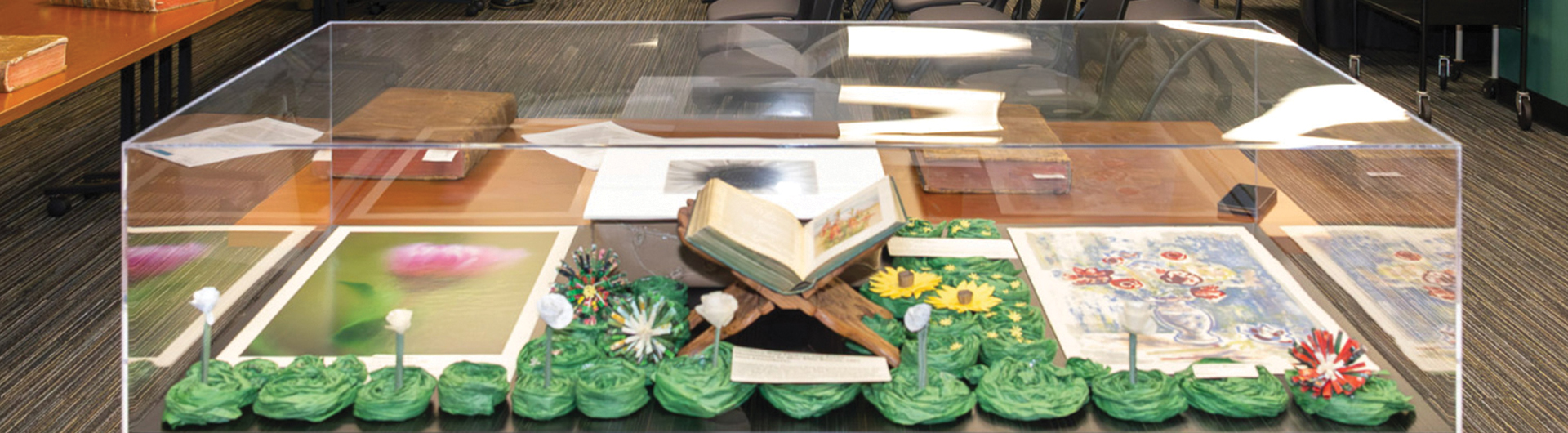
On the third floor of the University Library at Cal State Long Beach, a secluded reading room sits tucked into a corner few people notice. Beyond it, a storage room, once known as “the vault,” holds thousands of books and boxes, stacked and labeled, waiting to be called up.
Inside those boxes: a 1490 witch-hunting manual, its pages marked with wormholes and notes in the margins. Sealed World War II rations. The political papers of former congressman and CSULB psychology professor Alan Lowenthal. A felt pennant given to the second-place winner of the 1908 “Long Beach Festival of the Sea” baby parade. A rare copy of “The Nuremberg Chronicle.”
This is the Special Collections and University Archives — a trove that includes countless pieces of Long Beach history and what archivists call one of the largest fine art collections in the CSU system.
They just wish more of the campus community could access it.
“One aspect that we’re not currently flourishing in is our online presence,” said University Library Dean Elizabeth Dill. “We are just now starting to build a robust digital repository, providing access to all of these great materials that would normally be under lock and key.”
That effort received a significant boost on Friday, when U.S. Rep. Robert Garcia ‘02, ‘10, visited campus to announce $2.1 million in community project funding aimed squarely at modernizing, digitalizing and expanding the Special Collections.
Garcia said the federal funds would serve as the foundation of a new Long Beach Research Center within the library, “offering hands-on training in archival methods, digitization techniques and historical research to the public” while ensuring that students can access and study research materials “in a dynamic learning environment.”
“I strongly believe in the power of communities [to access] archives, historical documents and the preservation of key materials and artifacts, said Garcia, the ranking member of the House Committee on Oversight and Government Reform. “There are already documents here that have global impact, that need to be displayed appropriately.”
In addition to expanding the archives’ online presence, Dill said the plan includes remodeling the current space by adding glass walls to open sightlines and converting the adjoining storage room into exhibit and classroom space. The federal funds will not directly pay for additional staff, but Dill said growth remains part of the broader vision.
Over the past year and a half, the two-person team of University Archivist Heather Steele Gajewski and Special Collections Librarian Chloé Pascual has grown to four, with the addition of an archives assistant Briana Vazquez and a dedicated digital archivist, Bennie Allen Stoll.
Together, the team manages the daily demands of the archives: pulling materials for faculty and students, supporting dozens of class visits each semester, responding to outside researchers — including some who travel internationally — and processing a steady flow of university records.
They also maintain the campus syllabus archive.
They might receive 18,000 new syllabi in any given school year, Vazquez said. And requests to view them come in every day. “Two weeks ago, we had over 50 requests. And sometimes these people request five, six, seven, eight syllabi.”
Against that backdrop, deeper processing competes for time. Most modern archives, Gajewski explained, include inventories and online finding aids — road maps that tell researchers what exists and how to request it. “None of our stuff is heavily utilized,” she said, “because we do not have online finding aids.”
That means that while some collections are well known and frequently used in classes, others sit in boxes labeled for systems that no longer exist.
“Sometimes we open a box and there’s no folders, and we’re like, ‘What the heck is this?’” Gajewski said. “All of it is like a balancing game of trying to be good stewards of these resources while still making them available for research as quickly as we can.”
The work can feel endless but never dull.
“I get excited when someone comes in to do independent research on something,” Gajewski said, “because it’s an opportunity to uncover things that nobody knew we had.”
She said she enjoys the locally significant finds — an original adobe brick from San Juan Capistrano, for example — just as much as the unexplained oddities: a vintage viewfinder featuring “mushrooms in their natural habitats,” a doll wearing a homemade nursing uniform donated by College of Nursing grad, or the now-beloved sculpture of former CSULB President Robert Maxson’s head, found preserved in the bottom of a glass fish tank.
The shelves remain dense. The backlog remains real. But with renewed investment, archivists and librarians are hopeful that the university’s many hidden treasures will eventually find their way into student papers, faculty research and the community’s shared history.