
At a contentious school board meeting on Wednesday night, community members lambasted an Oakland Unified School District budget plan that will see the loss of crucial educators and support staff next year.
No definitive list of those positions has been presented to the school board, but principals recently received their tentative budget and staffing allocations for the fall, which in turn rallied families and educators. Parents, principals, and school staff showed up on Wednesday to appeal to the school board to restore literacy teachers, counselors, case managers, attendance clerks, community school managers, and other workers who support students and help schools run well.
“The subsequent decisions that leaders have had to make based on staffing and the budget that was handed to us do not reflect what it takes to run schools,” said Vanessa Flynn, principal at Sequoia Elementary School. “It’s a call to put thriving schools on the back burner and instead, to school leaders, the message is, ‘Do what you need to do to survive.’ Let’s please stop normalizing just surviving.”
During Wednesday’s school board meeting, the board got its first look at the list of positions that will be eliminated from the district’s central office, resulting in about $21 million in savings for the 2026-2027 school year. The board has to close a $103 million deficit in OUSD’s unrestricted general fund.
The plan presented by Hazard, Young, Attea and Associates, the consulting firm the board hired as fiscal advisors, attempts to trim the next school year’s budget by $102.5 million. Of those cuts, about $50 million are in progress or completed, according to a district report. Those cuts include $32 million in central office reductions and shifting more than $12 million in small school costs and the costs of such roles as attendance specialists and noon supervisors from the unrestricted general fund to other sources.
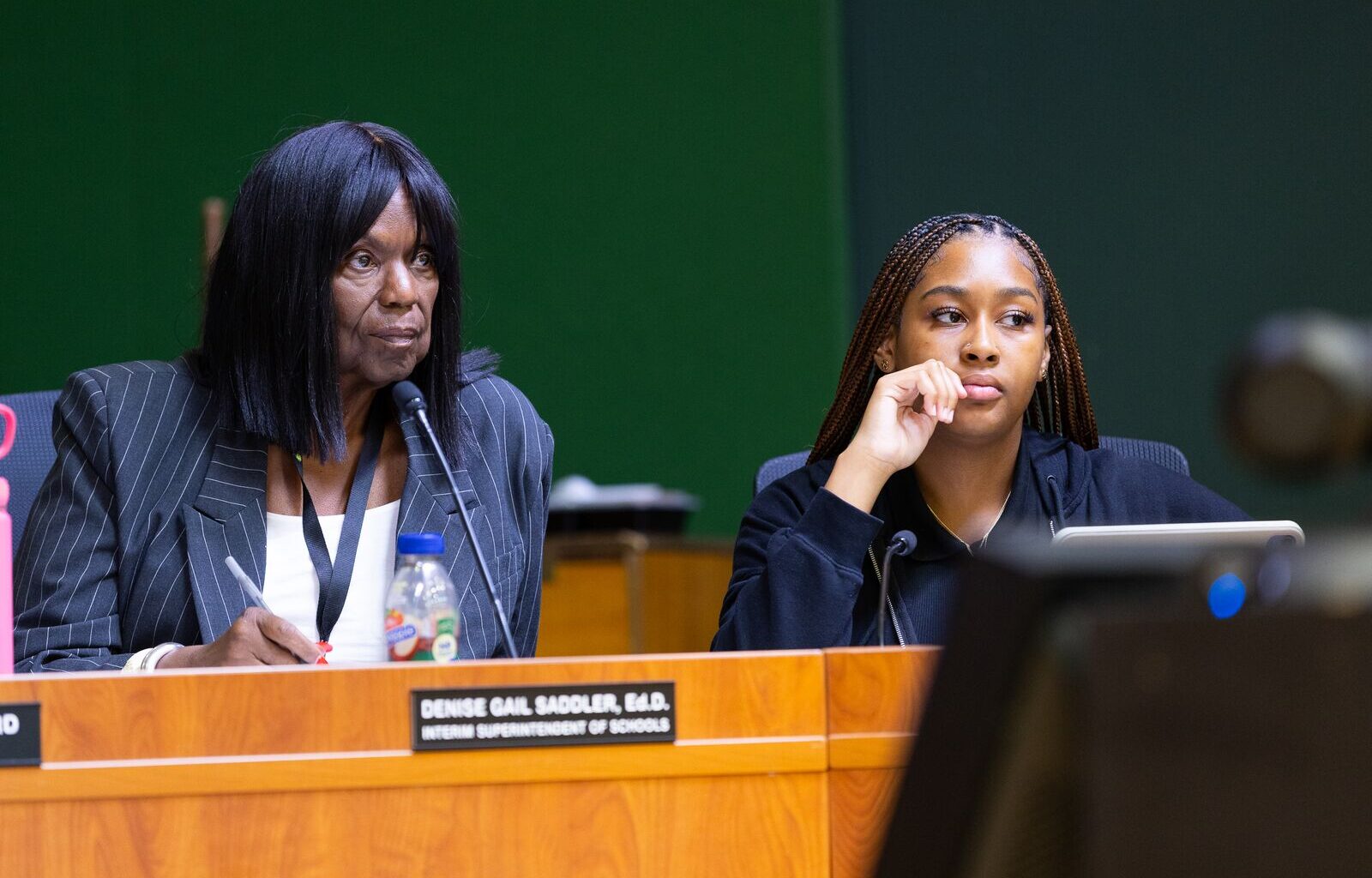
“In addressing the $100 million structural deficit, tonight, we present approximately $50 million in identified ongoing deductions,” interim superintendent Denise Saddler said Wednesday. “This cuts the original gap in half.”
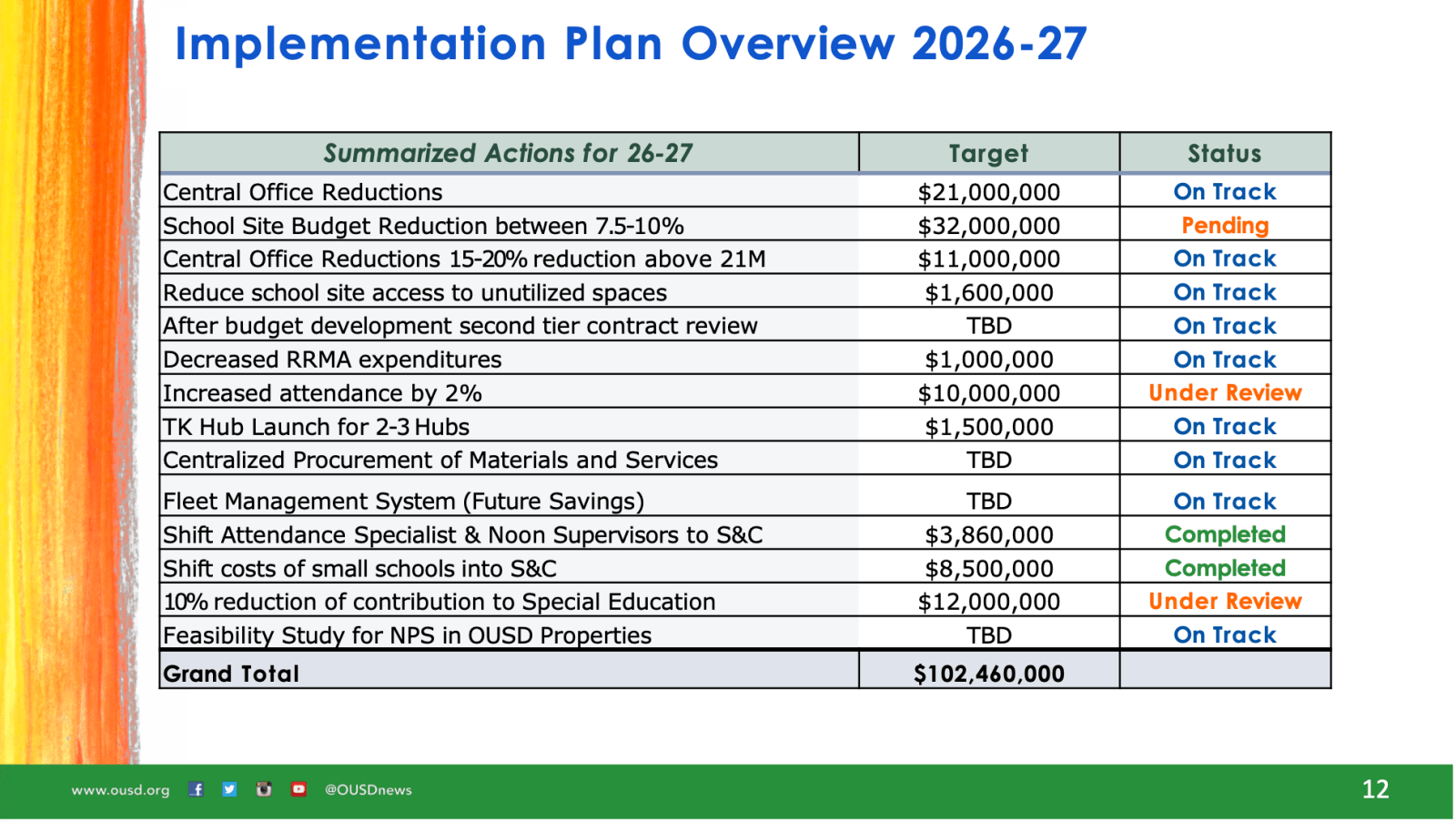 OUSD’s progress on its plan to cut more than $100 million from the 2026-2027 budget according to a Feb. 11 report. Credit: OUSD Financial Stabilization Implementation Plan
School attendance clerks, literacy coaches, community school managers, and other staff that had been funded through one-time dollars or grants that are expiring are also being eliminated. Some schools are trying to raise money to keep those roles in place. Kathryn Camp, a parent at Glenview Elementary, said the school’s parent teacher association would have to raise an additional $305,000 to fund reading intervention, mental health counselors, enrichment, and music classes.
“Cuts do not land equally, they widen inequities,” she said. “They create a two-tiered system: schools that can privately subsidize programs and schools that cannot.”
On Feb. 25, the board will see for the first time a list of all the positions slated for layoffs in the fall, and will have to approve them on that date to meet a March 15 statutory deadline for layoff notices. If the board does not approve a list before then — as presented, or with amendments — OUSD would be locked into its current staffing levels for next year. That would make it nearly impossible to approve a balanced budget for 2026-2027, inviting in county intervention a year after leaving receivership. In a previous budget proposal, OUSD staff estimated the district would need to cut around 640 positions to resolve the entire $100 million deficit.
In a January letter to the school board, Alameda County superintendent Alysse Castro, who reviews budgets for all districts in the county, criticized the board’s history of delaying or reversing imperative budget decisions
“Each delay narrows the district’s options,” Castro wrote. “Statutory timelines for employee notices, collective bargaining requirements, and reserve compliance mean that decisions deferred today often become forced decisions tomorrow.”
The plan the board approved in October to address the deficit directed Saddler and her staff to focus cuts on the district’s central office instead of schools. Those reductions mean the capacity of the central office to support principals, provide professional development, conduct hiring and onboarding, manage facilities, and oversee academic programs will be reduced. Those potential layoffs include literacy and STEM coordinators, custodians, recruitment specialists, counselors and social workers for students learning English, and college and career readiness coordinators. Roughly two-thirds of the central office workforce will be impacted, Saddler said.
“In a district where 75 to 80% of our budget is compensation, there is no path to closing a $50 million gap without impacting jobs,” Saddler said. “I’m taking a fine-toothed comb and looking at all of our expenditures. I’m even looking at our utility uses, our water bills, our garbage bills. I’m looking at where we can get energy efficiency and cost savings throughout while maintaining a high quality experience for our students and staff.”
The board’s plan also directed staff not to consider closing or consolidating schools. Directors defended that decision Wednesday evening, addressing questions from community members about whether closing small schools would mean there’s more money to go around to other campuses.
“I know it’s something many people want to believe: that if we closed all of those schools we could save every position we’re considering. I want to say it’s not true,” said Rachel Latta, director for District 1. “I want to say to all the schools losing centralized funding, I hear you and I feel it too. I will also say I am unapologetic that I don’t think we should point to other schools to find money from them.”
Some of the central office staff reductions are being accomplished through voluntary buyouts, a plan the board moved forward in November. During the opt-in period that ended in January, 145 employees said they would participate in the plan if offered, out of 1,066 eligible. For workers 55 and older who have been with OUSD for at least five years, the early retirement plan would pay 75% of their salary into a tax-sheltered annuity over five years.
The savings for the district would come from offloading those senior salaries and replacing those individuals with less experienced workers who earn lower wages, or not replacing those roles at all. On average, those who opted in had more than 20 years with OUSD, earning salaries around $95,000. If every one of those positions were replaced with more junior staff, the district would come out in the red, losing $2 million over five years. But if the district replaces only 80% of those positions, the district could save $10 million during that period, with savings rising as high as $46 million if even fewer people are replaced.
The board voted on Wednesday to extend the opt-in period for buyouts to Feb. 19.
Other parts of the budget, such as a plan to increase attendance by 2%, resulting in an additional $10 million in state revenue, and reducing the special education budget by $12 million, have yet to be detailed in a report to the school board.
With a $100 million target, the board would have to cut even more to fund raises for teachers, whose negotiations with the district entered a fact-finding stage in January.
“Part of our issue in the district for many years has been that we funded lots of things that we didn’t have the money for,” said Jennifer Brouhard, president of the board. “We’ve moved around money, not in shady ways, but we’ve done things to pay for certain programs that were important. I think, though, that we’re at the point right now that we don’t have any more money to move around to pay somebody.”
“*” indicates required fields