
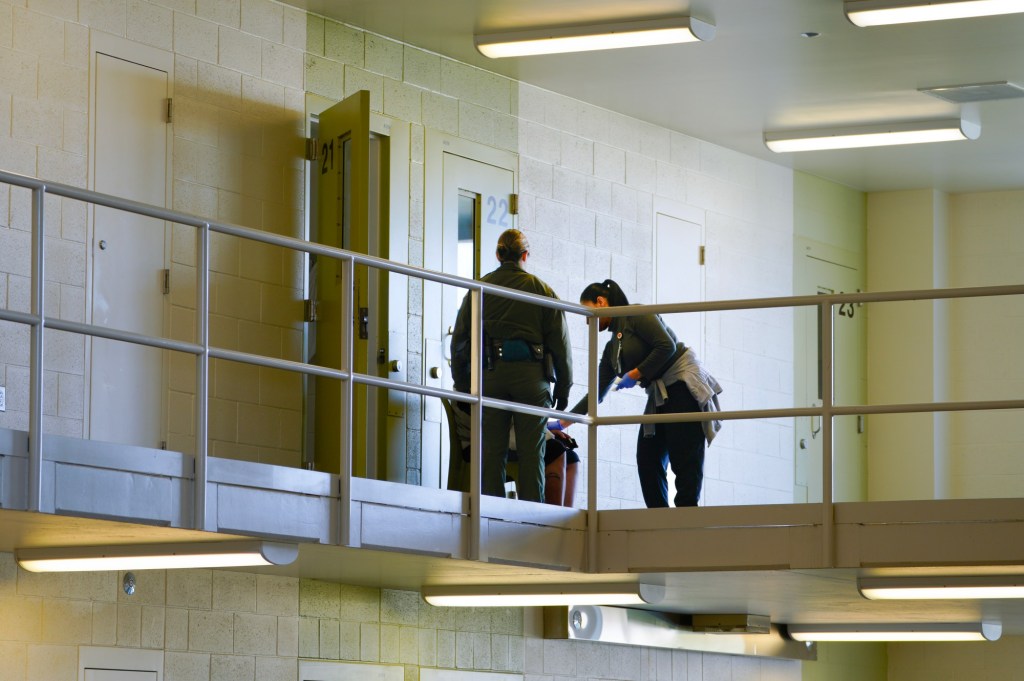
A federal judge has denied motions to dismiss a lawsuit over the death of a developmentally disabled woman in San Diego County jail custody, allowing her family’s claims of unconstitutional medical neglect, violations of federal disabilities law and other systemic failures to move forward.
In a 70-page order Tuesday, U.S. District Judge William Hayes ruled that the lawsuit sufficiently argued that sheriff’s deputies, jail medical staff and private healthcare contractors had failed to respond appropriately as Roselee Bartolacci’s mental and physical health deteriorated during her nearly two months in the Las Colinas jail.
The ruling clears the way for the case to proceed into discovery and a potential trial. Hayes denied motions to dismiss filed by San Diego County, Sheriff Kelly Martinez and jail medical contractors NaphCare and Correctional Healthcare Partners.
Bartolacci, 32, was developmentally disabled and suffered from schizoaffective disorder, a mental illness that combines symptoms of schizophrenia and a mood disorder. Her mother’s lawsuit describes her as functioning at the level of a young child.
In early 2023, the psychiatric medication Bartolacci relied on stopped working. The lawsuit says she began hearing voices, experiencing paranoia and having angry outbursts.
On April 6, 2023, Bartolacci struck her mother with a hammer during what the lawsuit describes as a psychiatric crisis. Her mother called 9-1-1 to seek help from San Diego County’s psychiatric emergency response team but was told no mental health clinicians were available. Sheriff’s deputies responded instead.
According to the lawsuit, Bartolacci’s mother told deputies about her daughter’s mental illness and asked them to take her to a psychiatric hospital for treatment. She also told them Bartolacci was a client of the San Diego Regional Center, which provides services to people with developmental disabilities.
Instead, deputies arrested her and booked her into jail.
The lawsuit alleges deputies failed to tell jail intake staff that Bartolacci was in the midst of a mental health crisis or that she was a regional center client, despite policies requiring that regional centers be notified within 24 hours whenever one of their clients is booked into jail.
Bartolacci was deemed “uncooperative” and initially placed in administrative segregation, a form of solitary confinement, before being moved into the jail’s psychiatric stabilization unit, the lawsuit says.
Despite being under observation by medical and mental health staff, her health declined significantly over the next seven weeks.
A jail psychiatrist documented her sitting naked on the floor of her cell, unable to answer questions and sucking on her fingers.
Medical records referenced in the lawsuit show Bartolacci refused medication, food and liquids for extended periods. She was hospitalized twice but returned to jail both times.
During one hospitalization, medical staff described her as covered in feces and urine. During another, she was diagnosed with acute renal failure, malnutrition and sepsis, among other serious conditions.
The admitting emergency room doctor noted that Bartolacci “had a high probability of imminent or life-threatening deterioration,” the lawsuit says.
She was found unresponsive in her cell late on May 28, 2023, and pronounced dead shortly after midnight. Her autopsy report notes that she had lost 41 pounds over the 53 days she was in jail.
The medical examiner ruled Bartolacci died from a heart condition. But autopsy lab tests showed abnormal electrolyte levels consistent with dehydration and malnutrition, including hyperkalemia, or dangerously elevated potassium, a condition that can disrupt the heart’s rhythm.
Hayes emphasized that he was not deciding on the merits of the allegations in the case. At this stage, the court must assume they are true and decide only whether the case can proceed.
A spokesperson for the Sheriff’s Office declined comment, citing pending litigation, but noted that the office revised its policies in May 2024 to improve how it identifies and accommodates people with disabilities.
Last year, the county’s Citizens’ Law Enforcement Review Board reviewed Bartolacci’s death and found no misconduct by sheriff’s deputies.
Executive Officer Brett Kalina said investigators looked into whether deputies violated policy or protocol by not taking her to a psychiatric hospital or conveying information provided by her mother, but he said he could not give details due to confidentiality restrictions.
Bartolacci’s case is among several lawsuits filed in recent years alleging inadequate care for people with mental illness — a central claim in a separate federal class-action lawsuit seeking to improve jail conditions.
On Thursday, lawyers in that case announced they had reached a settlement with the county that will require Sheriff Kelly Martinez to improve the level of mental health care provided in the county’s jails.