
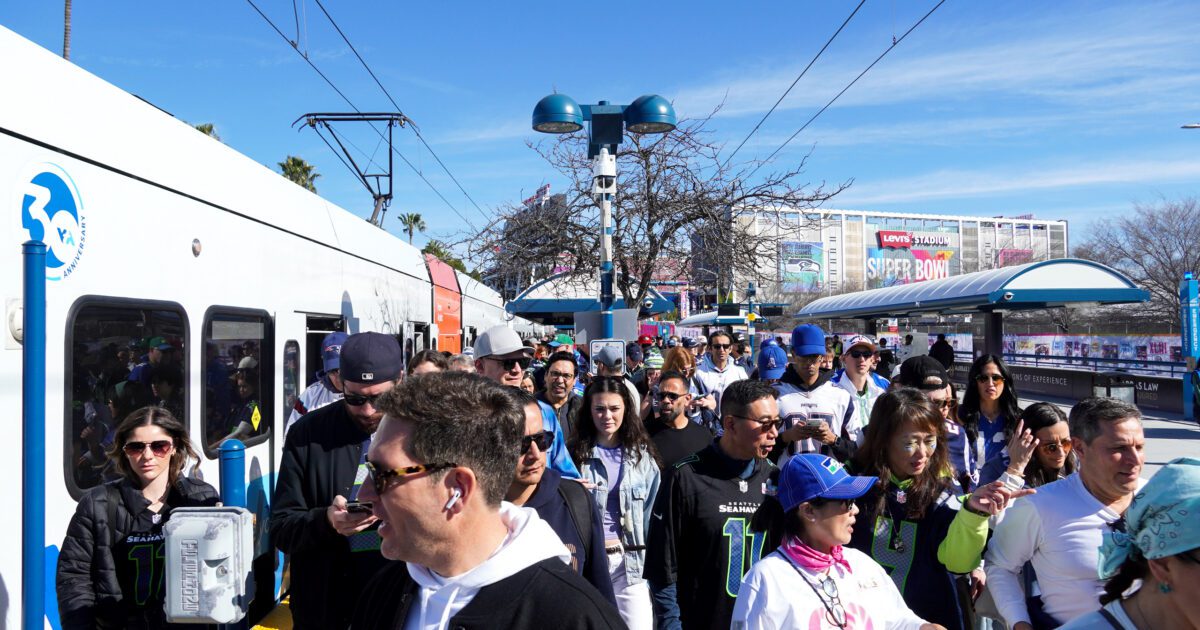
Public transit ridership to and from Levi’s Stadium in Santa Clara for the Super Bowl hit an all-time high with 30,000 trips — although not without a few bumps along the way.
VTA tallied 28,000 light rail trips and 2,600 bus rides for the big game, which the National Football League said drew 70,823 people. That means about 20% of the crowd rode on VTA, assuming they took public transit in both directions.
The 30,000 trips were 5,000 more than VTA expected on Feb. 8, and beat the previous record of 23,400 trips for the Taylor Swift “Eras” tour at Levi’s Stadium in 2023.
“After the Super Bowl 60 game, VTA safely moved more than 15,000 passengers from Levi’s Stadium by bus and light rail within 90 minutes — beating the NFL’s two-hour crowd management benchmark,” VTA spokeswoman Stacey Hendler Ross told San José Spotlight. “While short waits are expected when tens of thousands of fans depart a venue at once, VTA teams efficiently moved record numbers of riders. … This was a significant public transit achievement.”
For some riders, VTA light rail required more than a little patience. One of those riders, Erik Schoennauer, a land use consultant who lives in San Jose, has notched about 30 trips to events at Levi’s Stadium.
“We were squeezed on like sardines,” Schoennauer told San José Spotlight.
Schoennauer arrived at the Japantown/Ayer station at 11 a.m. on game day and didn’t get on a train for 40 minutes, as one full train passed the station without stopping. Once on board, the packed train passed stations further up the line. He later left the game early to beat the crowd, only to be told trains wouldn’t run until the game was over.
“I witnessed a few thousand people, coming and going, who were confused and annoyed,” Schoennauer said. “That’s not the experience we want our visitors to have.”
Lety Cavlan, a freelance camera operator in San Jose who worked at the Super Bowl, had no trouble getting to the stadium from the Hostetter station because she left home at 6 a.m.
Returning home from the Lick Mill station next to the stadium at 9:15 p.m. was tougher. Cavlan had to wait 30 minutes for a train to arrive and another 10 minutes for the train to depart.
The train initially showed it running on the Green Line, then suddenly switched to the Orange Line, which goes to Cavlan’s stop.
“That confused a lot of people,” Cavlan told San José Spotlight. “But they did make a lot of announcements about it.”
Cavlan helped out-of-town riders who wanted to get downtown by telling them to ride a few stops on the Orange Line, which doesn’t go there, then get off and order an Uber or Lyft.
Monica Mallon, a local transit advocate and San José Spotlight columnist, didn’t have a Super Bowl ticket but traveled on public transit to the stadium to see for herself how VTA performed.
“I noticed that there were a lot of ambassadors and signs to help riders and visitors get where they needed to go,” Mallon told San José Spotlight. “There was of course some level of chaos and crowding as there is with any major event, but I was very impressed overall … VTA was able to meet the moment, provide safe and reliable service and carry tens of thousands of passengers to and from the game.”

The next challenge for VTA is the FIFA World Cup, with six matches coming to Levi’s Stadium in June and July.
Because public transit agencies typically lose money on each ticket sold, surges in ridership increase financial strain.
Last month, VTA General Manager Carolyn Gonot sent a letter to state legislators in the Bay Area seeking $44 million in extra funding for the World Cup.
“Unfortunately, the additional operations, safety and security needs required for this event exceed VTA’s current resources,” she wrote in the letter.
Contact Mike Langberg at [email protected].