
Weeks before the Anaheim City Council readied a June 2020 vote on whether to legalize retail cannabis, an influential lobbyist appeared to declare the effort dead on arrival.
Two cannabis companies, From the Earth and Mr. Nice Guy, paid the Anaheim Chamber of Commerce $310,000 to advance their cause.
The prognosis after the chamber established a cannabis task force with the funds renewed suspicions between consultants and the two cannabis clients as to whether the behind-the-scenes push entailed fraud and deception.
It is a legal question that will go before a federal judge later this month, when former chamber chief executive Todd Ament attempts to withdraw a plea deal in which he previously admitted guilt to a cannabis-related wire fraud charge.
Related emails, financial records and spreadsheets — including those that informed an FBI investigation into task force money transfers as a key part of a federal corruption probe — were obtained by TimesOC ahead of the court date.
The documents detail the fallout from the failure to legalize retail cannabis as well as which companies were paid and how much they received along the way.
With legal retail cannabis seemingly all but dead in Anaheim, Chris Glew, an attorney and listed agent for Mr. Nice Guy cannabis dispensaries, fired off an email on May 28, 2020, to Ament and Jeff Flint, a lobbyist who wasn’t registered with the city but steered most of the task force funds to his affiliated companies, according to records reviewed by TimesOC.
In the email, Glew claimed Flint informed him a week before that the effort would fail to gain enough council votes and the only options going forward entailed a ballot measure or revisiting the issue with council a year from that time.
“The clients, as originally presented on date of hire, view a ballot initiative as a total loss,” Glew wrote in his email. “The initiative process is ripe with numerous pitfalls and makes all efforts to date meaningless from the clients’ perspective.”
Going back to the City Council in a year would “only serve to line the pockets of consultants,” he argued.
Though not named in court documents, Glew was an associate of Melahat Rafiei, a former Democratic Party operative who’d taken on From the Earth as a client, records show.
According to the task force’s ledgers, Mr. Nice Guy Enterprises contributed $85,000 to the effort, which began in July 2019. Chamber financial records show a company affiliated with From the Earth’s attorney, Dan Zaharoni, wired $225,000 spread out over three separate payments beginning that same month.
Rafiei, a cooperating witness with the FBI, explained to an agent her client’s payments were for access to the task force, which was “an illusion and an entity that was created just for show.” Funds would be paid for research, polling and focus groups, but Anaheim’s retail cannabis ordinance was expected to be “rubber stamped” by a council majority under Ament and Flint’s influence.
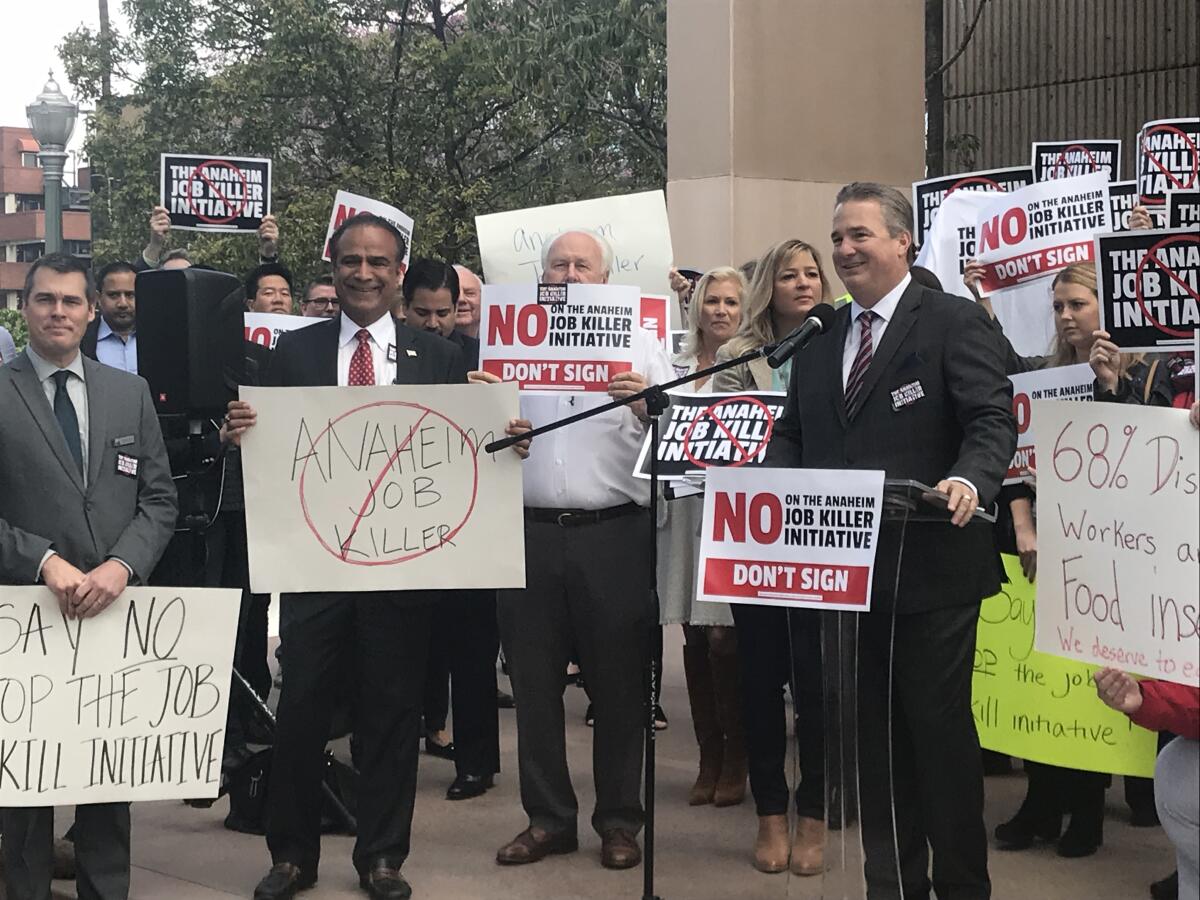
Chamber executive Todd Ament, right, cooperated with the FBI in the case against ex-Mayor Sidhu, left.
(Gabriel San Roman/Los Angeles Times)
In Ament’s attempt to withdraw his plea agreement, he has argued that, contrary to Rafiei’s statments, the task force put in real work. From the Earth “received the services it paid for,” his September court filing claimed.
According to the FBI, Flint transferred $41,000, a portion of From the Earth’s payment from his FSB consulting firm, to Ament’s private accounts, which the former chamber executive then allegedly used on personal expenses.
Ament’s attorneys claim that he merely failed to inform Rafiei about the payment which, they argue, is not enough to sustain a wire fraud charge under new, tightened legal definitions.
In an interview, Daniel Ahn, a former senior federal prosecutor on the case, weighed in on Ament’s chances in court next month.
“The key question is whether, based on the factual basis of the plea agreement, it can be said that Ament deceived From the Earth and Mr. Nice Guy into transferring money, regardless of whether they got what they paid for,”Ahn said. “If the answer is yes, then unwinding the plea on this basis will be a tough row to hoe.”
A spokesperson for Ament’s legal team declined to comment for this story.
Suspicions heightened
Glew’s May 28, 2020 email to Ament and Flint went a week without any response. On June 5, 2020, he sent a follow-up email in which he claimed Ament had given him no substantive update on retail cannabis in months, save to ask for more money. Glew also learned that Pete Mitchell, another consultant, was part of the cannabis team. He referenced phone calls with him and claimed Mitchell said he’d been involved since day one.
“Pete also made it clear that he has obtained other clients from very lucrative terms to work on a ballot initiative,” Glew wrote. “This is very alarming as he is part of the Todd Ament and Jeff Flint team we hired to avoid the ballot initiative from the beginning.”
Mitchell responded after the email was forwarded to him.
“I was not a part of the team, as you put it, since day one and am my own entity,” he wrote. “I have not received any compensation from clients. I have one client only, at this point, in cannabis and I am not receiving funds and I am doing it on a win bonus only scenario.”
Mitchell claimed he had no “business ventures” with Ament and Flint. His involvement, he said, came “much later,” at the request of council members to curry favor for legal retail cannabis from law enforcement. Mitchell had counted the Anaheim Police Assn. as a client.
The explanation appeared to disarm Glew, at least on the surface.
“I will assume, based on this email, that you are hereby not representing the clients we brought to Jeff and Todd so Melahat and I will no longer be discussing the payments with you as previously requested by you,” he wrote. “I cannot ask you to work in any specific direction, but I look forward to your support in developing the best policies for Anaheim.”
Corruption scandals have hung over Anaheim City Hall since an FBI probe surfaced almost four years ago.
(Gabriel San Román)
A task force ledger from July 2020 noted that FSB shared its payment not only with Ament but also with Mitchell’s firm. Mitchell emailed Flint on May 20, 2020, asking if he needed wire transfer information, but it is unclear if the correspondence was related to a task force payment.
Another ledger showed Mitchell’s consulting company under an accounts payable column dating back to July 2019. Mitchell confirmed to TimesOC he was paid around $20,000, describing his role as a subcontractor.
“I became a person who wanted to shepherd good policy on this, but it became so disjointed,” Mitchell added. “I eventually wanted no part of an ordinance or this process, so I was glad it was killed.”
He said he was “disgusted” by the revelations in the FBI probe.
Flint did not respond to requests for comment.
Ahead of the June 9, 2020, council meeting, according to email records, Flint prepared two scripts for Harry Sidhu, who served as mayor at the time, to read in the event the ordinance passed or failed.
Political consultant Matt Cunningham wrote a letter in Ament’s name to council members before the vote. It claimed that the chamber had taken “no position” on legal retail cannabis.
“We became aware that outside cannabis interests intended to qualify a ballot initiative to repeal Anaheim’s prohibition on cannabis businesses,” the letter read.
“Rather than have outside actors to potentially decide the terms of cannabis legalization in Anaheim, the chamber launched a cannabis policy task force to study the potential impacts and effects on Anaheim if the City Council were to consider lifting the ban.”
After three hours of debate, a council majority rejected the ordinance. Sidhu later changed his vote to join the majority.
In the aftermath, Flint sent Rafiei a ledger on how the task force money was spent. Rafiei shared it with the FBI and surreptitiously recorded a meeting with Flint and Glew over expenses in September 2020.
According to the ledger, the task force appeared to spend nearly $100,000 on polling and focus groups through a Flint-affiliated company. C3 Public Strategies, another Flint-affiliated company, also expensed $70,700 for a canvassing program. Task force funds also purchased voter data.
Rafiei became upset when she learned Dirk Voss was also hired as a consultant and Chuck Farano provided legal services for the task force.
“He’s our direct competition,” she said of Farano, whose name was redacted in FBI transcripts. “[He] was going out there telling his clients all the things we were working on in here.”
The FBI flagged the task force ledger for inconsistencies. FSB payments totaled $60,000 when chamber records show $80,000 in payments to the Flint company.
Ordinance abandoned
Legal retail cannabis never came back before council. Ballot measures never qualified, including one pulled from the city clerk’s office on May 16, 2022, the same day an FBI affidavit was filed in court detailing allegations of corruption related to an attempted sale of Angel Stadium.
Flint has not been accused of criminal wrongdoing. He now heads HexaCom Group, a new public affairs company. Rafiei is currently at a San Pedro halfway house after a judge sentenced her to six months on cannabis-related attempted wire fraud charge in Anaheim.
The chamber is seeking victim status in the Ament case and $41,000 in restitution.
Federal prosecutors previously attempted to drop Ament’s own wire fraud charge, but a judge declined.
After Ament’s hearing this month, he is scheduled to be sentenced in March.
In a sentencing memo, federal prosecutors are pushing for time served in addition to $225,000 in restitution for From the Earth.