
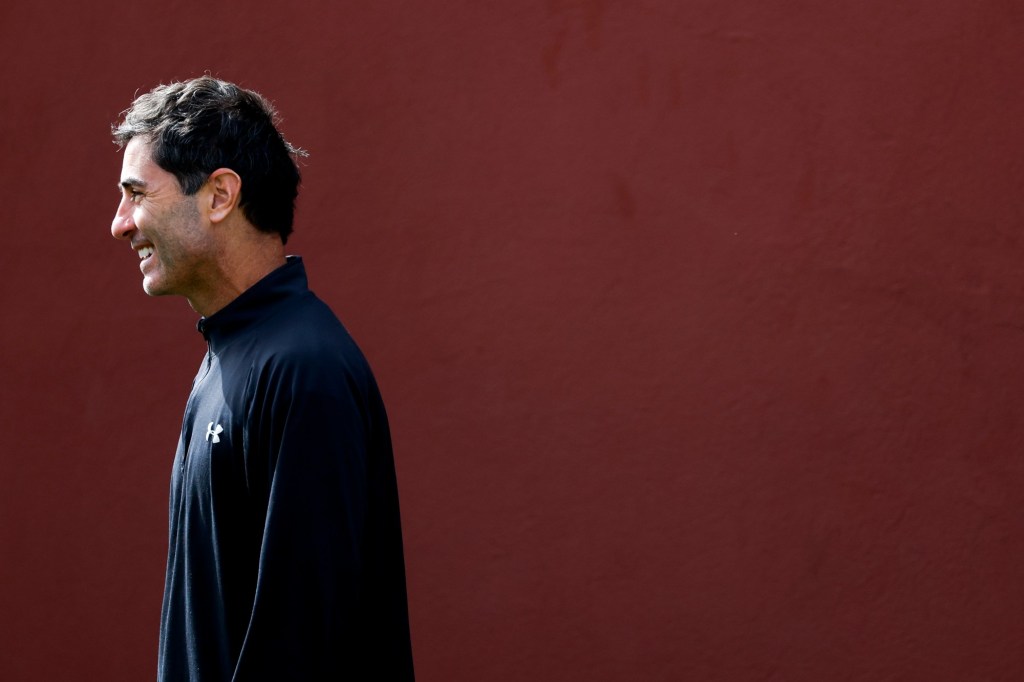
If the Padres are indeed sold to one of the world’s billionaires as the Cactus League season gets going, it’d be shocking to see A.J. Preller not continue as the team’s general manager.
Why would the new top boss not retain Preller through the August trade deadline, at bare minimum, while also getting an up-close sense of how Preller and his staff operate?
The timing alone, it seems, would demand that Preller stays on the job for a while.
Spring training’s leisurely pace doesn’t apply to people in Preller’s line of work.
The bottom of the roster must be sorted out, in addition to the daily happenings of 29 other teams. As opening day draws close, churning up a lot of fringe-player movement, it’s a great time to seek value on the margins in waiver claims and trades. Proximity to his organization’s minor leaguers adds to a GM like Preller’s evaluation duties, as does the chance to scout draft-eligible players.
The wheels will only spin faster from there.
By mid-June, a general manager of a contending team should know what upgrades are needed. And July requires scaling two mountains: the amateur draft and the escalating trade market, which runs to Aug. 3.
Padres’ A.J. Preller addresses contract extension, which still seems likely
There’s a Padres-specific reason that argues for sticking with Preller — or even extending him beyond this year.
Padres manager Craig Stammen just this month began his first spring training as a manager or coach at any level, and counts Preller as a mentor after having worked two-plus years under him in the front office.
Parting with Preller so early into the manager’s tenure would be a disservice to Stammen.
The key Preller question, then, as the GM heads into his contract year and 12th season in the job, appears to be this:
If the team is sold, will the new top boss decide to keep Preller beyond this season?
A strong case for Preller begins with one word: Relevance.
Preller has done his part to help the Padres achieve relevance not just on the field but in the public imagination and the baseball media.
Everyone knows who the Padres are, coast to coast. In San Diego County, the Padres are rock stars.
In the so-called attention economy, don’t take such relevance for granted.
The Padres appear headed to their third consecutive year of setting a franchise record for home attendance. They’ll land in the top seven in attendance for the sixth straight year. If they end up second in MLB at the turnstiles, no one will be surprised. After all, only the Dodgers beat them in attendance in 2023 and 2025.
At the ownership level, there’s precedent for the Padres undergoing a shakeup at this time of year.
In February 2009, former Diamondbacks CEO Jeff Moorad became the Padres’ CEO and presumptive team owner after majority owner John Moores agreed to a three-year installment plan to transfer control of the club. Though Moores retained team control, he allowed Moorad full say on staffing.
Moorad inherited Kevin Towers, a Moores favorite. The league’s longest-tenured GM, Towers was under contract through 2010.
Moorad retained Towers through spring training and most of the season.
Not swayed by the team’s second-half surge, Moorad fired him in October with the Padres at 74-85.
Back then, the Padres’ world moved in a different orbit.
In Mission Valley, the Chargers surged toward their fourth straight AFC West title.
Petco Park played so big that the games lacked the tension created by a home-run threat. The dampening atmospherics and massive right field infuriated sluggers such as Barry Bonds, Jeff Bagwell and Albert Pujols. The Padres dressed like the Brewers and Mariners, forsaking the brown-and-gold merchandise boom to come.
Even the ’10 team’s stunning run to 90 wins didn’t quicken many pulses.
Change was needed. The outfield was shrunk, spicing up all games. Smart brown-and-gold uniforms were introduced, giving the Padres a unique, money-making niche that stretches beyond San Diego.
MLB breathed hope into all its markets, adding two wild-card berths.
A wild-card spot this year would be the team’s fifth in seven years and October sellouts.
Preller, after a fast start as a headline grabber and rough early stretch as a team-builder, has become Mr. Relevant.