
San Francisco teachers were basking in a deal reached Friday with the school district that will give them raises and fully funded healthcare. But before they pop Champagne, they may want to glance across the bay to see what can be lost after a big win.
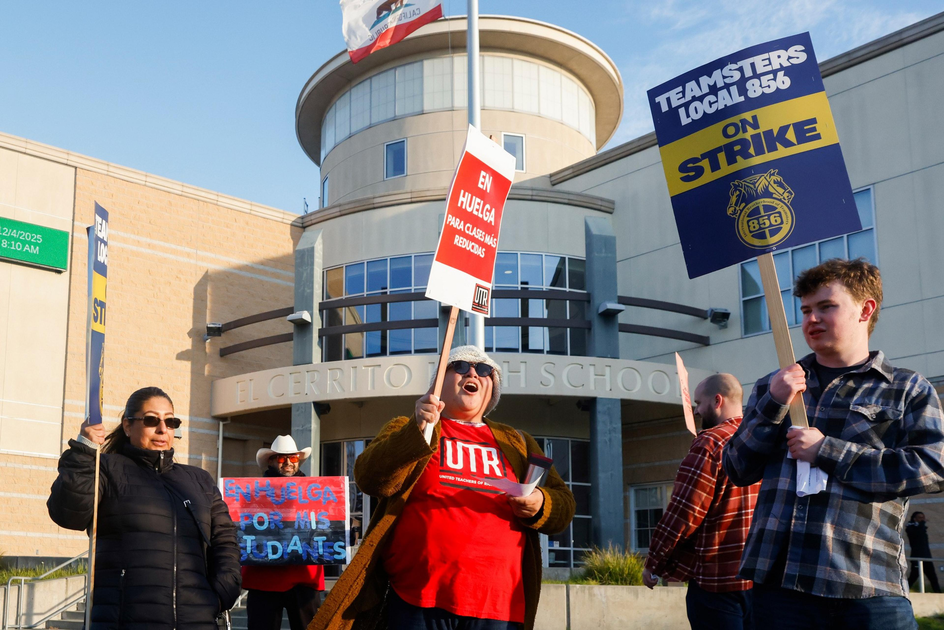
A strikingly similar scene played out in December in the West Contra Costa Unified School District. The teachers there, who serve 25,000 students in Richmond and surrounding towns, walked away with raises after a four-day strike. Sound familiar?
But this week, just two months after that victory, the West Contra Costa district’s board voted unanimously for a sweeping fiscal solvency package that slashes roughly $60 million from the budget — raising questions about whether the gains educators fought for on the picket line can survive the financial reckoning.
The district says the new contract blew its budget out of the water. A preexisting deficit of $13.9 million spiked with an additional $105 million in expenses over three years, EdSource reported (opens in new tab).
The proposed cuts include approximately $42 million in staffing and program reductions and $18 million drawn from reserves. Among the changes: the elimination of classroom aides, the merging of two middle schools, and the restructuring of a group of outreach workers who serve as a critical link between campuses and families.
School board member Leslie Reckler said voting for the cuts was a matter of institutional survival. “It was either do this or face insolvency,” she said. “And it’s not a joke.”
The district suffered a previous bankruptcy in the early 1990s, forcing it under state oversight and requiring a $29 million loan repayment and nearly $19 million in interest-rate payments, according to SFGate (opens in new tab). The district must now reduce its budget by $127 million over three years or face a return to state oversight.
Reckler, whose children attended West Contra Costa schools during the previous state receivership, said the memory of that era — three-hour kindergarten days, no libraries, crumbling buildings — still weighs on her. “I had no idea,” she recalled of first enrolling her child.
Francisco Ortiz, a leader of United Teachers of Richmond, criticized the district’s spending priorities and the manner in which the reductions were proposed.
He said the district is overspending its board-approved budget by $8 million on consultants and professional services, while travel and conference spending by the central office is projected at $1.5 million — nearly double what the board authorized.
“That could have saved the merger,” Ortiz said, referring to the consolidation of two middle schools. “It’s a really hard hit to that specific school community.”
Ortiz also challenged the district’s financial projections, arguing that fully budgeting vacant positions as though they carry full salaries and benefits paints a misleading fiscal picture. He said Gov. Gavin Newsom’s proposed state budget includes ongoing increases to special-education funding and Learning Recovery Emergency Block Grants that could bring $20 million to $40 million in revenue — none of which was factored into the solvency plan.
Community pressure did produce some concessions before the vote. The district agreed to explore rewriting the job descriptions of school community-outreach workers, potentially allowing them to be paid through federal funds. Advocates also fought to preserve the elementary band program, which Ortiz described as the pipeline feeding the district’s award-winning secondary music programs.
Both Reckler and Ortiz framed the district’s predicament as a symptom of a statewide crisis. Reckler said concerned teachers and parents should focus on how Sacramento funds public education, rather than blasting district leadership.
“The cannon is aimed at the wrong place,” she said. “It’s the state and the way the state funds schools. We can only do what the state gives us money to do.”
The tension between labor victories and fiscal constraints may soon materialize in San Francisco as well.
Despite Friday’s tentative agreement between the San Francisco Unified School District and United Educators of San Francisco, the possibility of layoffs or school closures looms. SFUSD Superintendent Maria Su said Friday that “while we have a deal today, we still need more support in the future.”
Ortiz, who visited San Francisco picket lines this week, said he was moved by the solidarity on display in both cities. “The collective is ready to fight for something that they absolutely believe in,” he said.
But the question facing both districts — and others across California where contracts are expiring in quick succession, including Oakland — is whether the promises made at the bargaining table can be kept without gutting the schools they were meant to improve.
The West Contra Costa budget package that includes major cuts covers only the 2026-27 fiscal year. Reckler said it is too early to address what comes next. “Who knows what will happen?” she said. “It could get better. It could get worse.”
Ortiz said he does not believe a state takeover is imminent but urged the district to absorb reductions through existing vacancies rather than layoffs. He encouraged parents to stay engaged. “The more empowered our constituents are,” he said, “the more accountable we can keep those who are in decision-making power.”
On Friday morning, UESF Executive Vice President Frank Lara was sanguine about the prospect of belt-tightening at SFUSD, calling it a “separate conversation” from “this historic agreement.”
He characterized SFUSD’s budget challenges as largely the result of mismanagement, noting that money the district previously claimed not to have materialized at the bargaining table.
“I hope that the power, the energy, the love that we’ve received shows this district management, or any district management or any board elected, that people have hope, and people want to see SFUSD succeed,” Lara said. “If I was a leader under that context, I would look for opportunities to expand.”