
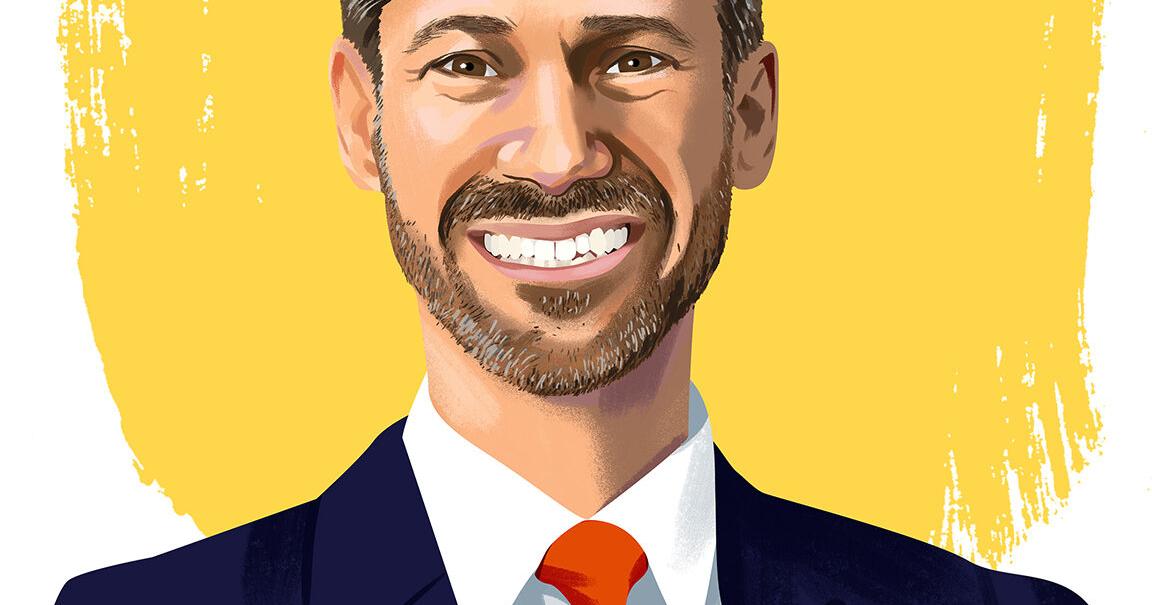

Like San Jose, but bigger: That’s effectively Matt Mahan’s plan for California should voters elect him to be the state’s next governor. In an era of populism and polarization, the mayor of the Bay Area’s most populous city promises pragmatism.
Mahan, who was elected mayor in 2022 after just two years on the San Jose City Council, was late to join an already crowded field of Democratic candidates. He’s looking to make a historically uncommon leap straight from big-city mayor to California governor without any prior experience in Sacramento.
Mahan’s statewide pitch is that his administration has already made marked improvements in the quality of life in San Jose. And despite his lack of experience in Sacramento, Mahan argues that it’s actually at the local level where cutting-edge policy is implemented and tested — with the state too often standing in the way of progress.
Though he’s gained a reputation as a chief critic of Gov. Gavin Newsom, Mahan rejects that label and argues he’s just as sharply disapproving of President Donald Trump. He’s just as quick to shrug about his tight relationship with big tech and its leaders, arguing that it’s natural for them to be in his corner given their presence in Silicon Valley.
What took you so long? Why did you wait so long to jump into the race? Look, I have the best job in the world. I love being mayor of a city. I am passionate about San Jose.
Jumping in this race was a big decision and not one that I took lightly. To be honest, for most of last year I sort of dismissed the notion despite quite a bit of outreach. But I’ve been watching the race closely, and as a mayor — in fact, the only current mayor — in the race and of a big city, I’m acutely aware of the challenges our community faces — the public-safety challenges, addiction and untreated mental-health issues, barriers to building housing. I have a pretty good sense of what it takes to deliver results.
We’ve been doing that in San Jose, but the ability to keep making progress for not just me, but all mayors across the state, is largely through Sacramento.
It’s extremely uncommon for a mayor to be elected governor. What do you say to voters who are skeptical of your experience and qualifications for a job at the state level, having never served in any capacity in Sacramento? Gov. Newsom was a mayor, and I would think he would argue that most of the relevant experience that he gained for the role was as mayor of a big city.
Our local leaders are closest to the problems. They’re also closest to the solutions. We’re typically on the cutting edge of policy innovation because we’re where the implementation happens, and I think that perspective is especially relevant.

San Jose Mayor Matt Mahan: “Our local leaders are … typically on the cutting edge of policy innovation because we’re where the implementation happens, and I think that perspective is especially relevant.”
Vera Nieuwenhuis/Associated Press
We’ve learned a lot in San Jose. We’ve led the state in reducing homelessness; we’re down about one-third in the last few years. We have led the way in reducing crime — we’re down over 20% — and last year, San Jose became the safest big city in the country, which we’re very proud of. We had thousands of homes that were stuck in the pipeline for years. We got over 2,000 homes under construction last year, [and] expect over 2,000 more homes this year that had been stuck because, frankly, our requirements and impact fees were in the way.
Is one of the fees that was rolled back [in order] to stimulate new housing development the requirement that developers include affordable housing? What role does affordable housing play, if you are governor, in new housing development that is desperately needed in California? San Jose has managed to be a leader in affordable-housing production. We have a lot of policy work that clears the way for affordable housing to get built.
At the same time, I think the objective lesson from the last 10 to 15 years of housing policy in California is that if you try to load up new housing construction with every other societal ill — you try to tack on the need for affordable housing, all of the latest and greatest environmental and climate policies, the traffic impact, the parking, the parks and other amenities, and you add all of those as requirements — you get the perfect solution on paper.
You also get a bureaucracy that, in our case, has 15 pages worth of fees that we can add to a new housing project. And you get zero housing and therefore you get none of those things.
There’s a sequencing to this. Let’s get the building in the ground. If we get the building in the ground and we have homes for people, then we have more residents, we have growth, we have more talent which attracts jobs, we have the recurring revenue of property taxes, all the sales taxes that folks generate when they’re buying things in the neighborhood or elsewhere in the city.
It’s not either-or. I’m for affordable housing. I’m for basic dignified shelter and inpatient treatment for those who are literally living and dying on our streets. I’m for encouraging market-rate [housing].
I’m curious to hear you reflect on your homelessness policy in San Jose, but also, maybe opine on how scalable it is statewide. I know you’ve focused heavily on tiny homes to help alleviate San Jose’s problems. In a way, I think it’s much easier statewide because we’re dealing with this challenge in the most expensive place in the country to build [and] to buy. Land is at a premium in Silicon Valley.
What we’re doing is finding cost-effective, scalable alternatives to the streets that offer dignity, safety, connection to case management … meet the very basic needs of our most vulnerable population without letting the perfect be the enemy of the good.
We haven’t just done tiny homes … We have bought 10 motels and converted them into transitional housing. We have done safe-parking, safe-sleeping sites that give people a structured alternative with connection to services, with on-site security, with 3 meals a day, to help people stabilize.
Known for his 2020 presidential bid, the billionaire-turned-environmentalist is eyeing the governor’s mansion

Advocates warn Department of Public Health reductions will be felt in programs serving vulnerable

Points of contention remain in discussions for a new two-year contract
What we find is when we stop that inflow to unsheltered homelessness and we connect people with services, they find ways to get out. There are different pathways off of the streets once someone’s in a safe, stable environment.
I supported and continue to support Gov. Newsom’s push for CARE Court, but the implementation at the county level has been really rough. The next governor has to build on Gov. Newsom’s vision for CARE Court and Prop. 1, which is building out more treatment and then be extremely hands-on in working with each of the counties and the major cities to figure out implementation.
Since you’re lauding Gov. Newsom, I will bring up the fact that you’ve been a main critic of Gov. Newsom. I wonder how you would confront the Trump administration, given that you’ve been critical of the way in which Gov. Newsom has done it? I’ve actually been more critical of the Trump administration, but that’s just not very newsworthy in a state that is so heavily Democratic. We’ve sued the Trump administration over a half-dozen times in San Jose.
We’ve funded legal support for our immigrant population. I will absolutely fight for our values and fight strong and push back against excess, overreach and abuse of power from the federal administration here at home.

San Jose Mayor Matt Mahan speaks in the California gubernatorial candidate debate Tuesday, Feb. 3, 2026, in San Francisco.
Laure Andrillon/Associated Press
Some have tried to label me as a critic or an ally at different times. My North Star on this has been to be policy focused, outcome focused, and again, give the governor credit and support him and advocate and stand with him on the things I agree with — and be honest when I disagree.
I know from the experience of our residents, including those living out in encampments, our police officers, our outreach workers, the judges who run our drug courts, that we had some unintended consequences when we pursued criminal-justice reform. We really took the teeth out of the drug courts, and that led to more overdose deaths on our streets.
If I can circle back to where we began, thinking about the people who were coming to you and pushing you to run for governor — many of those people are in Silicon Valley. How do you convince Americans who are increasingly skeptical of the companies whose executives are now supporting you, that you can hold those very executives and their companies accountable as governor of California? Palantir comes to mind, just to throw that one out there. [Editor’s note: Palantir is a software company with extensive government and military contracts, including with the U.S. Department of Homeland Security and Immigration and Customs Enforcement. Co-founder Joe Lonsdale, an ally and supporter of Trump, contributed the maximum $78,400 to Mahan’s campaign last month.] On people reaching out and encouraging me to run — most of the feedback I got was literally at the grocery store, the gas station. I take my kids to the grocery store every Sunday, and it sometimes takes me a couple of hours to get through. It’s like a walking town-hall meeting, and the number of people who’ve come up and said, “You’re doing a great job here in San Jose, I think you should run for governor.”
I think that would be a bad sign, and I think the fact that many — not all — but many of the largest employers in the San Jose metro area are supportive has more to do with the fact that they have seen how I lead and bring people together and try to balance different interests and focus on outcomes.
I don’t determine my policies based on who is supporting me in a given race or has given money to a campaign. I have not gone through and looked at all the reports. I don’t really track it closely. I go out and try to make the case and fundraise and share a vision when I’m campaigning, but the vision is consistent — it has been since I ran for council six years ago. I’m not running for the tech sector.
In San Jose as mayor, we started something called the GovAI Coalition, which was actually about leveling the playing field and helping the public sector be able to demand higher standards from vendors in the tech world and say “we have an interest in protecting data privacy, data security.” We don’t use facial recognition. We delete data on regular cadences because we don’t want to store people’s personal information. Even when it’s useful data, we put limits on what we collect. We don’t share with third parties.

San Jose Mayor Matt Mahan, pictured to attendees after the California gubernatorial candidate debate Tuesday, Feb. 3, 2026, in San Francisco, says most of the encouragement he received to governor he received “was literally at the grocery store, the gas station. I take my kids to the grocery store every Sunday, and it sometimes takes me a couple of hours to get through.”
Laure Andrillon
I actually know enough about technology to be able to be an advocate for the resident and their privacy, which is something I personally care about.
I will ask what you think of the proposed billionaire tax. I know you’ve come out against it. Why? I don’t support the billionaire tax, not because I’m worried for the billionaires, I’m worried for the rest of us. I think that my concern is that it won’t work in practice and that the unintended consequences could be severe for working and middle class people. We have already had over $1 trillion worth of wealth leave the state since it was proposed. [Editor’s note: Venture capitalist and “All-In” podcast co-host Chamath Palihapitiya claimed on X last month that “the total wealth that has left California” equaled $1 trillion, referring to the billionaires who had left the state by then.] That means our revenue going forward every year is reduced.
I think that that means that over time, middle-class families are going to be asked to pick up more of the bill, and I think there are better ways to address economic inequality.
There are a number of tax loopholes that I would go after that feel really unfair. For example, a very simple one that I know is commonly used is, very high net-worth individuals can borrow against their unrealized stock gains — and borrow and invest and endlessly use the borrowed funds at a very low interest rate, and never need to sell the stock, meaning they never pay taxes on it, so they don’t pay any capital gains [tax].
You could also change the capital-gains rate. I mean, there are a lot of other options just in the tax code for leveling the playing field more, which I would very much support.
It’s one of these shiny objects in politics where you have something that sounds really good and then you look at the data and you just have to be honest with people. We’ve made measurable progress on our biggest issues by bringing that mindset of not being hyperpartisan, not being overly populist and just reacting to the latest shiny object, but good governance, accountable governance, and that’s, that’s really what I’m trying to offer.
It’s hard in a moment of rising populism and partisanship. I mean, we’re really divided. People are really frustrated, but the only path forward to push back on the MAGA movement and to ultimately deliver better outcomes is to actually make government work better for everybody and solve real problems, and that’s what I’m all about.