
Now comes phase two. Last year’s blitz of bills, capping off years of gradual legislative efforts to remove regulatory barriers to building dense housing across California, has, in Wicks’ view, teed up this next big swing.
“Over the last eight to 10 years or so the Legislature and the governor have really taken a bulldozer to a lot of the bureaucratic hurdles when it comes to housing,” said Wicks. “But one of the issues that we haven’t fundamentally tackled is the cost of construction.”
Factory-built housing can arrive on a construction site in varying levels of completeness. There are prefabricated panels (imagine the baked slabs of a gingerbread house) and fully three-dimensional modules (think, Legos).
Interest in the use of both for apartment buildings has been steadily growing in California over the last decade. Investors have poured billions of dollars into the nascent sector, albeit with famously mixed results. In California’s major urban areas, but especially in the San Francisco Bay Area, cranes delicately assembling factory-built modules into apartment blocks has become a more familiar feature of the skyline.
Randall Thompson, who runs the prefabrication division of Nibbi Brothers General Contractors, said he’s seen attitudes shift radically just in the last couple of years. Not long ago, pitching a developer on factory-built construction was a tough sell. But a few years ago he noted a growing number of “modular-curious” clients willing to run the numbers. Now many are coming to him committed to the idea from the get-go.
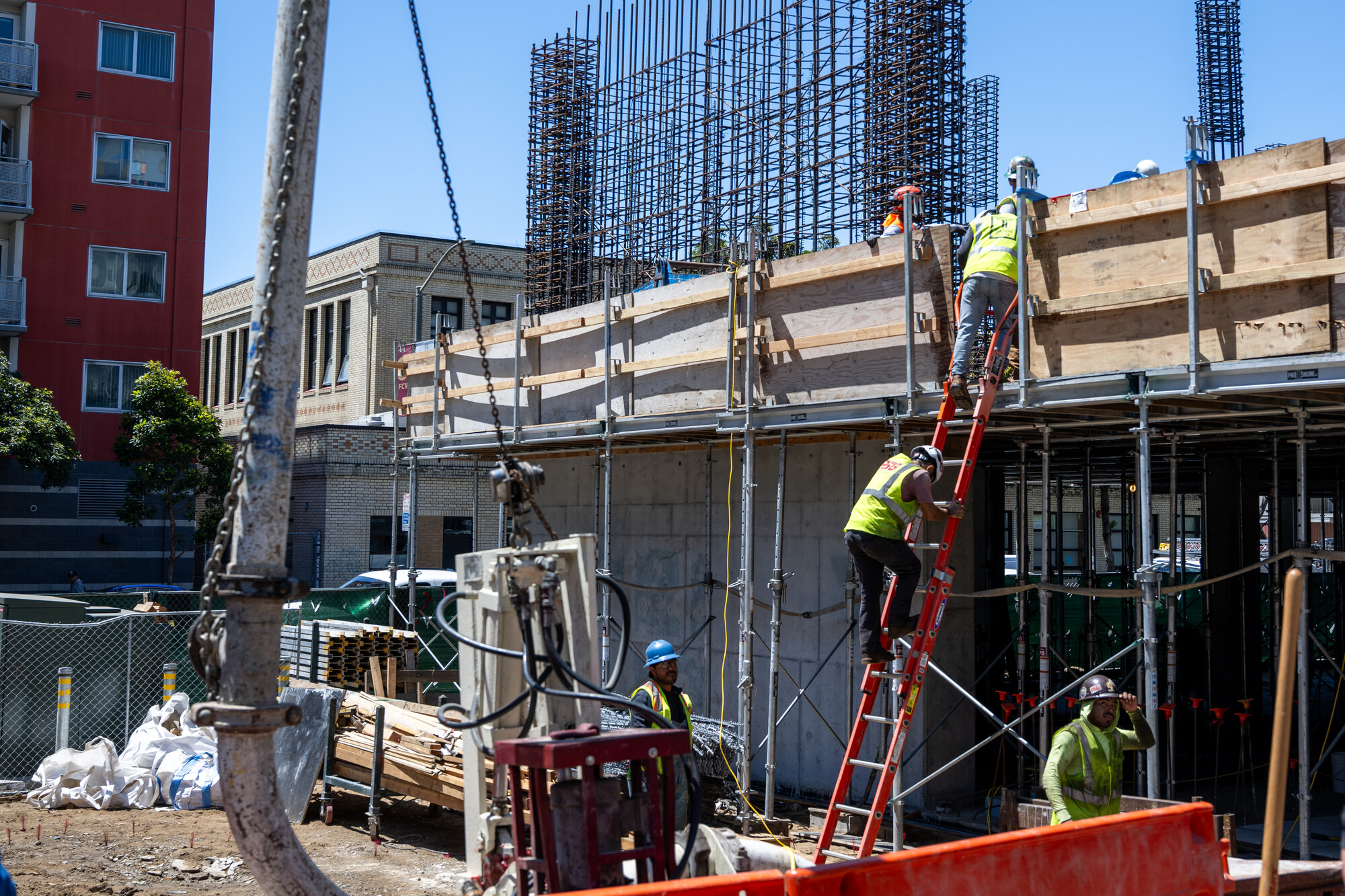 Construction workers build at 750 Golden Gate Ave., in San Francisco, on June 18, 2025, during a groundbreaking ceremony marking the start of two affordable housing projects. One will deliver 75 units prioritized for SFUSD and City College educators, and the other at 850 Turk will add 92 family apartments. (Beth LaBerge/KQED)
Policymakers are interested too, debating whether public policy and taxpayer money should be used to propel off-site construction from niche application to a regular, if not dominant, feature of the industry.
Evidence from abroad is fueling that optimism: In Sweden, where Wicks and a gaggle of other lawmakers visited last fall, nearly half of residential construction takes place in a factory.
The renewed national interest is part of a “back to the drawingboard” energy that has pervaded policy circles at every level of government in the face of a national affordability crisis, said Chad Maisel, a Center for American Progress fellow and a former Biden administration housing policy advisor.
Yes, the country has tried and failed at this before, most notably with Operation Breakthrough. Yes, individual companies have gone bust trying to make off-site happen at scale. “But we haven’t really given it our all,” Maisel said.
Henry Ford, but for housing
If the goal is to bring down building costs, rethinking the basics of the construction process is an obvious place to start.
Over the last century, economic sectors across the United States have seen explosions in labor productivity, with industries using technological innovation, fine-tuned production processes and globe-spanning supply chains to squeeze ever more stuff out of the same number of workers.
Construction has been a stagnant outlier. Since the 1970s, labor productivity has actually declined sector-wide, according to official government statistics. In 2023 the average American construction worker added about as much value on a construction site as one in 1948.
“When you go to buy a car, you don’t get 6,000 parts shipped to your house and then someone comes and builds it for you,” said Ryan Cassidy, vice president of real estate development at Mutual Housing California, an affordable housing developer based in Sacramento that committed last year to build its next five projects with factory-built units.
 A truck is piled with planks salvaged by Perks Deconstruction from an old farmhouse in Aurora. The wood will be transported to the company’s warehouse, where it will be sorted and priced for sale. (Hart Van Denburg/CPR News)
In theory, breaking down the building process into a series of discrete, repeatable tasks can mean fewer highly trained workers are needed per unit. Standardized panels and modules allow factories to buy materials in bulk at discount.
The work can be done faster, because it’s centralized, tightly choreographed, closely monitored and possibly automated — but also because multiple things can happen at the same time. Framers don’t have to wait for a foundation to set before getting started on the bedrooms.
Off-site construction reliably cuts construction timelines by 10 to 30 percent, according to an analysis by the Terner Center. Some even rosier estimates have put the figure closer to 50%.
That can translate into real savings. “Factory-built housing has the potential to reduce hard (labor, material and equipment) costs by 10 to 25% — at least under the right conditions,” Terner’s director, Ben Metcalf, said at the select committee’s first hearing in early January.
But historically, it’s been very hard to get those conditions right.
The ghost of Katerra
The main hitch is an obvious one: Factories are hugely expensive to set up and run. Off-site construction companies only stand to make up those costs if they can run continuously and at full capacity. Mass production only pencils out if it massively produces.
That means factory production isn’t especially well-suited to industries that boom and bust, in which surplus production can’t be stockpiled in a warehouse and everything is made to order and where local variations in climate, topography and regulation require bespoke products of varying materials, designs, configurations and sizes.
All of which describes the current real estate sector.
“In a world in which housing projects are approved one at a time under various local rules and designs and sometimes after years of piecing together financing sources, it’s hard to build out that pipeline for a factory,” said Metcalf at the early January hearing.
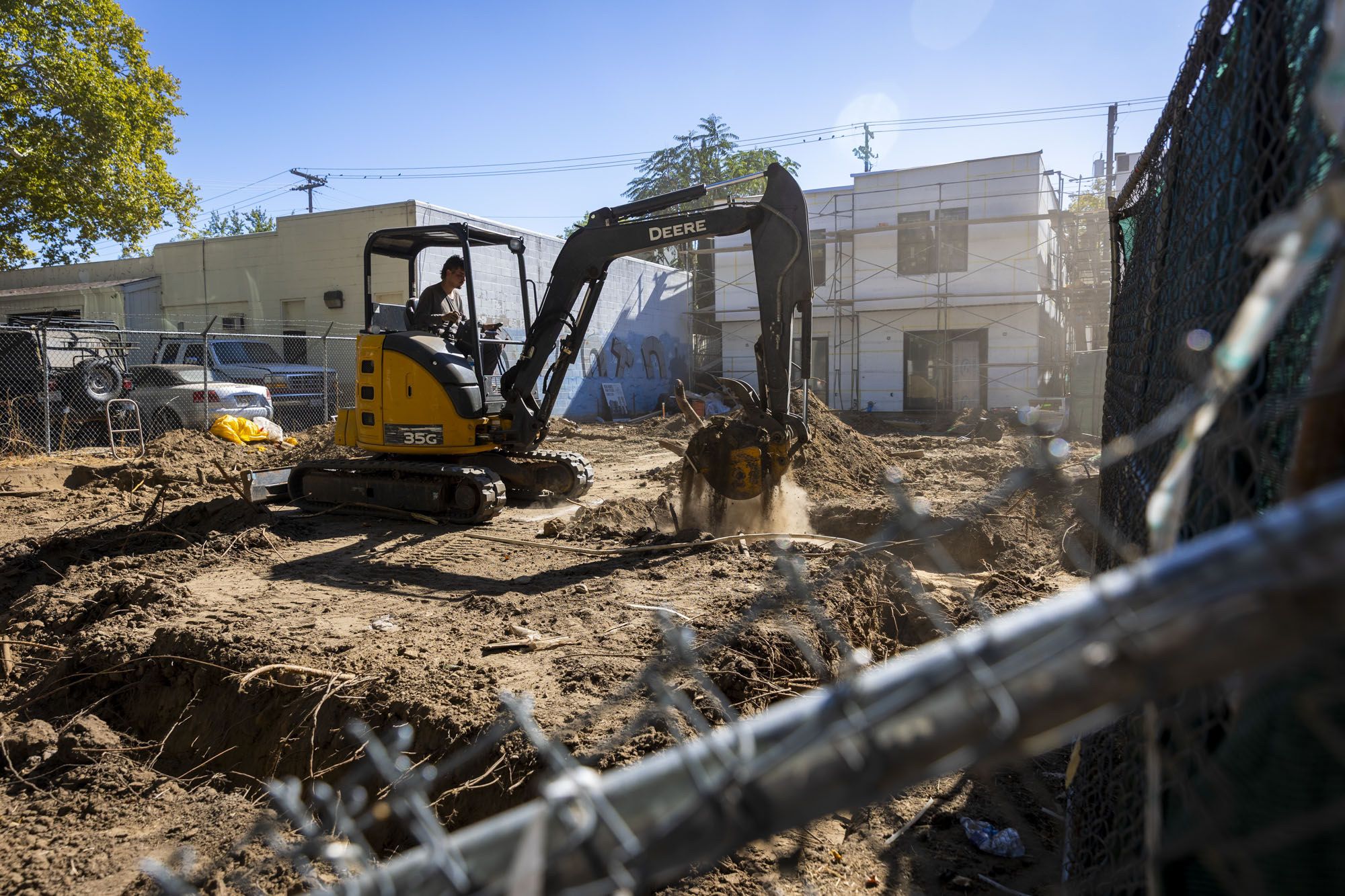 A construction worker operates machinery to move dirt at the site of new middle housing units at 2824 D Street in Sacramento on October 7, 2025. Developers are reviving “middle housing” such as duplexes and cottage clusters, but say California’s rollout of the new rules has been anything but smooth. (Tâm Vũ/KQED)
The particular financial needs of a factory also upend business as usual for developers and real estate funders.
Industrial construction “costs less overall but costs more in the short term. Everything is frontloaded,” said Jan Lindenthal-Cox, chief investment officer at the San Francisco Housing Accelerator Fund. All design, engineering and material decisions have to be finalized long before the factory gears start turning. Real estate investors and lenders tend to be wary of putting up quite so much money so early in the process.
The Accelerator Fund, a privately-backed non-profit, is hoping to ease some of those concerns by providing short-term, low-cost loans to developers in order to cover those higher-than-usual early costs. The hope is that traditional funders — namely, banks and investors — will eventually feel confident enough to take over that role “once this is a more proven approach,” said Lindenthal-Cox.
Such skittishness pervades every step of the off-site development process, said Apoorva Pasricha, chief operation officer at Cloud Apartments, a San Francisco-based start-up.
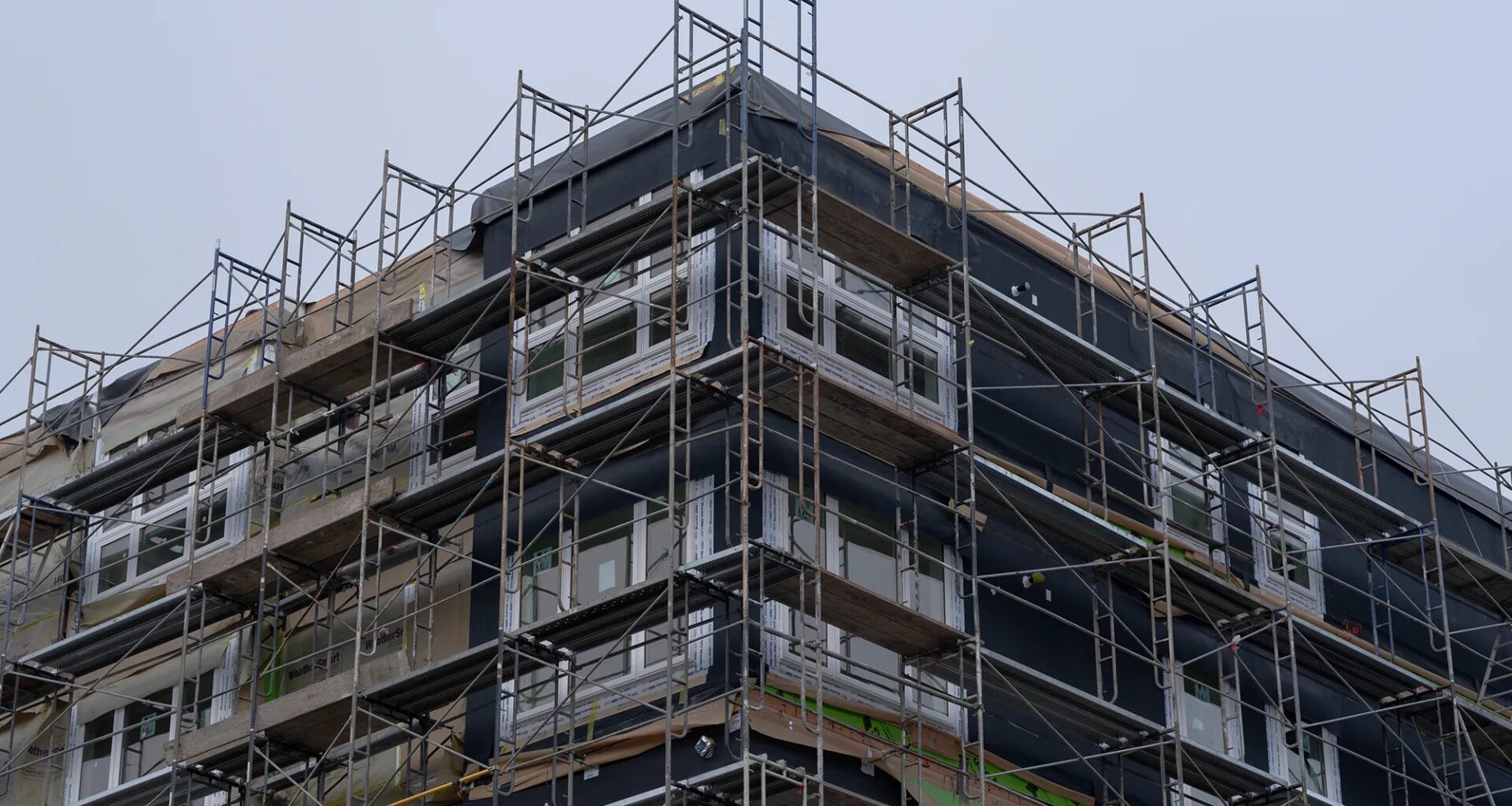
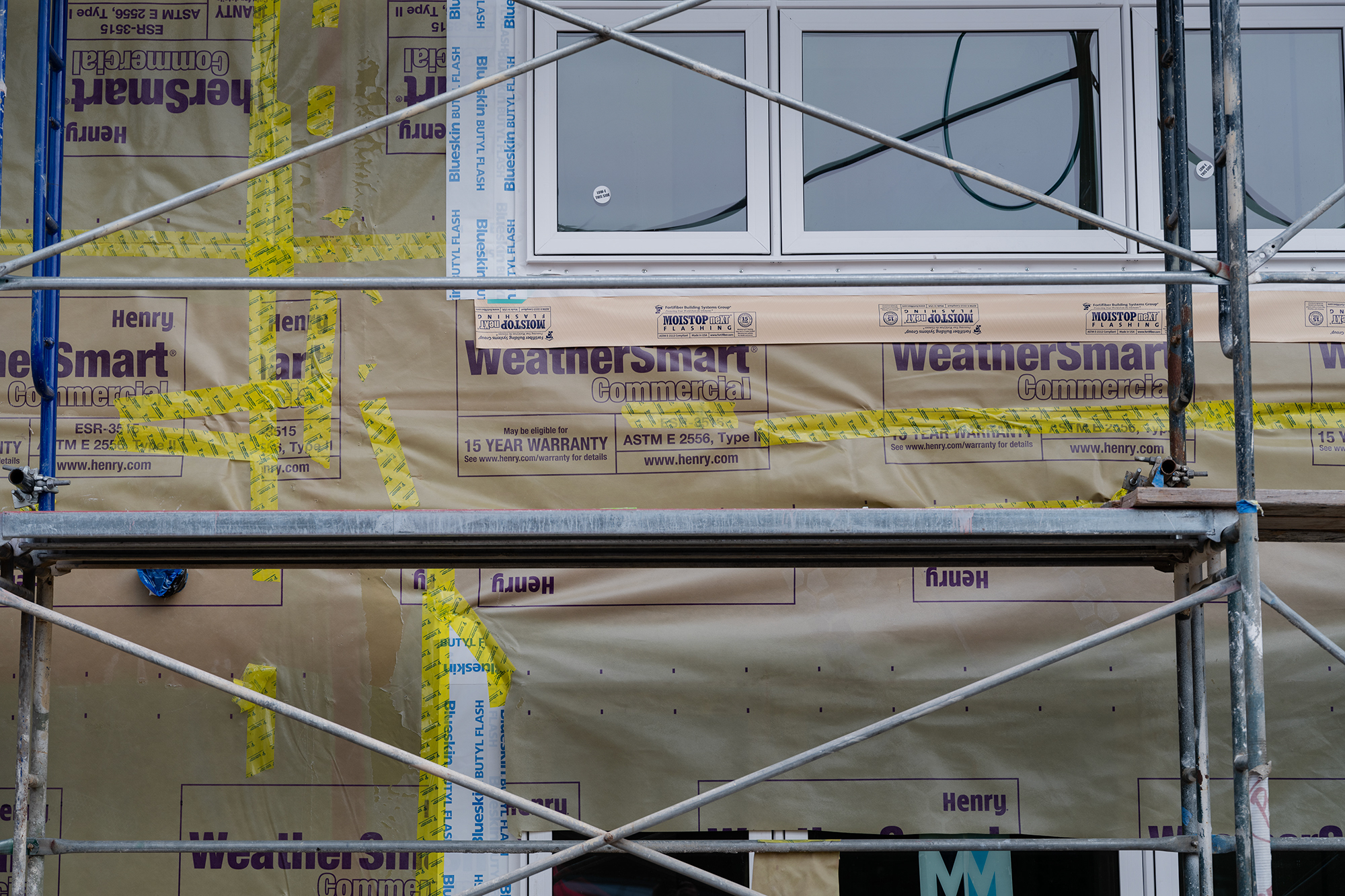 Scaffolding sits in front of a weather-resistant barrier on the exterior of Drake Avenue Apartments at the site of the factory housing complex at 825 Drake Avenue in Marin City on Feb. 7, 2026. (Scaffolding sits in front of a weather-resistant barrier on the exterior of factory-built housing, Drake Avenue Apartments, at 825 Drake Avenue in Marin City on Feb. 7, 2026. Photo by Jungho Kim for CalMatters)
A subcontractor unfamiliar with modular construction might bid a project higher than they otherwise would to compensate for the uncertainty. Building code officials might be extra cautious or extra slow in approving a project for the same reason.
As the industry grows, “creating familiarity with the process helps drive that risk down,” said Pasricha. “The question is, who is going to be willing to pay the price to learn?”
Some would-be pioneers have paid it. In 2021, the Silicon Valley-based modular start up Katerra went spectacularly bankrupt after spending $2 billion in a hyperambitious gambit to disrupt the building industry. Katerra still hangs over the industry like a specter.
Brian Potter, a former Katerra engineer who now writes the widely-read Construction Physics newsletter, said he too was once wooed by the idea that “‘we’ll just move this into a factory and we will yield enormous improvements.’”