

Cara, age 4, of Santa Ana is happy and energetic and, by all indications, super smart.
Her parents, Adella and Leo, say their youngest is curious about “everything,” particularly (this month) recipes and bugs. She’s interested in animals, too, and sometimes tries to use a toy stethoscope to track her cat’s heart rate. (The cat isn’t always into it.) She’s already a fine conversationalist (“This is Miranda,” Cara explains, via video phone, as she points to a plush lady dinosaur she favors. “She’s got lots of friends.”); and, lately, she’s been sounding out words, in English and Spanish, on the pages of books that her parents or older siblings read to her.
Her parents say there’s just one problem:
She’s about to start public school.
“I just don’t want her to lose what’s special,” said Adella, choking up at the thought.
“School can do that. It can take away what’s special.”
School isn’t supposed to do that, of course. And no school would say it’s true. But a half century of data — from the Coleman report in 1966 to more recent studies by Harvard and the General Accounting Office, among others — point to a hard but unmistakable truth:
Lower-income students like Cara tend to get a less effective public education than wealthy students do.
The data on this is unambiguous. Test scores, dropout rates, college prep work — and, later, college graduation rates and the higher incomes that often come with those degrees — all favor wealthy students over lower-income students. By some measures, by the end of high school, a wealthy student in the United States typically gets a year more education than a lower-income student does.
The why of it remains a point of debate, and the pattern doesn’t apply to every student or play out in every school district (more on that in a bit). But education experts say there’s no dispute that the rich school/poor school divide is real.
And it isn’t distant.
In January, the Census Bureau published data describing the economic status of K-12 students in every school district in the United States. While previous surveys measured student poverty by adding up the number of kids in a school district who qualified for free meals, this report looked at the incomes reported by the families of K-12 students and came up with a “low income” label only after comparing those numbers to the local costs for essentials like housing, food and transportation.
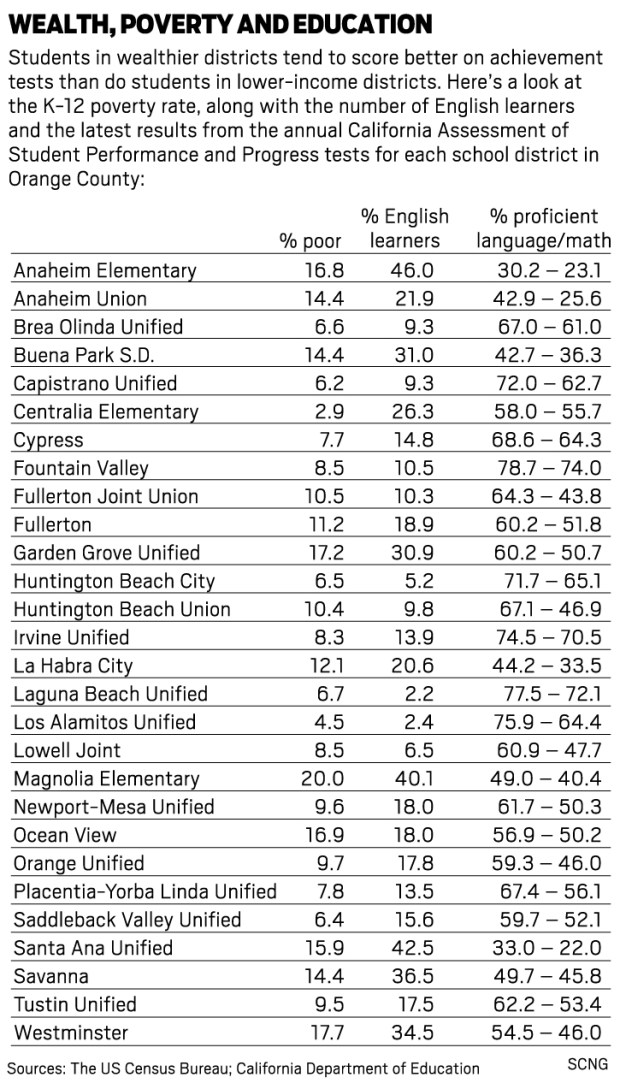
In Orange County — a place with many different versions of economic comfort and large swaths of economic hardship — the results weren’t surprising. In the county’s wealthier districts, roughly 1 in 20 students comes from families struggling to pay the basics; in other places, the ratio is closer to 1 in 5.
On its own, that report didn’t reveal much. But when combined with state data on the number of English learners in each district and the latest results in language and math proficiency tests, the report tells a bigger story. Overall, the five wealthiest districts in Orange County scored about 20% higher, on average, than did the five poorest districts on the California Assessment of Student Performance and Progress tests, which are given annually as a rough (but consistent) measure of how well schools teach the basics of language and math.
The rich school/poor school divide is, according to the data, alive and well in Orange County.
But there are some glaring exceptions.
‘Sympathy? No. Empathy? Yes’
“The common wisdom — but I don’t believe in it — is that most of the challenges for lower-income students reside at home. Instead, I feel that the biggest challenge, for us, is what happens in our schools,” said Gabriela Mafi, superintendent of Garden Grove Unified School District, the third biggest district in Orange County and, according to census data, the district with the county’s second highest ratio (about 17.2%) of low-income students.
“What happens at school is what we can control.”
At Garden Grove Unified, that strategy is helping thousands of students beat the odds.
Last year, 65.1% of the students who graduated from the eight high schools in the Garden Grove district did so after passing all of the classes needed to qualify to apply to colleges in the University of California or California State University systems. By comparison, the county average for producing college-ready graduates was 59.1%, and the state average was 53.9%.
And those college-prep numbers are just the newest data points in what has been a 20-year transformation at Garden Grove Unified, which has morphed from one of the lower-performing school districts in Southern California to middle of the pack in generally high-achieving Orange County.
The district’s scores on English language arts and math tests are in the ballpark with districts that cover wealthier communities, like Newport Beach, Tustin and Laguna Hills. Achievement scores in Advanced Placement testing and access to AP courses also are relatively high. And the district has been recognized with several education-centric awards, including 11 California Distinguished Schools in 2025 and having its high schools named to the AP Honor roll by the College Board. (For what it’s worth, U.S. News & World Report recently listed four Garden Grove Unified schools in its annual school rating guide, including La Quinta High, which ranked 473rd out of more than 24,000 public high schools in the country.)
The district has implemented a number of programs to make that happen.
Some are about setting examples. In elementary school and middle school, Garden Grove Unified campuses have regular “teacher college” days, with educators wearing something symbolic of their alma mater and talking with students about what college was like for them and how it affected their lives.
Other programs are more concrete, including the wide use of AVID classes, a national program that helps aspiring first-generation college students learn the ins and outs of being a good student, from organization and planning to how to ask for help and what kind of language to use when talking with teachers. Garden Grove Unified also offers free college guidance, with one-on-one help for high school students trying to apply to college or trade schools without strong family experience.
But beyond those programs, powerful as they’ve proven to be, Mafi argues that the biggest catalyst for change is about attitude — making every student believe that college is within their reach and that they’re worthy of going.
“We make sure that every adult who interacts with our students believes in those kids and has high expectations of them,” Mafi said. “We want them to have the same expectations of our students that we would want for our own children.
“This idea that poor students can’t overcome challenges, it’s inherently classist.”
For Mafi, who has been superintendent at Garden Grove Unified since 2013, that belief has been a key part of her life and career.
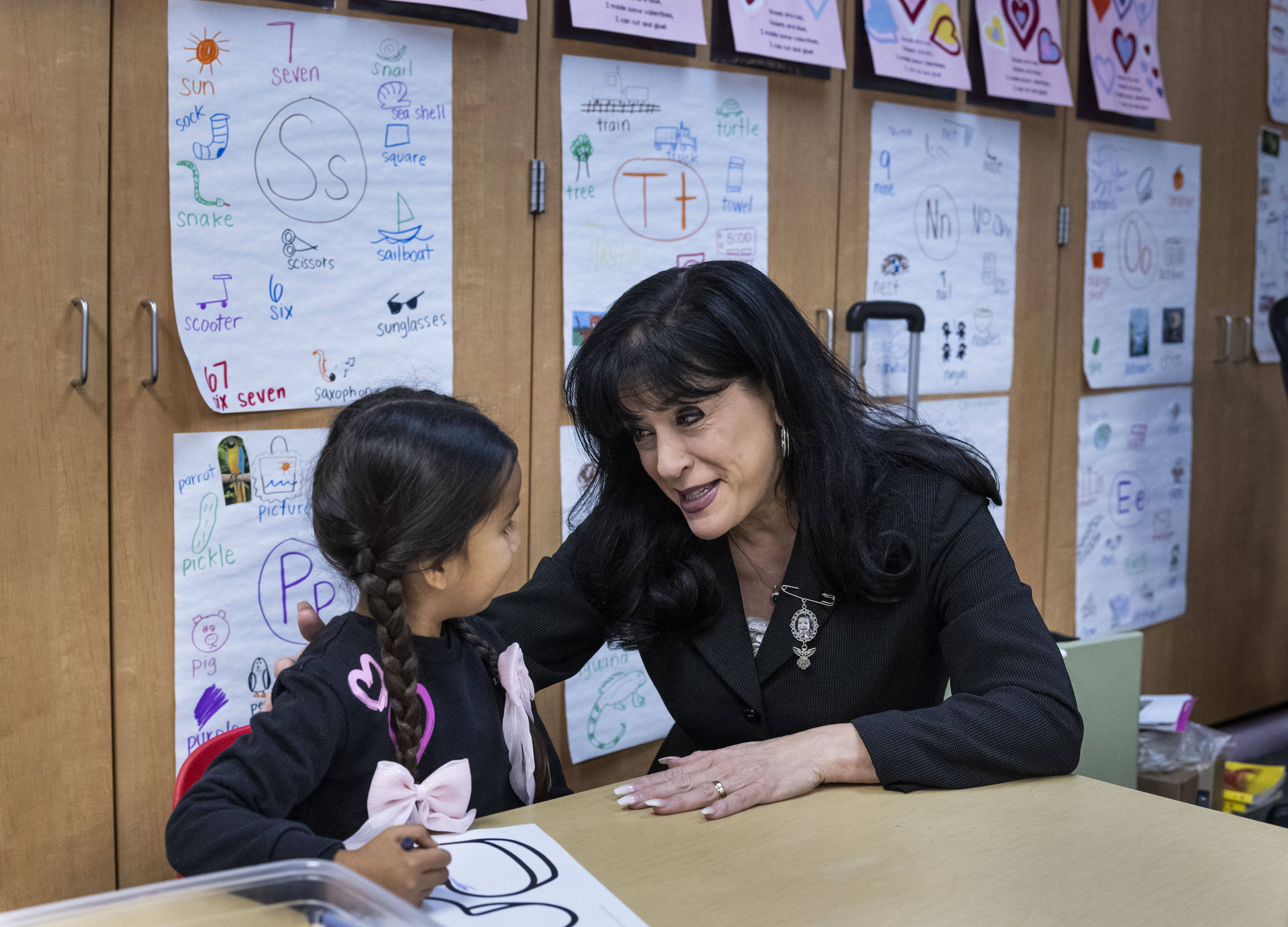
Garden Grove Unified School District Superintendent Gabriela Mafi talks with Miya Carrasco in her transitional kindergarten/kindergarten class at Rosita Elementary School in Santa Ana, CA on Thursday, February 12, 2026. (Photo by Paul Bersebach, Orange County Register/SCNG)
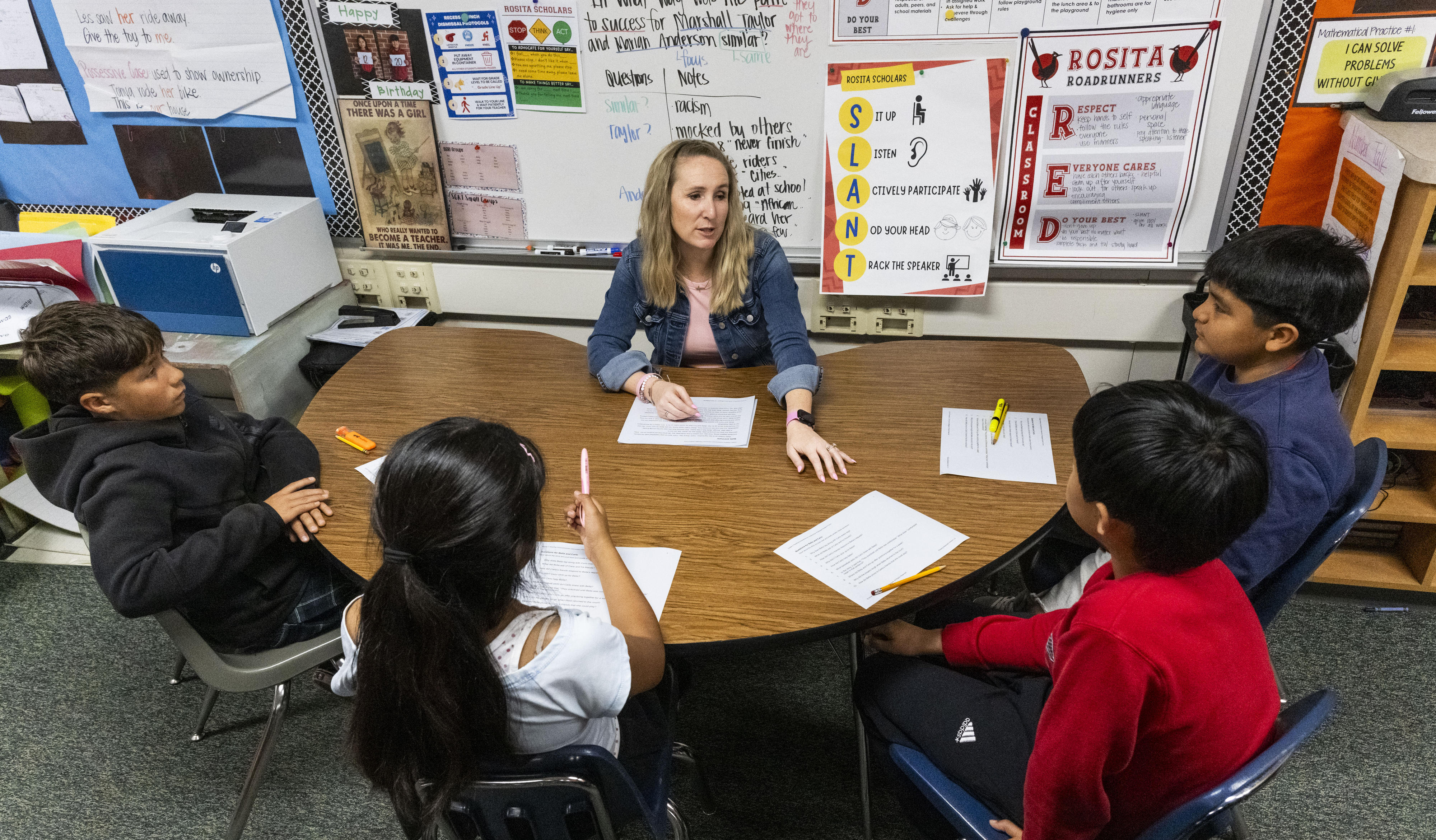
Sixth-grade teacher Lindsay Rachal works with students at Rosita Elementary School in Santa Ana, CA on Thursday, February 12, 2026. (Photo by Paul Bersebach, Orange County Register/SCNG)
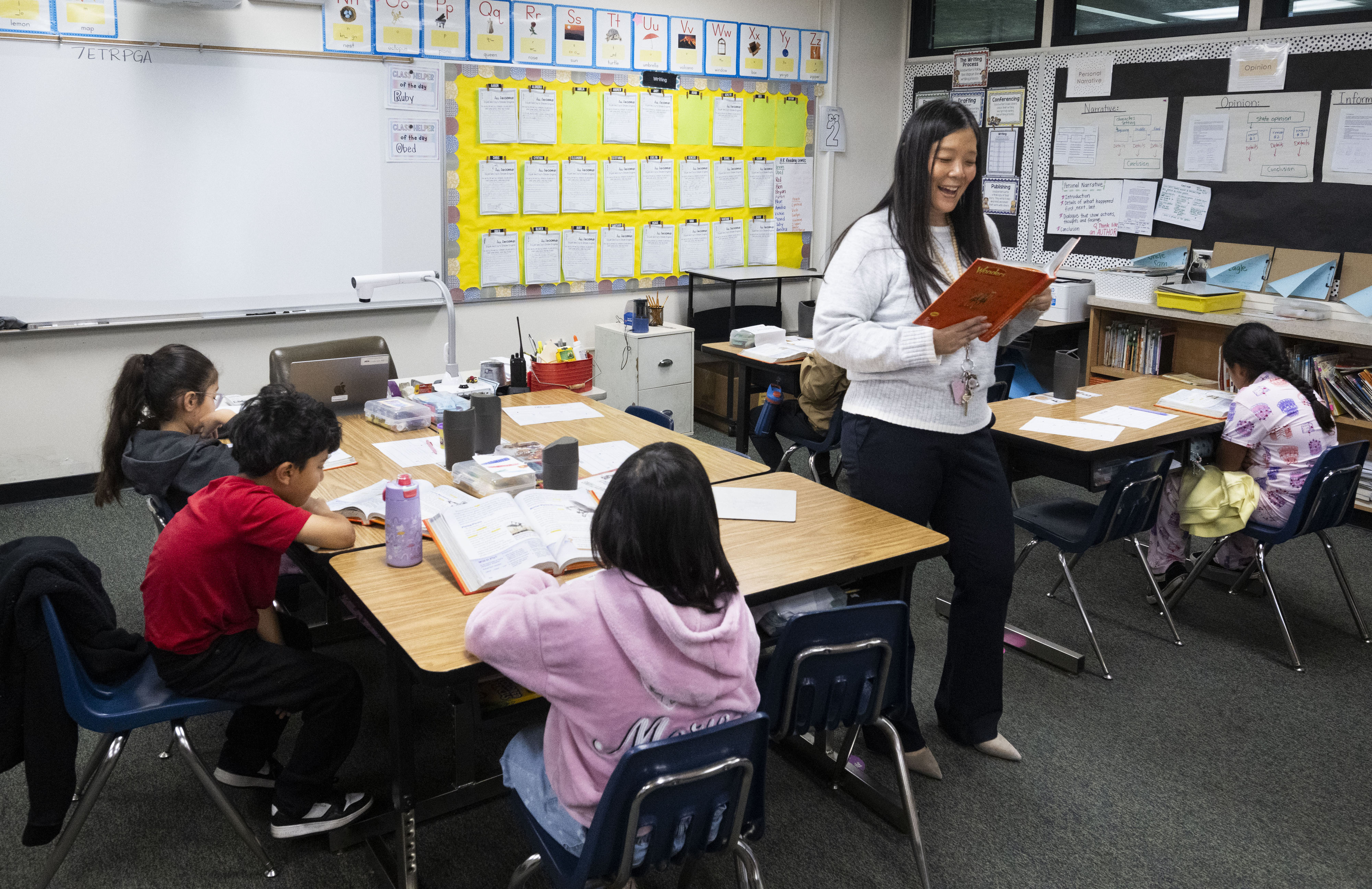
Third-grade teacher Linda Kim works with students at Rosita Elementary School in Santa Ana, CA on Thursday, February 12, 2026. (Photo by Paul Bersebach, Orange County Register/SCNG)
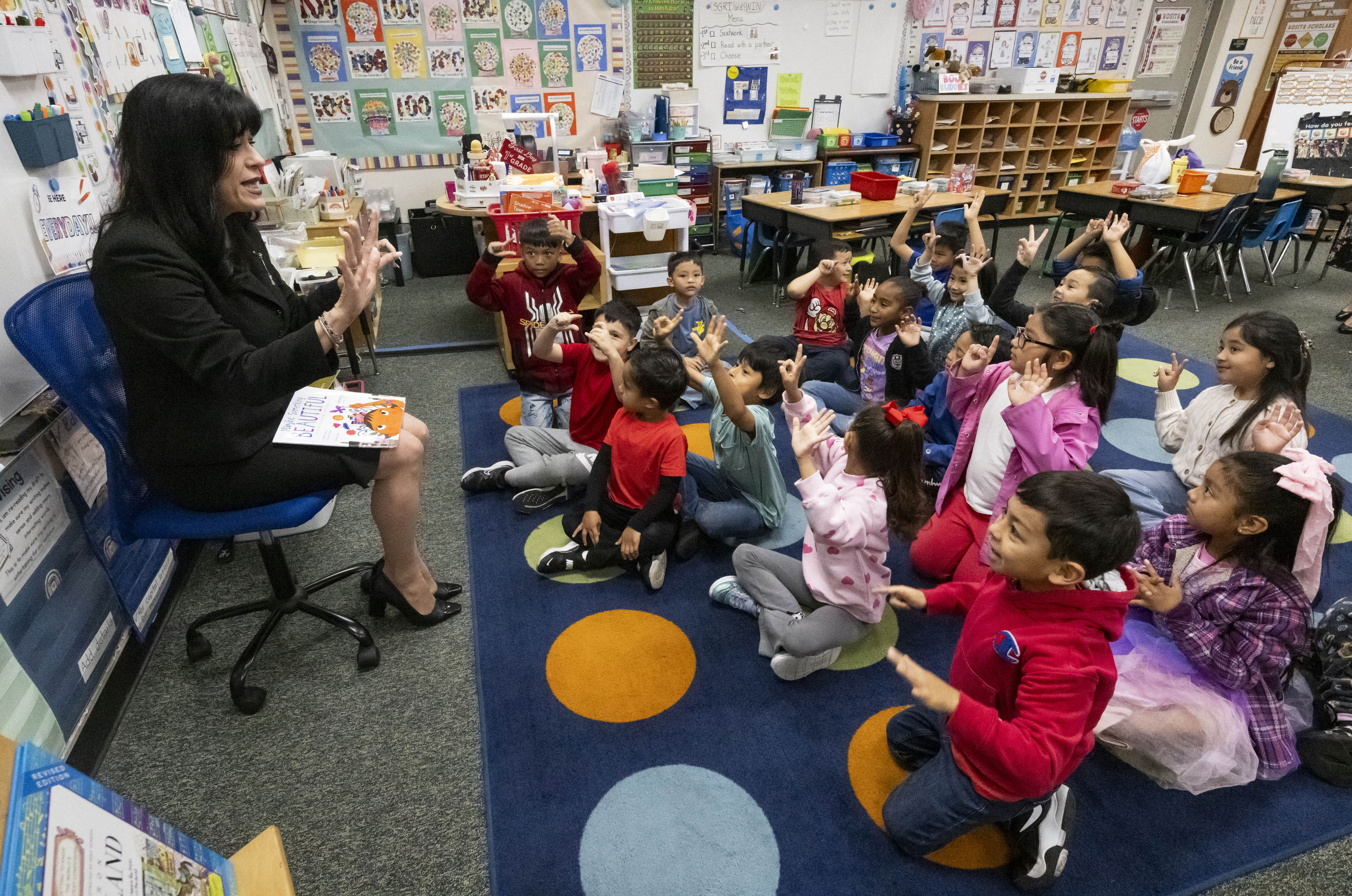
Garden Grove Unified School District Superintendent Gabriela Mafi talks with teacher Kris Corder’s first-grade class at Rosita Elementary School in Santa Ana, CA on Thursday, February 12, 2026. (Photo by Paul Bersebach, Orange County Register/SCNG)
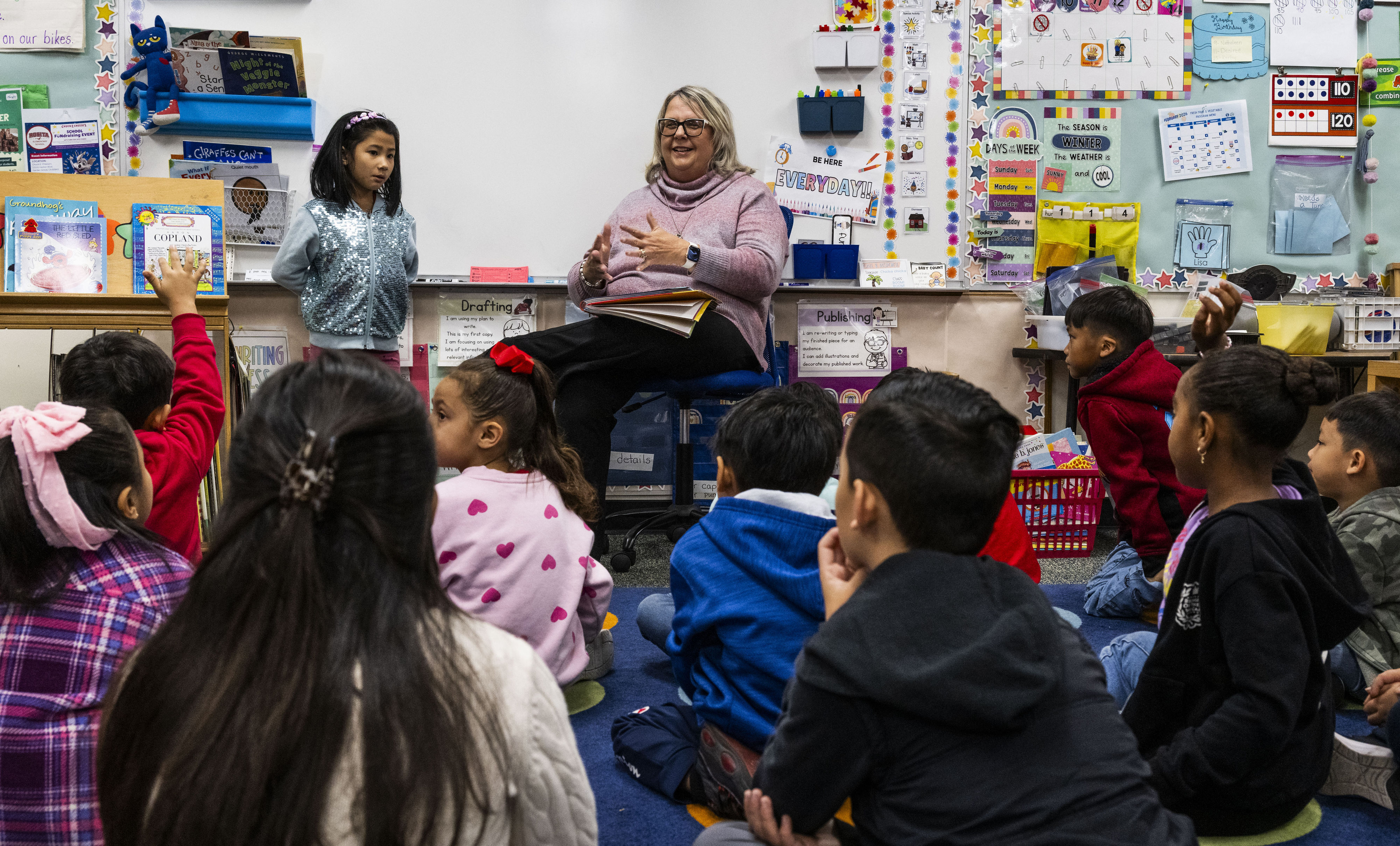
Teacher Kris Corder works with her first-grade students at Rosita Elementary School in Santa Ana, CA on Thursday, February 12, 2026. (Photo by Paul Bersebach, Orange County Register/SCNG)
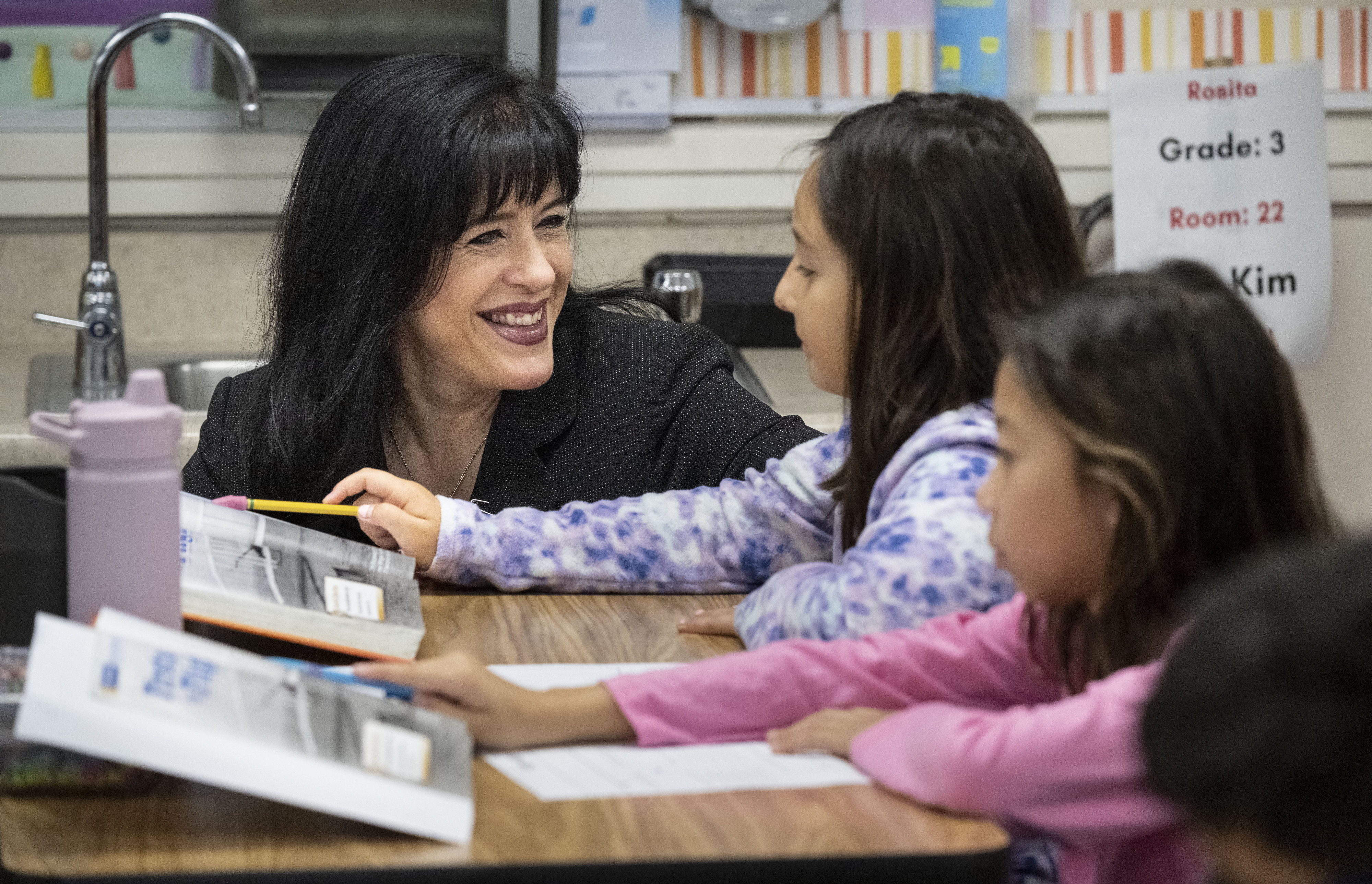
Garden Grove Unified School District Superintendent Gabriela Mafi talks with students in Linda Kim’s third-grade class at Rosita Elementary School in Santa Ana, CA on Thursday, February 12, 2026. (Photo by Paul Bersebach, Orange County Register/SCNG)
Show Caption
1 of 6
Garden Grove Unified School District Superintendent Gabriela Mafi talks with Miya Carrasco in her transitional kindergarten/kindergarten class at Rosita Elementary School in Santa Ana, CA on Thursday, February 12, 2026. (Photo by Paul Bersebach, Orange County Register/SCNG)
Once, Mafi was Cara — a smart kid from a poor family about to enter an uncertain world of school.
She grew up with five siblings in the south Los Angeles community of West Athens, which at the time was an economically challenged area. Mafi had family support and was held to high standards, but her education was inconsistent. She said she bounced between rigorous Catholic school, when her mother could afford it, and back to public schools that, at the time, were struggling.
But Mafi kept bouncing, educationally, well into adulthood. She finished her schooling with a doctorate in education.
“I share that story with our sixth graders,” Mafi said. “Yes, I lived in a bad area. But, no, that didn’t stop me. And it shouldn’t stop them.”
Attitude, of course, is hard to quantify. And in Garden Grove Unified, it’s deployed against challenges that are often all too tangible.
Gangs and violence aren’t an idle threat in some of the neighborhoods that feed students into Garden Grove Unified. Neither is hunger. At many of the district’s 67 schools, more than 8 in 10 students eat breakfast and lunch on campus. Language, too, can be a barrier; about a third of the district’s nearly 38,000 students qualify as “English learners,” meaning their parents speak a language other than English at home. (Spanish and Vietnamese are the most common non-English languages at Garden Grove Unified, but in all, at least 59 languages are spoken at home.)
Kids in the district often face other challenges, big and small, that might not apply in wealthier communities. Some lack access to Wi-Fi or new technology, or they live in houses that are so crowded there isn’t much space for studying and homework. Many don’t have anyone in their families who can help with their homework if they need it.
Mafi said teachers and others acknowledge it all without letting any of it become an excuse.
“Sympathy? No. But empathy? Yes, we feel empathy,” Mafi said.
“The reality is students in poverty don’t need their lives to be easier. They need to work hard to make their lives better.
“Empathy is about caring and loving. Sympathy can sometimes be about expecting less,” she added.
“We don’t do that.”
New era of challenge
Garden Grove Unified isn’t the only local school district on the upswing. Over the past decade, the county average for college readiness has jumped nearly 20%.
Garden Grove Unified, also, isn’t the only local district to improve in the face of challenges related to money and language. Some 11.1% of all K-12 students in the county, about 48,000 students in all, are low-income according to the new census report.
And, critically, Garden Grove isn’t the only district that’s becoming a resource for a range of services that aren’t traditionally connected to school.
Since the pandemic, Garden Grove Unified has implemented ASPIRE, a multiprong program that links therapists and social workers to every school in the district. Students who are teetering academically or who are getting in trouble too much — or who show sudden changes in behavior — are urged to visit with ASPIRE counselors. A parent simply needs to sign off, and the care is free.
“Mental health doesn’t have anything to do with income. And it doesn’t really have a stigma anymore. It’s just part of being healthy,” said Marci Loo, principal of Izaak Walton Intermediate in Garden Grove.
“And we see it as just part of helping the students, and their families, in every way we can,” Loo added.
“They’re not going to learn much if all their needs aren’t taken care of.”
Combined, all of the offerings at Garden Grove Unified — everything from food and after-school clubs to sports and homework assistance — can keep a student on a campus from as early as 7 a.m. to as late as 7 p.m. Libraries open early and stay open late. Teachers and others are often available to talk.
“We have all of these things to keep kids busy and learning,” Loo said.
“But it’s also about joining something. If a gang offers something, like a feeling of belonging, we have to offer a sense of belonging, too.”
Yet, going forward, that comprehensive help, and the attitude it represents, might not be enough to keep the momentum going for lower-income students.
For one thing, being poor is getting tougher.
Last month, new federal rules kicked in that will make it harder for families to qualify for the Supplemental Nutritional Assistance Program, or SNAP, which, in turn, could make it harder for some kids to get fed at home. Also last month, the federal government discontinued pandemic-era assistance that helped pay for health insurance, driving up insurance premiums for millions of families around the country, including many who are close to low-income. There’s even a proposal from the federal Department of Housing and Urban Development that could change the rules to receive homelessness assistance in a way that might force several hundred local families, including many with children, back to shelters or the streets.
All of those changes translate into more potential stress for lower-income students. And that, experts say, can be a drag on learning.
Federal help in safety net items — such as food and shelter and health care — does directly impact students. A study from the Los Angeles Unified School District, for example, found that lost access to dental care was the strongest predictor of student absences.
But John Rogers, a professor of education at UCLA who has studied the link between money and learning, suggested a bigger issue in the new war on poverty is about self-image and expectation.
When anybody, lower-income or otherwise, is treated with hostility, they tend to lose confidence and the belief that they’re capable of things like education and attainment.
“Relative definitions of poverty focus on inequality, perceptions of well-being, and views of social mobility,” Rogers wrote via email. “My sense is that … this has the greatest effect on how students view school, and how they view opportunities in broader society.”
It’s exactly the attitude Mafi has pushed hard to vanquish in her district.
And, this year, there’s a new wild card: the federal effort to deport millions of people.
Cara’s parents, Adella and Leo, said they’re legal U.S. residents and that Cara, born in Arizona, is a U.S. citizen. Still, Adella refused to disclose her last name or her specific neighborhood because she’s afraid of becoming a target of immigration enforcement.
Mafi, of Garden Grove Unified, suggested that fear isn’t unfounded. She said the district includes many families who include people without proper documentation, and that she is aware of families who have lost members in immigration sweeps, sometimes taken into custody in front of children.
Fear of immigration enforcement, she added, might be prompting some families to disconnect from public schooling.
“Usually, our (student population) grows by a few hundred by this time of year. But this year we’re down from the start of the year. That’s a result of what’s happening,” Mafi said.
Beyond the extremes, she added, is a constant feeling of fear. That feeling, if it continues unabated, can distract even the best students.
“Our students are primarily born here, so they’re not at risk. But they’re afraid to let their parents leave the house,” Mafi said.
“Does it affect what they can and can’t achieve? No. But does it require us to offer additional outreach? Yes. That is a frightening thing.”