
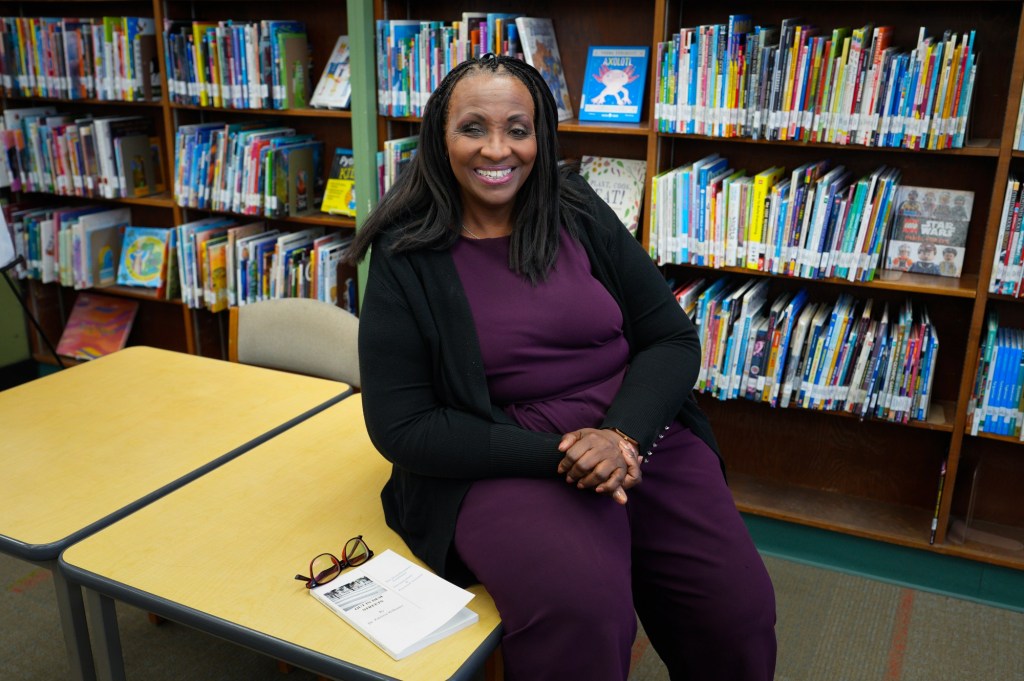
Over a period of 90 days in 2014, Patricia Williams lost everything.
A longtime school teacher in Ohio, she had been on leave for about six months taking care of her 17-year-old son, who was sick. When he passed away, Williams came to San Diego to visit her daughter, who was in the Navy. While here, Williams’ house in Ohio burned down, her contract for her teaching job was canceled, and she was stranded in a new city with nowhere to live.
“I lost everything. Life had to start over,” she says. “I had been on the street for 10 years, off and on. I was out in the street from 2014. Sometimes I had apartments, but I never got a physical job until 12 years ago, so I’ve been unemployed for over 10 years, that’s why I couldn’t get an apartment.”
Despite earning associate’s and bachelor’s degrees in business administration, and a master’s and doctorate in education before losing her child, her job, and her home, she wasn’t able to land a job. She says she submitted more than 100 applications with local secondary and community college school districts, took and passed the required exams, but says she was told that she had too much experience. Voices of Our City Choir, a nonprofit that supports people who are homeless with their choir and additional resources and services, was able to help and she got a part-time job at the Oak Park Library four years ago and affordable housing in Vista two years ago.
During her time on the street, she began talking to other people who were also homeless, documenting their stories about what happened to them. She was encouraged to write a book, and she did. “Out in Dem Streets: The Homelessness Pandemic” shares the stories of the people she spoke to over 165 pages, and she will talk about the book and her experience as part of the Black History Month program at the Oak Park Library from 11 a.m. to 1 p.m. Feb. 21.
Williams is also the founder of Push the Word Out Publications, a publishing company that also provided educational consulting, training, grant writing, and other services and courses. She took some time to talk about sharing the stories of the dozens of folks in the book, the misconceptions people have about homelessness, and how she kept going even during the times when she wanted to give up.
Q: Tell us about “Out in Dem Streets: The Homelessness Pandemic.”
A: Well, I was sleeping in my car when I did this documentary. I was already homeless, so I was out in the streets with these people, and I wanted to know how they got there. I wasn’t planning to write a book, but the lady who wrote my foreword, DeForrest Hancock, she encouraged me to write the book. She advocates for the homeless here in the city, to the city council. I met and became friends with her in the (Voices of Our City) choir, but I wasn’t planning to write it. I just actually collected the stories, and I kept saying, ‘I like these stories because they’re different than mine.’ Everybody thinks that homelessness is the same, that we’re all the same people. On the back of the book, it says, “Although there’s many stories written about homelessness, this book was written by someone who had experienced homelessness for the past 10 years. I wanted to let people know that homelessness is a pandemic and that it would take many of us to help advocate for those who cannot, or have given up advocating solutions for themselves.” It’s about empathy and getting health advocacy for homelessness.
Q: What was your process for coming up with the concept, figuring out how to execute it?
A: People were putting us all in one box, but everybody’s story is different. They were thinking that because a person’s homeless that we’re all the same—we’re all drug addicts, we’re this, we’re that. I wanted to share these stories because the thing we have in common is our human rights and our humanness. I wanted people to have empathy when people are thinking about homelessness. I’m a Ph.D., I have education, I’ve taught for more than 36 years and never thought I would be in the street. So, there are people like me out there.
Q: How many people are featured throughout the book and what are some of their stories?
A: I haven’t really counted them, but the book is framed as, “Why? Why are we out in dem streets? Who are we out in dem streets? What do we do out in the streets? And how can nonprofits help?” One of the stories is of a lady who might be housed now, but when I wrote this she was not housed. She lost her daughter, her son got shot, and she was living in her car near the area where her son was shot. I protected all of the people I interviewed, so I didn’t put their names, I didn’t put the area she lived in, none of that. It’s just the story of her losing her daughter, her home, her son getting shot in the area where she was homeless. She was sleeping in her car and people knew who shot her son, but never turned him in. It took a year for them to find the young man that shot her son, and she was totally depressed. She didn’t want to talk to the agencies, and it was a lot of grief and pain for her because it was a period of, like, two or three years that all of these people (in her life) died.
Q: What kinds of misconceptions do you hear about homelessness and about people who are homeless?
A: Some of the misconceptions are that we’re all drug addicts, or have some type of mental instability, and that is not true for everyone. Of course, there are people out there with disabilities and mental struggles and challenges, but not everyone. Or people say that we don’t want to pay our bills, we’re neglecting ourselves. Those are all of the myths that we are talking about in this book, that a person out in the street wants to take advantage just to get what they want at the time they want it. That’s not necessarily true, so that’s why I wanted to tell all these different stories.
Q: What do you think is important for people to understand about this issue of losing housing and the road to acquiring it again?
A: It’s going to take a lot of people, it can’t be done by just one organization, but it has to be done in unity of these organizations, and they’re all separate. You have organizations that say they’ve never heard of some of the nonprofits that are helping the homeless people. Everybody needs to be communicating with each other about this (homelessness) pandemic because it’s not going to stop if there’s miscommunication. This book is trying to open people’s eyes, to get them to practice empathy. When you’re thinking about homelessness in general, it’s not just a certain type of person, and it’s not just one kind of organization that will help. I also talk about the churches, I talk about the nonprofits, I talk about the government in this book, and all of the things that people told me was a problem—failed policies, misappropriated funding, wage disparities, the rents rising, the lack of mental health care facilities.
Q: Were there ever moments when you wanted to give up? That you felt like continuing to try wasn’t worth the effort? What helped you to keep going?
A: Yes, and there were several people that said the same thing. I decided I was going to give up when I was living in my car, in safe parking areas, because I found out how much money they get per car, and they were building new buildings around us. Part of this book is about my personal faith and my belief in God and prayer. I’ve had a life of prayer, and I’ve had churches help me. There are people out there wanting to help. I call them Band-Aids, but their Band-Aids are needed. They help us. So instead of me dying, they give me a Band-Aids so I can heal a little bit. The churches give food, they give us showers, they give us things to help us keep going, saying that maybe one day I’ll get an apartment, maybe one day I’ll get off the street.